Centauri Dreams
Imagining and Planning Interstellar Exploration
The Rest is Silence: Empirically Equivalent Hypotheses about the Universe
Because we so often talk about finding an Earth 2.0, I’m reminded that the discipline of astrobiology all too easily falls prey to an earthly assumption: Intelligent beings elsewhere must take forms compatible with our planet. Thus the recent post on SETI and fireflies, one I enjoyed writing because it explores how communications work amongst non-human species here on Earth. Learning about such methods may lessen whatever anthropomorphic bias SETI retains. But these thoughts also emphasize that we continue to search in the dark. It’s a natural question to ask just where SETI goes from here. What happens if in all our work, we continue to confront silence? I’ve been asked before what a null result in SETI means – how long do we have to keep doing this before we simply acknowledge that there is no one out there? But a better question is, how would we ever discover a definitive answer given the scale of the cosmos? If not in this galaxy, maybe in Andromeda? If not there, M87?
In today’s essay, Nick Nielsen returns to dig into how these questions relate to the way we do science, and ponders what we can learn by continuing to push out into a universe that remains stubbornly unyielding in its secrets. Nick is an independent scholar in Portland OR whose work has long graced these pages. Of late he has been producing videos on the philosophy of history. His most recent paper is “Human Presence in Extreme Environments as a Condition of Knowledge: An Epistemological Inquiry.” As Breakthrough Listen continues and we enter the era of the Extremely Large Telescopes, questions like these will continue to resonate.
by J. N. Nielsen

What would it mean for humanity to be truly alone in the universe? In an earlier Centauri Dreams post, SETI’s Charismatic Megafauna, I discussed the tendency to focus on the extraterrestrial equivalent of what ecologists sometimes call “charismatic megafauna”—which in the case of SETI consists of little green men, space aliens, bug-eyed monsters, Martians, and their kin—whereas life and intelligence might take very different forms from those with which we’re familiar. [1] We might not feel much of a connection to the discovery of an exoplanet covered in a microbial mats, which couldn’t respond to us, much less communicate with us, but it would be evidence that there is other life in the universe, which suggests there may be other life yet to be found, which also would mean that, as life, we aren’t utterly alone in the universe. This in turn suggests the alternative view that we might be utterly alone, without a trace of life beyond Earth, and this gets to some fundamental questions. One way to cast some light on these questions is through a thought experiment that would bring the method of isolation to bear on the problem. I will focus on a single, narrow, unlikely scenario as a way to think about what it would mean to be truly alone in the universe.
Suppose, then, we find ourselves utterly alone in the universe—not only alone in the sense of there being no other intelligent species with whom we could communicate, and no evidence of any having existed in the universe’s past (from which we could experience unidirectional communication), but utterly alone in the sense that there’s not any sign of life in the universe, not even microbes. This scenario begins where we are today, inhabiting Earth, looking out into the cosmos to see what we can see, listening for SETI transmissions, trying to detect life elsewhere, and planning missions and designing spacecraft to extend this search further outward into the universe. This thought experiment, then, is consistent with what we know of the universe today; it is empirically equivalent to a universe positively brimming with other life and other civilizations that we just haven’t yet found; at our current level of technology and cosmological standing, we can’t distinguish between the two scenarios.
There is a cluster of related problems in the philosophy of science, including the underdetermination of theories, the possibility of empirically equivalent theories, theory choice, and holism in confirmation. I’m going to focus on the possibility of empirically equivalent theories, but what follows could be reformulated in terms of the others. What is it for a theory to be underdetermined? “To say that an outcome is underdetermined is to say that some information about initial conditions and rules or principles does not guarantee a unique solution.” (Lipton 1991: 6) If there’s no unique solution, there may be many possible solutions. Empirically equivalent theories are these many possible solutions. [2]
The discussion of empirically equivalent theories today has focused on the expansion of the consequence class of a theory, i.e., adopting auxiliary hypotheses so as to derive further testable consequences. We’re going to look at this through the other end of the telescope, however. Two theories can have radically different consequence classes while our ability conduct observations that would confirm or disconfirm these consequence classes is so limited that the available empirical evidence cannot distinguish between the two theories. That our ability to observe changes, and therefore the scope of the empirical consequence class changes, due to technologies and techniques of observation has been called “variability of the range of observation” (VRO) and the “inconstancy of the boundary of the observable.” (discussed in Laudan and Leplin 1991). Given VRO, there may be a time in the history of science when the observable consequence classes of two theories coincide, even while their unobservable consequence class ultimately diverges; at this time, the two theories are empirically equivalent in the sense that no current observation can confirm one while disconfirming the other. This is why we build larger telescopes and more powerful particle accelerators: to gain access to observations that can decide between theories that are empirically equivalent at present, but which have divergent consequence classes.
Returning to our thought experiment, where we began as we are today (unable to distinguish between a populous universe and terrestrial exceptionalism)—what do we do next? In our naïveté we make progress with our ongoing search. We build better telescopes, and we orbit larger and more sophisticated telescopes, with the intention of performing exoplanet atmospheric spectroscopy. We build spacecraft that allow us to explore our solar system. We go to Mars, but we don’t find anything there; no microbes in the permafrost or deep in subterranean bodies of water, and no sign of any life in the past. But we aren’t discouraged by this, because it’s always been possible that there was never life on Mars. There are many other places to explore in our solar system. Eventually we travel to interesting places like Titan, with its own thick atmosphere. We find this moon to be scientifically fascinating, but, again, no life of any kind is found. We send probes into subsurface liquid water oceans, first on Enceladus, then Europa, and we find nothing more complex in these waters than what we see in the astrochemistry of deep space: some simple organic molecules, but no macromolecules. Again, these worlds are scientifically fascinating, but we don’t find life and, again, we aren’t greatly bothered because we’ve only recently accustomed ourselves to the idea that there might be life in these oceans, and we can readily un-accustom ourselves as quickly. But it does raise questions, and so we seek out all the subsurface oceans in our solar system, even the brine pockets under the surface of Ceres, this time with a little more urgency. Again, we find many things of scientific interest, but no life, and no other unexpected forms of emergent complexity.
Suppose we exhaust every potential niche in our solar system, from the ice deep in craters on Mercury, to moons and comets in the outer solar system, and we find no life at all, and nothing like life either—no weird life (Toomey 2013), no life-as-we-do-not-know-it (Ward 2007), and no alternative forms of emergent complexity that are peers of life (Nielsen 2024). All the while as we’ve been exploring our solar system, our cosmological “backyard” as it were, we’ve continued to listen for SETI signals, and we’ve heard nothing. And we’ve continued to pursue exoplanet atmospheric spectroscopy, and we have a few false positives and a few mysteries—as always, scientifically interesting—but no life and no intelligence betrays itself. Now we’re several hundred years in the future, with better technology, better scientific understanding, and presumably a better chance of finding life, but still nothing.
If we had had some kind of a hint of possible life on another world, we could have had some definite target for the next stage of our exploration, but so far we’ve drawn a blank. We could choose our first interstellar objective by flipping a coin, but instead we choose to investigate the strangest planetary system we can find, with some mysterious and ambiguous observations that might be signs of biotic processes we don’t understand. And so we begin our interstellar exploration. Despite choosing a planetary system with ambiguous observations that might betray something more complex going on, once we arrive at the other planetary system and investigate it, we once again come up empty-handed. The investigation is scientifically interesting, as always, but it yields no life. Suppose we investigate this other planetary system as thoroughly as we’ve investigated our own solar system, and the whole thing, with all its potential niches for life, yields nothing but sterile, abiological processes, and nothing that on close inspection can’t be explained by chemistry, mineralogy, and geology.
Again we’re hundreds of years into the future, with interstellar exploration under our belt, and we still find ourselves alone in the cosmos. Not only are we alone in the cosmos, but the rest of the cosmos so far as we have studied it, is sterile. Nothing moves except that life that we brought with us from Earth. Still hundreds of years into the future and with all this additional exploration, and the scenario remains consistent with the scenario we know today: no life known beyond Earth. We can continue this process, exploring other scientifically interesting planetary systems, and trying our best to exhaustively explore our galaxy, but still finding nothing. At what threshold does this unlikelihood rise to the level of paradoxicality? Certainly at this point the strangeness of the situation in which we found ourselves would seem to require an explanation. So instead of merely searching for life, wherever we go we also seek to confirm that the laws of nature we’ve formulated to date remain consistent. That is to say, we test science for symmetry, because if we are able to find asymmetry, we will have found a limit to scientific knowledge.
We don’t have any non-arbitrary way to limit the scope of our scientific findings. If any given scientific findings could be shown to fail under translation in space or translation in time, then we would have reason to restrict their scope. Indeed, if we were to discover that our scientific findings fail beyond a given range in space and time, there would be an intense interest in exploring that boundary, mapping it, and understanding it. Eventually, we would want to explain this boundary. But without having discovered this boundary, we find ourselves in a quandary. Our science ought to apply to the universe entire. At least, this is the idealization of scientific knowledge that informs our practice. “On the one hand, there are truths founded on experiment, and verified approximately as far as almost isolated systems are concerned; on the other hand, there are postulates applicable to the whole of the universe and regarded as rigorously true.” (Poincaré 1952: 135-136) Earth and its biosphere are effectively an isolated system in Poincaré’s sense. We’ve constructed a science of biology based on experimentation within that isolated system (“verified approximately as far as almost isolated systems are concerned”), and the truths we’ve derived we project onto the universe (“applicable to the whole of the universe”). But our extrapolation of what we observe locally is an idealization, and our projecting a postulate onto the universe entire is equally an idealization. We can no more realize these idealizations in fact than we can construct a simple pendulum in fact. [3]
We need to distinguish between, on the one hand, that idealization used in science and without which science is impossible (e.g., the simple pendulum mentioned above), and, on the other hand, that idealization that is impossible for science to capture in any finite formalization, but which can be approximated (like the ideal isolation of experiment discussed by Poincaré). Holism in confirmation, to which I referred above (and which is especially associated with Duhem-Quine thesis), is an instance of this latter kind of idealization. Both forms of idealization force compromises upon science through approximation; we accept a result that is “good enough,” even if not perfect. Each form of idealization implies the other, as, for example, the impossibility of accounting for all factors in an experiment (idealized isolation) implies the use of a simplified (ideal) model employed in place of actual complexity. Thus one ideal, realizable in theory, is substituted for another ideal, unrealizable in theory.
Our science of life in the universe, i.e., astrobiology, involves these two forms of idealization. Our schematic view of life, embodied in contemporary biology (for example, the taxonomic hierarchy of kingdom, phylum, class, order, family, genus, and species, or the idealized individuation of species), is the idealization realizable in theory, while the actual complexity of life, the countless interactions of actual biological individuals within a population both of others of its own species and individuals of other species, not to mention the complexity of the environment, is the idealization unrealizable in theory. The compromises we have accepted up to now, which have been good enough for the description of life on Earth, may not be adequate in an astrobiological context. Thus the testing of science for symmetries in space and time ought to include the testing of biology for symmetries, but, since in this thought experiment there are no other instances of biology beyond Earth, we cannot test for symmetry in biology as we would like to.
Suppose that our research confirms that as much of our science as can be tested is tested, and this science is as correct as it can be, and so it should be predictive, even if it doesn’t seem to be doing a good job at predicting what we find on other worlds. We don’t have to stop there, however. If we don’t find other living worlds in the cosmos, we might be able to create them. Exploring the universe on a cosmological scale would involve cosmological scales of time. If we were to travel to the Andromeda galaxy and back, about four million years would elapse back in the Milky Way. If we were to travel to other galaxy clusters, tens of millions of years or hundreds of millions of years would elapse. These are biologically significant periods of time, by which I mean these are scales of time over which macroevolutionary processes could take place. Our cosmological exploration would give us an opportunity to test that. In the sterile universe that we’ve discovered in this thought experiment, we still have the life from Earth that we’ve brought to the universe, and over biological scales of time life from Earth could go on to its own cosmological destiny. In our exploration of a sterile universe, we could plant the seeds of life from Earth and seek to create the biological universe we expected to find. The adaptive radiation of Earth life, facilitated by technology, could supply to other worlds the origins of life, and if origins of life were the bottleneck that produced a sterile universe, then once we supply that life to other worlds, these other worlds should develop biospheres in a predictable way (within expected parameters).
It probably wouldn’t be as easy as leaving some microbes on another planet or moon; we would have to prepare the ground for them so they weren’t immediately killed by the sterile environment. In other words, we would have to practice terraforming, at least to the extent of facilitating the survival, growth, and evolution of rudimentary Earth life on other worlds. If every attempt at terraforming immediately failed, that would be as strange as finding the universe to be sterile, and perhaps more inexplicable. But that’s a rather artificial scenario. It’s much more realistic to imagine that we attempt the terraforming of many worlds, and, despite some initial hopeful signs, all of our attempts at terraforming eventually die off, all for apparently different reasons, but none of them “take.” This would be strange, but we could still seek some kind of scientific explanation for this that demonstrated truly unique forces to be at work on Earth that allowed the biosphere not only to originate but to survive over cosmological scales of time (the “rare Earth” hypothesis with a vengeance).
If the seeding of Earth life on other worlds didn’t end in this strange way (as strange as the strangeness of exploring a sterile universe, so it’s a continued strangeness), but rather some of these terraforming experiments were successful, what comes next could entail a number of possible outcomes of ongoing strangeness. Leaving our galaxy for a few billion years of exploration in other galaxies, upon our return we could study these Earth life transplantations. Transplanted Earth life on other worlds could very nearly reproduce the biosphere on Earth, which would suggest very tight constraints of convergent evolution. If origins of life are very rare, and conditions for the further evolution of life are tightly constrained by convergent evolution, that would partially explain why we found a sterile universe, but the conditions would be far stronger than we would expect, and that would be scientifically unaccountable.
Another strange outcome would be if our terraformed worlds with transplanted Earth life all branched out in radically different directions over our multi-billion year absence exploring other galaxies. We would expect some branching out, but there would be a threshold of branching out, with none of the biospheric outcomes even vaguely resembling any of the others, that would defy expectations, and, in defying expectations, we would once again find ourselves faced with conditions much stronger than we would expect. In all these cases of strangeness—the strangeness of all our engineered biospheres failing, the strangeness of our engineered biospheres reproducing Earth’s biosphere to an unexpected degree of fidelity, and the strangeness of our engineered biospheres all branching off in radically different directions—we would confront something scientifically unaccountable. Even though we have no experience of other biospheres, we still have expectations for them based on the kind of norms we’ve come to expect from hundreds of years of practicing science, and departure from the norms of naturalism is strange. All of these scenarios would be strange in the sense of defying scientific expectations, and that would make them all scientifically interesting.
These scenarios are entirely consistent with our current observations, so that a sterile universe with Earth as the sole exception where life is to be found is, at the present time, empirically equivalent with a living universe in which life is commonplace. However, the exploration of our own solar system could offer further confirmation of a sterile universe, or disconfirm it, or modify it. If, as in the preceding scenario, we find nothing at all beyond Earth in our solar system, this will increase the degree of confirmation for the sterile universe hypothesis (which we could also call terrestrial exceptionalism). If we were to find life elsewhere in our solar system, but molecular phylogeny shows that all life in our solar system derives from a single origins of life event, then we will have demonstrated that life as we know it can be exchanged among worlds, but the likelihood of independent origins of life events would be rendered somewhat less probable, especially if we were to determine that any of the over life-bearing niches in our solar system were not only habitable, but unambiguously urable. [4]
If we were to find life elsewhere in our solar system and molecular phylogeny shows that these other instances of life derive from independent origins of life events, then this would increase the degree of confirmation of the predictability of origins of life events on the basis of our present understanding of biology. The number of distinct origins of life events could serve as a metric to quantify this. [5] If we were to find life elsewhere in the solar system and this life consists of an eclectic admixture of life with the same origins event as life on Earth, and life derived from distinct origins events, then we would know both that the distribution of life among worlds and origins of life were common, and on this basis we would expect to find the same in the cosmos at large. An exacting analysis of this maximal life scenario would probably yield interesting details, such as particular forms of life that appear the most readily once boundary conditions have been met, and particular forms of life that are more finicky and don’t as readily appear. Similarly, among life distributed across many worlds we would likely find that some varieties are more readily distributed than others.
If the solar system is brimming with life, we could still maintain that the rest of the cosmos is sterile, reproducing the same scenario as above, but the scenario would be less persuasive, or perhaps I should say less frightening, knowing that life had originated elsewhere and was not absolutely unique to Earth. Nevertheless, we could yet be faced with a scenario that is even more inexplicable than the above (call it the “augmented Fermi paradox” if you like). If we found our solar system to be brimming with life, with life easily originating and easily transferable among astronomical bodies, increasing our confidence that life is common in the universe and widely distributed, and then we went out to explore the wider universe and found it to be sterile, we would be faced with an even greater mystery than the mystery we face today. The dilemma imposed upon us by the Fermi paradox can yet take more severe forms than the form in which we know it today. The possibilities are all the more tantalizing given that at least some of these questions will be answered by evidence within our own solar system.
It seems likely that the Fermi paradox is an artifact of the contemporary state of science, and will persist as long as science and scientific knowledge retains its current state of conceptual development. Anglo-American philosophy of science has tended to focus on confirmation and disconfirmation of theories, while continental philosophy of science has developed the concept of idealization [6]; I have drawn on both of these traditions in the above thought experiment, and it will probably require resources from both of these traditions to resolve the impasse we find ourselves at present. Because science and scientific knowledge itself would be called into question in this scenario, there would be a need for human beings themselves to travel to the remotest parts of the universe to ensure the integrity of the scientific process and the data collected (Nielsen 2025b), and this will in turn demand heroic virtues (Nielsen 2025) on the part of those who undertake this scientific research program.
Thanks are due to Alex Tolley for suggesting this.
Notes
1. I have discussed different definitions of life in (Nielsen 2023), and I have formulated a common theoretical framework for discussing forms of life and intelligence not familiar to us in (Nielsen 2024b) and (Nielsen 2025a).
2. The discussion of empirically equivalent theories probably originates in (Van Fraassen 1980).
3. I am using “simple pendulum” here in the sense of an idealized mathematical model of a pendulum that assumes a frictionless fulcrum, a weightless string, a point mass weight bob, absence of air drag, short amplitude (small-angle approximation where sinθ≈θ), inelasticity of pendulum length, rigidity of the pendulum support, and a uniform field of gravity during operation of the pendulum. Actual pendulums can be made precise to an arbitrary degree, but they can never exhaustively converge on the properties of an ideal pendulum.
4. “Urable” planetary bodies are those that are, “conducive to the chemical reactions and molecular assembly processes required for the origin of life.” (Deamer, et al. 2022)
5. The degree of distribution of life from a single origins of life event, presumably a function of the particular form of life involved, the conditions of carriage (i.e., the mechanism of distribution), and the structure of the planetary system in question, would provide another metric relevant to assessing the ability of life to survive and reproduce on cosmological scales.
6. Brill has published fourteen volumes on idealization in the series Poznań Studies in the Philosophy of the Sciences and the Humanities.
References
Deamer, D., Cary, F., & Damer, B. (2022). Urability: A property of planetary bodies that can support an origin of life. Astrobiology, 22(7), 889-900.
Laudan, L. and Leplin, J. (1991). “Empirical Equivalence and Underdetermination.” Journal of Philosophy. 88: 449–472.
Lipton, Peter. (1991). Inference to the Best Explanation. Routledge.
Nielsen, J. N. (2023). “The Life and Death of Habitable Worlds.” Chapter in: Death And Anti-Death, Volume 21: One Year After James Lovelock (1919-2022). Edited by Charles Tandy. 2023. Ria University Press.
Nielsen, J. N. (2024a). Heroic virtues in space exploration: everydayness and supererogation on Earth and beyond,” Heroism Sci. doi:10.26736/hs.2024.01.12
Nielsen, J. N. (2024b). Peer Complexity in Big History. Journal of Big History, VIII(1); 83-98.
DOI | https://doi.org/10.22339/jbh.v8i1.8111 (An expanded version of this paper is to appear as “Humanity’s Place in the Universe: Peer Complexity, SETI, and the Fermi Paradox” in Complexity in Universal Evolution—A Big History Perspective.)
Nielsen, J.N. (2025a). An Approach to Constructing a Big History Complexity Ladder. In: LePoire, D.J., Grinin, L., Korotayev, A. (eds) Navigating Complexity in Big History. World-Systems Evolution and Global Futures. Springer, Cham. https://doi.org/10.1007/978-3-031-85410-1_12
Nielsen, J.N. (2025b). Human presence in extreme environments as a condition of knowledge: an Epistemological inquiry. Front. Virtual Real. 6:1653648. doi: 10.3389/frvir.2025.1653648
Poincaré, Henri. (1952). Science and Hypothesis. Dover.
Toomey, D. (2013). Weird life: The search for life that is very, very different from our own. WW Norton & Company.
Van Fraassen, B. C. (1980). The scientific image. Oxford University Press.
Ward, P. (2007). Life as we do not know it: the NASA search for (and synthesis of) alien life. Penguin.

The Firefly and the Pulsar
We’ve now had humans in space for 25 continuous years, a feat that made the news last week and one that must have caused a few toasts to be made aboard the International Space Station. This is a marker of sorts, and we’ll have to see how long it will continue, but the notion of a human presence in orbit will gradually seem to be as normal as a permanent presence in, say, Antarctica. But what a short time 25 years is when weighed against our larger ambitions, which now take in Mars and will continue to expand as our technologies evolve.
We’ve yet to claim even a century of space exploration, what with Gagarin’s flight occurring only 65 years ago, and all of this calls to mind how cautiously we should frame our assumptions about civilizations that may be far older than ourselves. We don’t know how such species would develop, but it’s chastening to realize that when SETI began, it was utterly natural to look for radio signals, given how fast they travel and how ubiquitous they were on Earth.
Today, though, things have changed significantly since Frank Drake’s pioneering work at Green Bank. We’re putting out a lot less energy in the radio frequency bands, as technology gradually shifted toward cable television and Internet connectivity. The discovery paradigm needs to grow lest we become anthropocentric in our searches, and the hunt for technosignatures reflects the realization that we may not know what to expect from alien technologies, but if we see one in action, we may at least be able to realize that it is artificial.
And if we receive a message, what then? We’ve spent a lot of time working on how information in a SETI signal could be decoded, and have coded messages of our own, as for example the famous Hercules message of 1974. Sent from Arecibo, the message targeted the Hercules cluster some 25,000 light years away, and was obviously intended as a demonstration of what might later develop with nearby stars if we ever tried to communicate with them.
But whether we’re looking at data from radio telescopes, optical surveys of entire galaxies or even old photographic plates, that question of anthropocentrism still holds. Digging into it in a provocative way is a new paper from Cameron Brooks and Sara Walker (Arizona State) and colleagues. In a world awash with papers on SETI and Fermi and our failure to detect traces of ETI, it’s a bit of fresh air. Here the question becomes one of recognition, and whether or not we would identify a signal as alien if we saw it, putting aside the question of deciphering it. Interested in structure and syntax in non-human communication, the authors start here on Earth with the common firefly.
If that seems an odd choice, consider that this is a non-human entity that uses its own methods to communicate with its fellow creatures. The well studied firefly is known to produce its characteristic flashes in ways that depend upon its specific species. This turns out to be useful in mating season when there are two imperatives: 1) to find a mate of the same species in an environment containing other firefly species, and 2) to minimize the possibility of being identified by a predator. All this is necessary because according to one recent source, there are over 2600 species in the world, with more still being discovered. The need is to communicate against a very noisy background.
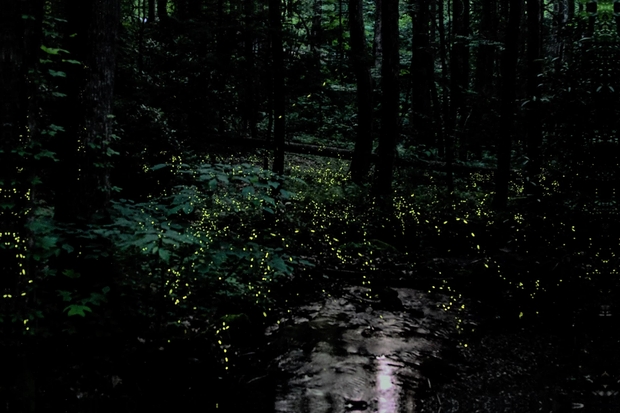
Image: Can the study of non-human communication help us design new SETI strategies? In this image, taken in the Great Smoky Mountains National Park, we see the flash pattern of Photinus carolinus, a sequence of five to eight distinct flashes, followed by an eight-second pause of darkness, before the cycle repeats. Initially, the flashing may appear random, but as more males join in, their rhythms align, creating a breathtaking display of pulsating light throughout the forest. Credit: National Park Service.
Fireflies use a form of signaling, one that is a recognized field of study within entomology, well analyzed and considered as a mode of communications between insects that enhances species reproduction as well as security. The evolution of these firefly flash sequences has been simulated over multiple generations. If fireflies can communicate against their local background using optical flashes, how would that communication be altered with an astrophysical background, and what can this tell us about structure and detectability?
Inspired by the example of the firefly, what Brooks and Walker are asking is whether we can identify structural properties within such signals without recourse to semantic content, mathematical symbols or other helpfully human triggers for comprehension. In the realm of optical SETI, for example, how much would an optical signal have to contrast with the background stars in its direction so that it becomes distinguishable as artificial?
This is a question for optical SETI, but the principles the authors probe are translatable to other contexts where discovery is made against various backgrounds. The paper constructs a model of an evolved signal that stands out against the background of the natural signals generated by pulsars. Pulsars are a useful baseline because they look so artifical. Their 1967 discovery was met with a flurry of interest because they resembled nothing we had seen in nature up to that time. Pulsars produce a bright signal that is easy to detect at interstellar distances.
If pulsars are known to be natural phenomena, what might have told us if they were not? Looking for the structure of communications is highly theoretical work, but no more so than the countless papers discussing the Fermi question or explaining why SETI has found no sign of ETI. The authors pose the issue this way:
…this evolutionary problem faced by fireflies in densely packed swarming environments provides an opportunity to study how an intelligent species might evolve signals to identify its presence against a visually noisy astrophysical environment, using a non-human species as the model system of interest.
The paper is put together using data from 3734 pulsars from the Australia National Telescope Facility (ATNF). The pulse profiles of these pulsars are the on-off states similar to the firefly flashes. The goal is to produce a series of optical flashes that is optimized to communicate against background sources, taking into account similarity to natural phenomena and trade-offs in energy cost.
Thus we have a thought experiment in ‘structure-driven’ principles. More from the paper:
Our aim is to motivate approaches that reduce anthropocentric bias by drawing on different communicative strategies observed within Earth’s biosphere. Such perspectives broaden the range of ETI forms we can consider and leverage a more comprehensive understanding of life on Earth to better conceptualize the possible modes of extraterrestrial communication… Broadening the foundations of our communication model, by drawing systematically from diverse taxa and modalities, would yield a more faithful representation of Earth’s biocommunication and increase the likelihood of success, with less anthropocentric searches, and more insights into deeper universalities of communication between species.
The authors filter the initial dataset down to a subset of pulsars within 5 kpc of Earth and compute mean period and duty cycle for each. In other words, they incorporate the rotation of the pulsar and the fraction in which each pulse is visible. They compute a ‘cost function’ analyzing similarity cost – how similar is the artificial signal to the background – and an energy cost, meaning the less frequent the pulses, the less energy expended. The terms are a bit confusing, but similarity cost refers to how much an artificial signal resembles a background pulsar signal, while energy cost refers to how long the signal is ‘on.’
So if you’re an ETI trying to stand out against a background field of pulsars, the calculations here produce a signal background period of 24.704 seconds and a duty cycle of ~0.004 (meaning that the signal is ‘on’ for 0.4 percent of the period). Such signals appear at the edge of the pulsar distribution – they would be signals that stand out by being relatively rare and also brief in contrast to the rest of the pulsar population. They would, in other words, serve as the optimal beacon for ETI attempting to communicate.
I spare you the math, which in any case is beyond my pay grade. But the point is this: A civilization trying to get our attention while broadcasting from a pulsar background could do so with a signal that has a long pulsar period (tens of seconds) and a low duty cycle. This would be sufficient to produce a signal that becomes conspicuous to observers. Now we can think about generalizing all this. The pulsar background is one of many out of which a possible signal could be detected, and the principles can be extended beyond the optical into other forms of SETI. The broad picture is identifying a signal against a background, proceeding by identifying the factors specific to each background studied.
Any time we are trying to distinguish an intentional signal, then, we need to optimize – in any signaling medium – the traits leading to detectability. Signals can be identified by their structural properties without any conception of their content as long as they rise above the noise of the background. Back to the fireflies: The paper is pointing out that non-human signaling can operate solely on a structure designed to stand out against background noise, with no semantic content. An effective signal need not resemble human thought.
Remember, this is more or less a thought experiment, but it is one that suggests that cross-disciplinary research may yield interesting ways of interpreting astrophysical data in search of signs of artificiality. On the broader level, the concept reminds us how to isolate a signal from whatever background we are studying and identify it as artificial through factors like duty cycle and period. The choice of background varies with the type of SETI being practiced. Ponder infrared searches for waste heat against various stellar backgrounds or more ‘traditional’ searches needing to distinguish various kinds of RF phenomena.
It will be interesting to see how the study of non-human species on Earth contributes to future detectability methods. Are there characteristics of dolphin communication that can be mined for insights? Examples in the song of birds?
The paper is Brooks et al., “A Firefly-inspired Model for Deciphering the Alien,” available as a preprint.
A Reversal of Cosmic Expansion?
We all relate to the awe that views of distant galaxies inspire. It’s first of all the sheer size of things that leaves us speechless, the vast numbers of stars involved, the fact that galaxies themselves exist in their hundreds of billions. But there is an even greater awe that envelops everything from our Solar System to the most distant quasar. That’s the question of the ultimate fate of things.
Nobody writes about this better than Fred Adams and Greg Laughlin in their seminal The Five Ages of the Universe (Free Press, 2000), whose publication came just after the 1998 findings of Saul Perlmutter, Brian Schmidt and Adam Riess (working in two separate teams) that the expansion of the universe not only persists but is accelerating. The subtitle of the book by Adams and Laughlin captures the essence of this awe: “Inside the Physics of Eternity.”
I read The Five Ages of the Universe just after it came out and was both spellbound and horrified. If we live in what the authors call the ‘Stelliferous era,’ imagine what happens as the stars begin to die, even the fantastically long-lived red dwarfs. Here time extends beyond our comprehension, for this era is assumed to last perhaps 100 trillion years, leaving only neutron stars, white dwarfs and black holes. A ‘Degenerate Era’ follows, and now we can only think in terms of math, with this era concluding after 1040 years. By the end of this, galactic structure has fallen apart in a cosmos littered with black holes.
Eventual proton decay, assuming this occurs, would spell the end of matter, with only black holes remaining in what the authors call ‘The Black Hole Era.’ Black hole evaporation should see the end of the last of these ‘objects’ in 10100 years. What follows is the ‘Dark Era’ as the cosmos moves toward thermal equilibrium and no sources of energy exist. This is the kind of abyss the very notion of which drove 19th Century philosophers mad. Schopenhauer’s ‘negation of the Will’ is a kind of heat death of all things.

But even Nietzsche, ever prey to despair, could talk about ‘eternal recurrence,’ and envision a future that cycles back from dissolution into renewed existence. You can see the kind of value judgments that float through all such discussions. Despair is a human response to an Adams/McLaughlin cosmos, or it can be. Even recurrence couldn’t save Nietzsche, who went quite mad at the end (precisely why remains a subject of debate). I have little resonance with 19th Century philosophical pessimism, so determinedly bleak. My own value judgment says I vastly prefer a universe in which expansion reverses.
Image: Friedrich Nietzsche (1844-1900). Contemplating an empty cosmos and searching for rebirth.
These thoughts come about because of a just released paper that casts doubt on cosmic expansion. In fact, “Strong progenitor age bias in supernova cosmology – II. Alignment with DESI BAO and signs of a non-accelerating universe” makes an even bolder claim: The expansion of the universe may be slowing. Again in terms of human preference, I would far rather live in a universe that may one day contract because it raises the possibility of cyclical and perhaps eternal universes. My limited lifespan obviously means that neither of the alternatives affects me personally, but I do love the idea of eternity.
An eternity, that is, with renewed possibilities for cosmic growth and endless experimentation with physical structure and renewed awakening of life. The paper, with lead researcher Young-Wook Lee (Yonsei University, South Korea) has obvious implications for dark energy and the so-called ‘Hubble tension,’ which has raised questions about exactly what the cosmos is doing. In this scenario, deceleration is fed by a much faster evolution of dark energy than we’ve imagined, so that its impact on universal expansion is greatly altered.
What is at stake here is the evidence drawn from Type 1a supernovae, which the Nobel-winning teams used as distance markers in their groundbreaking dark energy work. Young-Wook Lee’s team finds that these ‘standard candles’ are deeply affected by the ages of the stars involved. In this work, younger star populations produce supernovae that appear fainter, while older populations are brighter. Using a sample of 300 galaxies, the South Korean astronomers believe they can confirm this effect with a confidence of 99.999%. That’s a detection at the five sigma level, corresponding to a probability of less than one in three million that the finding is simply noise in the data.
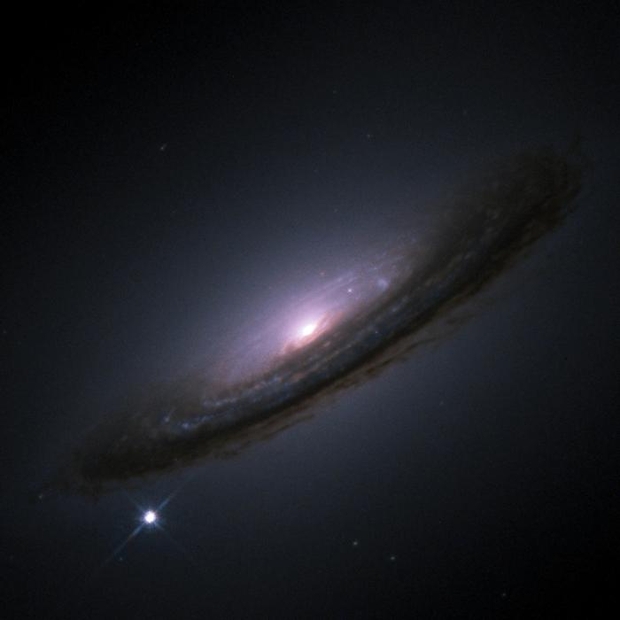
Image: Researchers used type Ia supernovae, similar to SN1994d pictured in its host galaxy NGC4526, to help establish that the universe’s expansion may actually have started to slow. Credit: NASA/ESA.
If this is the case, then the dimming of supernovae has to take into account not just cosmological effects but the somewhat more mundane astrophysics of the progenitor stars. Put that finding into the supernovae data showing universal expansion and a new model emerges, diverging from the widely accepted ΛCDM (Lambda Cold Dark Matter) cosmology, which offers a structure of dark energy, dark matter and normal matter. This work forces attention on a model derived from baryonic acoustic oscillations (BAO) and Cosmic Microwave Background data, which shows dark energy weakening significantly with time. From the paper:
…when the progenitor age-bias correction is applied to the SN data, not only does the future universe transition to a state of decelerated expansion, but the present universe also already shifts toward a state closer to deceleration rather than acceleration. Interestingly, this result is consistent with the prediction obtained when only the DESI BAO and CMB data are combined… Together with the DESI BAO result, which suggests that dark energy may no longer be a cosmological constant, our analysis raises the possibility that the present universe is no longer in a state of accelerated expansion. This provides a fundamentally new perspective that challenges the two central pillars of the CDM standard cosmological model proposed 27 yr ago.
Let’s pause a moment. DESI stands for the Dark Energy Spectroscopic Instrument, which is installed on the 4-meter telescope at Kitt Peak (Arizona). Here the effort is to measure the effects of dark energy by collecting, as the DESI site says, “optical spectra for tens of millions of galaxies and quasars, constructing a 3D map spanning the nearby universe to 11 billion light years.” Baryon acoustic oscillations are the ‘standard ruler’ that reflect early density fluctuations in the cosmos and hence chart the expansion at issue.
Here’s a comment from Young-Wook Lee:
“In the DESI project, the key results were obtained by combining uncorrected supernova data with baryonic acoustic oscillations measurements, leading to the conclusion that while the universe will decelerate in the future, it is still accelerating at present. By contrast, our analysis — which applies the age-bias correction — shows that the universe has already entered a decelerating phase today. Remarkably, this agrees with what is independently predicted from BAO-only or BAO+CMB analyses, though this fact has received little attention so far.”
Presumably it will receive more scrutiny now, with the team continuing its research through supernovae data from galaxies at various levels of redshift. That dark energy work is moving rapidly is reflected in the fact that the Vera Rubin Observatory is projected to discover on the order of 20,000 supernova host galaxies within the next five years, which will allow ever more precise measurements. Meanwhile, the evidence for dark energy as an evolving force continues to grow. Time will tell how robust the Korean team’s correction to what it calls ‘age bias’ in individual supernova readings really is.
The paper is Junhyuk Son et al., “Strong progenitor age bias in supernova cosmology – II. Alignment with DESI BAO and signs of a non-accelerating universe,” Monthly Notices of the Royal Astronomical Society, Volume 544, Issue 1, November 2025, pages 975–987 (full text).
Building an Interstellar Philosophy
As the AI surge continues, it’s natural to speculate on the broader effects of machine intelligence on deep space missions. Will interstellar flight ever involve human crews? The question is reasonable given the difficulties in propulsion and, just as challenging, closed loop life support that missions lasting for decades or longer naturally invoke. The idea of starfaring as the province of silicon astronauts already made a lot of sense. Thinkers like Martin Rees, after all, think non-biological life is the most likely intelligence we’re likely to find.
But is this really an either/or proposition? Perhaps not. We can reach the Kuiper Belt right now, though we lack the ability to send human crews there and will for some time. But I see no contradiction in the belief that steadily advancing expertise in spacefaring will eventually find us incorporating highly autonomous tools whose discoveries will enable and nurture human-crewed missions. In this thought, robots and artificial intelligence invariably are first into any new terrain, but perhaps with their help one day humans do get to Proxima Centauri.
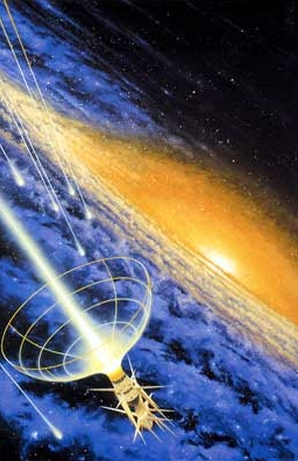
An interesting article in the online journal NOĒMA prompts these reflections. Robin Wordsworth is a professor of Environmental Science and Engineering as well as Earth and Planetary Sciences at Harvard. His musings invariably bring to mind a wonderful conversation I had with NASA’s Adrian Hooke about twenty years ago at the Jet Propulsion Laboratory. We had been talking about the ISS and its insatiable appetite for funding, with Hooke pointing out that for a fraction of what we were spending on the space station, we could be putting orbiters around each planet and some of their moons.
Image credit: Manchu.
It’s hard to argue with the numbers, as Wordsworth points out that the ISS has so far cost many times more than Hubble or the James Webb Space Telescope. It is, in fact, the most expensive object ever constructed by human beings, amounting thus far to something in the range of $150 billion (the final cost of ITER, by contrast, is projected at a modest $24 billion). Hooke, an aerospace engineer, was co-founder of the Consultative Committee for Space Data Systems (CCSDS) and was deeply involved in the Apollo project. He wasn’t worried about sending humans into deep space but simply about maximizing what we were getting out of the dollars we did spend. Wordsworth differs.
In fact, sketching the linkages between technologies and the rest of the biosphere is what his essay is about. He sees a human future in space as essential. His perspective moves backward and forward in time and probes human growth as elemental to space exploration. He puts it this way:
Extending life beyond Earth will transform it, just as surely as it did in the distant past when plants first emerged on land. Along the way, we will need to overcome many technical challenges and balance growth and development with fair use of resources and environmental stewardship. But done properly, this process will reframe the search for life elsewhere and give us a deeper understanding of how to protect our own planet.
That’s a perspective I’ve rarely encountered at this level of intensity. A transformation achieved because we go off planet that reflects something as fundamental as the emergence of plants on land? We’re entering the domain of 19th Century philosophy here. There is precedent in, for example, the Cosmism created by Nikolai Fyodorov in the 19th Century, which saw interstellar flight as a simple necessity that would allow human immortality. Konstantin Tsiolkovsky embraced these ideas but welded them into a theosophy that saw human control over nature as an almost divine right. As Wordsworth notes, here the emphasis was entirely on humans and not any broader biosphere (and some of Tsiolkovsky’s writings on what humans should do to nature are unsettling}.
But getting large numbers of humans off planet is proving a lot harder than the optimists and dreamers imagined. The contrast between Gerard O’Neill’s orbiting arcologies and the ISS is only one way to make the point. As we’ve discussed here at various times, human experiments with closed loop biological systems have been plagued with problems. Wordsworth points to the concept of the ‘ecological footprint,’ which makes estimates of how much land is required to sustain a given number of human beings. The numbers are daunting:
Per-person ecological footprints vary widely according to income level and culture, but typical values in industrialized countries range from 3 to 10 hectares, or about 4 to 14 soccer fields. This dwarfs the area available per astronaut on the International Space Station, which has roughly the same internal volume as a Boeing 747. Incidentally, the total global human ecological footprint, according to the nonprofit Global Footprint Network, was estimated in 2014 to be about 1.7 times the Earth’s entire surface area — a succinct reminder that our current relationship with the rest of the biosphere is not sustainable.
As I interpret this essay, I’m hearing optimism that these challenges can be surmounted. Indeed, the degree to which our Solar System offers natural resources is astonishing, both in terms of bulk materials as well as energy. The trick is to maintain the human population exploiting these resources, and here the machines are far ahead of us. We can think of this not simply as turning space over to machinery but rather learning through machinery what we need to do to make a human presence there possible in longer timeframes.
As for biological folk like ourselves, moving human-sustaining environments into space for long-term occupation seems a distinct possibility, at least in the Solar System and perhaps farther. Wordsworth comments:
…the eventual extension of the entire biosphere beyond Earth, rather than either just robots or humans surrounded by mechanical life-support systems, seems like the most interesting and inspiring future possibility. Initially, this could take the form of enclosed habitats capable of supporting closed-loop ecosystems, on the moon, Mars or water-rich asteroids, in the mold of Biosphere 2. Habitats would be manufactured industrially or grown organically from locally available materials. Over time, technological advances and adaptation, whether natural or guided, would allow the spread of life to an increasingly wide range of locations in the solar system.
Creating machines that are capable of interstellar flight from propulsion to research at the target and data return to Earth pushes all our limits. While Wordsworth doesn’t address travel between stars, he does point out that the simplest bacterium is capable of growth. Not so the mechanical tools we are so far capable of constructing. A von Neumann probe is a hypothetical constructor that can make copies of itself, but it is far beyond our capabilities. The distance between that bacterium and current technologies, as embodied for example in our Mars rovers, is vast. But machine evolution surely moves to regeneration and self-assembly, and ultimately to internally guided self-improvement. Such ‘descendants’ challenge all our preconceptions.
What I see developing from this in interstellar terms is the eventual production of a star-voyaging craft that is completely autonomous, carrying our ‘descendants’ in the form of machine intellects to begin humanity’s expansion beyond our system. Here the cultural snag is the lack of vicarious identification. A good novel lets you see things through human eyes, the various characters serving as proxies for yourself. Our capacity for empathizing with the artilects we send to the stars is severely tested because they would be non-biological. Thus part of the necessary evolution of the starship involves making our payloads as close to human as possible, because an exploring species wants a stake in the game it has chosen to play.
We will need machine crewmembers so advanced that we have learned to accept their kind as a new species, a non-biological offshoot of our own. We’re going to learn whether empathy with such beings is possible. A sea-change in how we perceive robotics is inevitable if we want to push this paradigm out beyond the Solar System. In that sense, interstellar flight will demand an extension of moral philosophy as much as a series of engineering breakthroughs.
The October 27 issue of The New Yorker contains Adam Kirsch’s review of a new book on Immanuel Kant by Marcus Willaschek, considered a leading expert on Kant’s era and philosophy. Kant believed that humans were the only animals capable of free thought and hence free will. Kirsch adds this:
…the advance of A.I. technology may soon put an end to our species’ monopoly on mind. If computers can think, does that mean that they are also free moral agents, worthy of dignity and rights? Or does it mean, on the contrary, that human minds were never as free as Kant believed—that we are just biological machines that flatter ourselves by thinking we are something more? And if fundamental features of the world like time and space are creations of the human mind, as Kant argued, could artificial minds inhabit entirely different realities, built on different principles, that we will never fully understand?
My thought is that if Wordsworth is right that we are seeing a kind of co-evolution at work – human and machine evolution accelerated by expansion into this new environment – then our relationship with the silicon beings we need will demand acceptance of the fact that consciousness may never be fully measured. We have yet to arrive at an accepted understanding of what consciousness is. Most people I talk to see that as a barrier. I’m going to see it as a challenge, because our natures make us explorers. And if we’re going to continue the explorations that seem part of our DNA, we’re now facing a frontier that’s going to demand consensual work with beings we create.
Will we ever know if they are truly conscious? I don’t think it matters. If I’m right, we’re pushing moral philosophy deeply into the realm of the non-biological. The philosophical challenge is immense, and generative.
The article is Wordsworth, “The Future of Space is More Than Human,” in the online journal NOĒMA, published by the Berggruen Institute and available here.
Jupiter’s Impact on the Habitable Zone
I’ve been thinking about how useful objects in our own Solar System are when we compare them to other stellar systems. Our situation has its idiosyncrasies and certainly does not represent a standard way for planetary systems to form. But we can learn a lot about what is happening at places like Beta Pictoris by studying what we can work out about the Sun’s protoplanetary disk and the factors that shaped it. Illumination can come about in both directions.
Think about that famous Voyager photograph of Earth, now the subject of an interesting new book by Jon Willis called The Pale Blue Data Point (Princeton, 2025). I’m working on this one and am not yet ready to review it, but when I do I’ll surely be discussing how the best we can do at studying a living terrestrial planet at a considerable distance is our own planet from 6 billion kilometers. We’ll use studies of the pale blue dot to inform our work with new instrumentation as we begin to resolve planets of the terrestrial kind.
But let’s look much further out, and a great deal further back in time. A 2003 detection at Beta Pictoris led eventually to confirmation of a planet in the early stages of formation there. Probing how exoplanets form is an ongoing task stuffed with questions and sparkling with new observations. As with every other aspect of exoplanet research, things are moving quickly in this area. Perhaps 25 million years old, this system offers information about the mechanisms involved in the early days of our own. Here on Earth, we also get the benefit of meteorites delivering ancient material for our inspection.
The role of Jupiter in shaping the protoplanetary disk is hard to miss. We’re beginning to learn that planetesimals, which are considered the building blocks of planets, did not form simultaneously around the Sun, and the mechanisms now coming into view affect any budding planetary system. In new work out of Rice University, senior author André Izidoro and graduate student Baibhav Srivastava have gone to work on dust evolution and planet formation using computer simulations that analyze the isotopic variation among meteorites as clues to a process that may be partially preserved in carbonaceous chondrites.
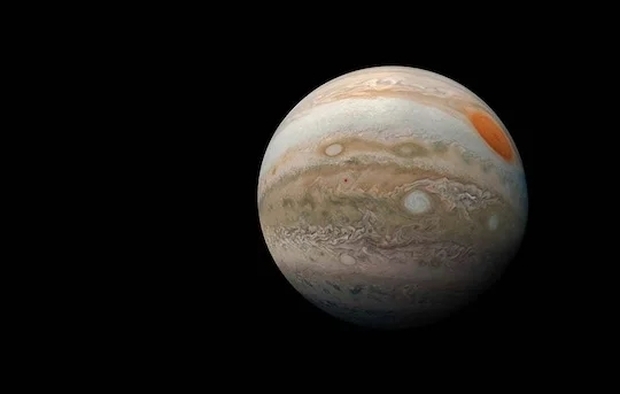
Image: Enhanced image of Jupiter by Kevin M. Gill (CC-BY) based on images provided courtesy of NASA/JPL-Caltech/SwRI/MSSS (Credit: NASA).
The authors posit that dense bands of planetesimals, created by the gravitational effects of the early-forming Jupiter, were but the second generation of such objects in the system’s history. The earlier generation, whose survivors are noncarbonaceous (NC) magmatic iron meteorites, seems to have formed within the first million years. Some two to three million years would pass before the chondrites formed, containing within themselves calcium-aluminum–rich inclusions from that earlier time. The rounded grains called ‘chrondules’ contain once molten silicates that help to preserve that era.
The key fact: Meteorites from objects that formed during the first generation of planetesimal formation melted and differentiated, making retrieval of their original composition problematic. Chondrites, which formed later, better preserve dust from the early Solar System and also contain distinctive ‘chondrules,’ which solidified after going through an early molten state. But the very presence of this isotopic variation demands explanation. From the paper:
…the late accretion of a planetesimal population does not appear readily compatible with a key feature of the Solar System: its isotopic dichotomy. This dichotomy—between NC and carbonaceous (CC) meteorites —is typically attributed to an early and persistent separation between inner and outer disk reservoirs, established by the formation of Jupiter or a pressure bump. In this framework, Jupiter (or a pressure bump) acts as a barrier that prevents the inward drift of pebbles from the outer disk and mixing, preserving isotopic distinctiveness.
But this ‘barrier’ would also seem to prevent small solids moving inwards to the inner disk, so the question becomes, how did enough material remain to allow the formation of early planetesimals at the later era of the chondrites? What is needed is a way to ‘re-stock’ this reservoir of material. Hence this paper. The authors hypothesize a ‘replenished reservoir’ of inner disk materials gravitationally gathered in the gaps in the disk opened up by Jupiter. The accretion of the chondrites and the locations where the terrestrial planets formed are interconnected as the early disk is shaped by the gas giant.
André Izidoro (Rice University) is senior author of the paper:
“Chondrites are like time capsules from the dawn of the solar system. They have fallen to Earth over billions of years, where scientists collect and study them to unlock clues about our cosmic origins. The mystery has always been: Why did some of these meteorites form so late, 2 to 3 million years after the first solids? Our results show that Jupiter itself created the conditions for their delayed birth.”
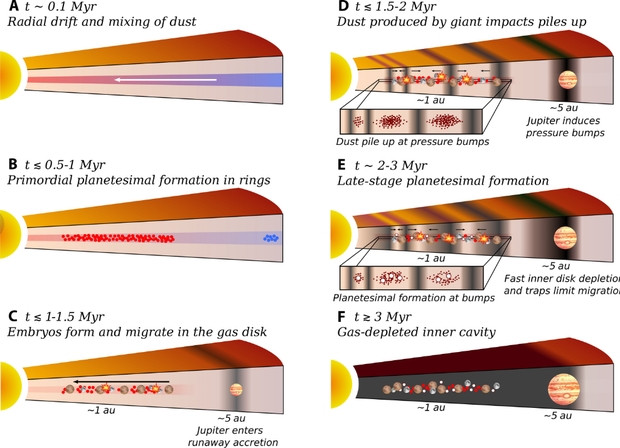
Image: This is Figure 1 from the paper. Caption: Schematic illustration of the proposed evolutionary scenario for the early inner Solar System over the first ~3 Myr. (A) At early times (t ~ 0.1 Myr), radial drift and turbulent mixing transport dust grains across the disk. (B) Around ≲ 0.t to 1 Myr, primordial planetesimal formation occurs in rings. (C) By ~1.5 Myr, growing planetary embryos start to migrate inward under the influence of the gaseous protoplanetary disk, whereas Jupiter’s core enters rapid gas accretion phase. (D) Around ~2 Myr, Jupiter’s gravitational perturbations excite spiral density waves, inducing pressure bumps in the inner disk. Giant impacts among migrating embryos generate additional debris. Pressure bumps act as dust traps, halting inward drift of small solids and leading to dust accumulation. (E) Between ~2 and 3 Myr, dust accumulation at pressure bumps leads to the formation of a second generation of planetesimals. Rapid gas depletion in the inner disk, combined with the presence of these traps, limits the inward migration of growing embryos. (F) By ~3 Myr, the inner gas disk is largely dissipated, resulting in a system composed of terrestrial embryos and a second generation of planetesimals—potentially the parent bodies of ordinary and enstatite chondrites—whereas the inner disk evolves into a gas-depleted cavity.
A separation between material from the outer Solar System and the inner regions preserved the distinctive isotopic signatures in the two populations. Opening up this gap, according to the authors, enabled regions where new planetesimals could grow into rocky worlds. Meanwhile, the presence of the gas giant also prevented the flow of gaseous materials toward the inner system, suppressing what might have been migration of young planets like ours toward the Sun. These are helpful simulations in that they sketch a way for planetesimals to form without being drawn into our star, but there are broad issues that remain unanswered here, as the paper acknowledges:
Our simulations demonstrate that Jupiter’s induced rapid inner gaseous disk depletion, gaps, and rings are broadly consistent with both the birthplaces of the terrestrial planets and the accretion ages of the parent bodies of NC chondrites. Our results suggest that Jupiter formed early, within ~1.5 to 2 Myr of the Solar System’s onset, and strongly influenced the inner disk evolution….
And here is reason for caution:
…we…neglect the effects of Jupiter’s gas-driven migration. This simplification is motivated by the fact that, once Jupiter opens a deep gap in a low-viscosity disk, its migration is expected to be fairly slow, particularly as the inner disk becomes depleted. Simulations show that, in low-viscosity disks, migration can be halted or reversed depending on the local disk structure. In reality, Jupiter probably formed beyond the initial position assumed in our simulations and first migrated via type I migration and eventually entered in the type II regime… but its exact migration history is difficult to constrain.
The authors thus guide the direction of future research into further consideration of Jupiter’s migration and its effects upon disk dynamics. Continuing study of young disks like that afforded by the Atacama Large Millimeter/submillimeter Array (ALMA) and other telescopes will help to clarify the ways in which disks can spawn first gas giants and then rocky worlds.
The paper is Srivastava & Izidoro, “The late formation of chondrites as a consequence of Jupiter-induced gaps and rings,” Science Advances Vol. 11, No. 43 (22 October 2025). Full text.
Interstellar Mission to a Black Hole
We normally think of interstellar flight in terms of reaching a single target. The usual destination is one of the Alpha Centauri stars, and because we know of a terrestrial-mass planet there, Proxima Centauri emerges as the best candidate. I don’t recall Proxima ever being named as the destination Breakthrough Starshot officially had in mind, but there is such a distance between it (4.2 light years) and the next target, Barnard’s Star at some 5.96 light years, that it seems evident we will give the nod to Proxima. If, that is, we decide to go interstellar.
Let’s not forget, though, that if we build a beaming infrastructure either on Earth or in space that can accelerate a sail to a significant percentage of lightspeed, we can use it again and again. That means many possible targets. I like the idea of exploring other possibilities, which is why Cosimo Bambi’s ideas on black holes interest me. Associated with Fudan University in Shanghai as well as New Uzbekistan University in Tashkent, Bambi has been thinking about the proliferation of black holes in the galaxy, and the nearest one to us. I’ve been pondering his notions ever since reading about them last August.
Black holes are obviously hard to find as we scale down to solar mass objects, and right now the closest one to us is GAIA-BH1, some 1560 light years out. But reading Bambi’s most recent paper, I see that one estimate of the number of stellar mass black holes in our galaxy is 1.4 X 10⁹. Bambi uses this number, but as we might expect, estimates vary widely, from 10 million to 1 billion. These numbers are extrapolated from the population of massive stars and to a very limited extent on clues from observational astronomy.
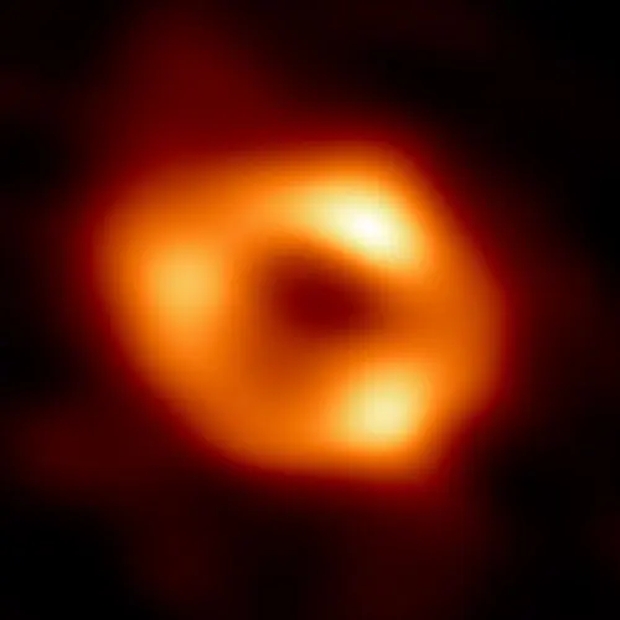
Image: The first image of Sagittarius A*, or Sgr A*, the supermassive black hole at the center of our galaxy. Given how hard it was to achieve this image, can we find ways to locate far smaller solar-mass black holes, and possibly send a mission to one? Credit: Event Horizon Telescope Collaboration.
Bambi calculates a population of 1 black hole and 10 white dwarfs for every 100 stars in the general population. If he’s anywhere close to right, a black hole might well exist within 20 to 25 light years, conceivably detected in future observations by its effects upon the orbital motion of a companion star, assuming we are so lucky as to find a black hole in a binary system. The aforementioned GAIA-BH1 is in such a system, orbiting a companion star.
Most black holes, though, are thought to be isolated. One black hole (OGLE-2011-BLG-0462) has been detected through microlensing, and perhaps LIGO A+, the upgrade to the two LIGO facilities in Hanford, Washington, and Livingston, Louisiana, can help us find more as we increase our skills at detecting gravitational waves. There are other options as well, as Bambi notes:
Murchikova & Sahu (2025) proposed to use observational facilities like the Square Kilometer Array (SKA), the Atacama Large Millimiter/Submillimiter Array (ALMA), and James Webb Space Telescope (JWST). Isolated black holes moving through the interstellar medium can accrete from the interstellar medium itself and such an accretion process produces electromagnetic radiation. Murchikova & Sahu (2025) showed that current observational facilities can already detect the radiation from isolated black holes in the warm medium of the Local Interstellar Cloud within 50 pc of Earth, but their identification as accreting black holes is challenging and requires multi-telescope observations.
If we do find a black hole out there at, say, 10 light years, we now have a target for future beamed sailcraft that offers an entirely different mission concept. We’re now probing not simply an unknown planet, but an astrophysical object so bizarre that observing its effects on spacetime will be a primary task. Sending two nanocraft, one could observe the other as it approaches the black hole. A signal sent from one to the other will be affected by the spacetime metric – the ‘geometry’ of spacetime – which would give us information about the Kerr solution to the phenomenon. The latter assumes a rotating black hole, whereas other solutions, like that of Schwarzschild, describe a non-rotating black hole.
Also intriguing is Bambi’s notion of testing fundamental constants. Does atomic physics change in gravitational fields this strong? There have been some papers exploring possible variations in fundamental constants over time, but little by way of observation studying gravitational fields much stronger than white dwarf surfaces. Two nanocraft in the vicinity of a black hole may offer a way to emit photons whose energies can probe the nature of the fine structure constant. The latter sets the interactions between elementary charged particles.
For that matter, is a black hole inevitably possessed of an event horizon, or is it best described as an ‘horizonless compact object’ (Bambi’s term)?
In the presence of an event horizon, the signal from nanocraft B should be more and more redshifted (formally without disappearing, as an observer should never see a test-particle crossing the event horizon in a finite time, but, in practice, at some point the signal leaves the sensitivity band of the receiver on nanocraft A). If the compact object is a Kerr black hole, we can make clear predictions on the temporal evolution of the signal emitted by nanocraft B. If the compact object is a fuzzball [a bound state without event horizon], the temporal evolution of the signal should be different and presumably stop instantly when nanocraft B is converted into fuzzball degrees of freedom.
There are so many things to learn about black holes that it is difficult to know where to begin, and I suspect that if many of our space probes have returned surprising results (think of the remarkable ‘heart’ on Pluto), a mission to a black hole would uncover mysteries and pose questions we have yet to ask. What an intriguing idea, and to my knowledge, no one else has made the point that if we ever reach the level of launching a mission to Proxima Centauri, we should be capable of engineering the same sort of flyby of a nearby black hole.
And on the matter of small black holes, be aware of a just released paper examining the role of dark matter in their formation. This one considers black holes on a much smaller scale, possibly making the chances of finding a nearby one that much greater. Let me quote the abstract (the italics are mine). The citation is below:
Exoplanets, with their large volumes and low temperatures, are ideal celestial detectors for probing dark matter (DM) interactions. DM particles can lose energy through scattering with the planetary interior and become gravitationally captured if their interaction with the visible sector is sufficiently strong. In the absence of annihilation, the captured DM thermalizes and accumulates at the planet’s center, eventually collapsing into black holes (BHs). Using gaseous exoplanets as an example, we demonstrate that BH formation can occur within an observable timescale for superheavy DM with masses greater than 106 GeV and nuclear scattering cross sections. The BHs may either accrete the planetary medium or evaporate via Hawking radiation, depending on the mass of the DM that formed them. We explore the possibility of periodic BH formation within the unconstrained DM parameter space and discuss potential detection methods, including observations of planetary-mass objects, pulsed high-energy cosmic rays, and variations in exoplanet temperatures. Our findings suggest that future extensive exoplanet observations could provide complementary opportunities to terrestrial and cosmological searches for superheavy DM.
The paper is Bambi, “An interstellar mission to test astrophysical black holes,” iScience Volume 28, Issue 8113142 (August 15, 2025). Full text. The paper on black holes and dark matter is Phoroutan-Mehr & Fetherolf, “Probing superheavy dark matter with exoplanets,” Physical Review D Vol. 112 (20 August 2025), 036012 (full text).

Follow with RSS or E-Mail