
By analyzing a carefully selected set of 544 distant galaxies, researchers are beginning to learn how galaxies take their mature forms, becoming the glorious objects we see today. Sandra Faber (University of California at Santa Cruz), puts it this way: “We are now well on our way to seeing how galaxies evolved over the last half of the age of the universe. This work is not over, but the outlines of a theory are emerging.”
The galaxies in question weigh in with redshifts in the range of 0.1 to 1.2, which translates to ‘look-back’ times of between 2 and almost eight billion years. These adolescent galaxies are far more disordered than nearby ones, but it turns out that the relationship between a galaxy’s mass and the orbital speed of its stars and gas is consistent over different types of galaxy and over billions of years of galactic evolution.
In other words, the more massive a galaxy is, the faster the stars and gas inside it move. That analysis includes a ‘dispersion component’ that adds to the disk’s rotational motion a way to analyze its disordered internal movements. The fit between stellar mass and internal velocities turns out to be tight, and it even works in the complex environment of galactic collisions and their subsequent mergers.
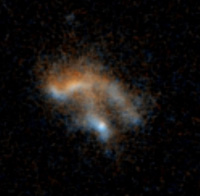
This new study extends and defines the so-called Tully-Fisher relation that had been used to correlate the luminosity of a spiral galaxy with its rotational speed. Now we’re correlating mass and rotation. But spirals and the remnants of collisions are only two types of galaxy. The third is the elliptical galaxy, where a different law had been observed: the more massive the galaxy, the faster the random motion of its stars. The new work pulls both regimes together and incorporates both rotation and random velocity.
Image: An irregular galaxy, the result of a galactic merger. This is one of many such galaxies studied by AEGIS (see below), whose data now reveal common ground in the principles governing the formation of spiral, elliptical and irregular galaxies. Credit: Hubble Space Telescope images taken by the DEEP2 Team, UC Santa Cruz and UC Berkeley.
Bringing ellipticals into the mix is significant. They’re largely free of star formation and made up of much older populations of stars than spiral galaxies, which show the blue light of hot, young stars. Now we learn that galaxies as diverse as these are more regular than we thought, emerging through the same set of generalized principles. What’s involved here may well date back to the Big Bang itself. Faber again:
“Galaxies began life as quantum fluctuations–tiny density fluctuations that created the seeds for the later coagulation of structure in the universe. When gravity took over, those seeds made galaxies, and we think that process is reflected in the Tully-Fisher relation.”
For more on all this, and in particular the remarkable galaxy study known as AEGIS (All-wavelength Extended Groth Strip International Survey), see the AEGIS site. A special issue of Astrophysical Journal Letters will be appearing to cover initial AEGIS results, including a paper describing the above work. It’s Faber et al., “Star formation in AEGIS field galaxies since z=1.1 . Staged galaxy formation, and a model of mass-dependent gas exhaustion,” with preprint available here.
Stars Form Better in the Cosmic Suburbs
Written by Fraser Cain
Galaxies, like people, tend to stick together. These
galaxies collect together into communities large and small,
called clusters and even superclusters. According to new
research gathered by NASA’s Spitzer Space Telescope,
stars seem to form better in the cosmic suburbs of these
clusters.
Galaxy clusters can be enormous, locking together
thousands of galaxies into a mutual gravitational dance.
Seen from afar, these groups of galaxies form large blobs
(the clusters) linked together by spider web-like filaments
that stretch for millions of light-years. The filaments contain
the smaller collections of galaxies working their way towards
the largest clusters.
Spitzer’s infrared view revealed two of these filaments in
the galaxy cluster Abell 1763. Galaxies are traveling along
these filaments, and will eventually collide with the larger
cluster itself.
Full article here:
http://www.universetoday.com/2008/01/28/stars-form-better-in-the-cosmic-suburbs/