
What exactly is the object astronomers have discovered 30,000 light years away in the constellation Cepheus? The Spitzer Space Telescope found it, but the source only shows up in mid-infrared images as a re-orange blob. Scan the same region of sky in visible light or near-infrared and you see absolutely nothing, and x-ray and radio views of the same region have never betrayed the object.
A stealth supernova? Apparently so, in the eyes of Patrick Morris (California Institute of Technology), who is lead author of a paper on the discovery in the April Astrophysical Journal Letters. And it’s a fascinating find, because the average supernova (if there is such a thing) makes itself known by lighting up surrounding areas of dust. The new object is far from the galaxy’s most crowded and dusty regions, so the gas and radiation it would have spewed into space had little to interact with.
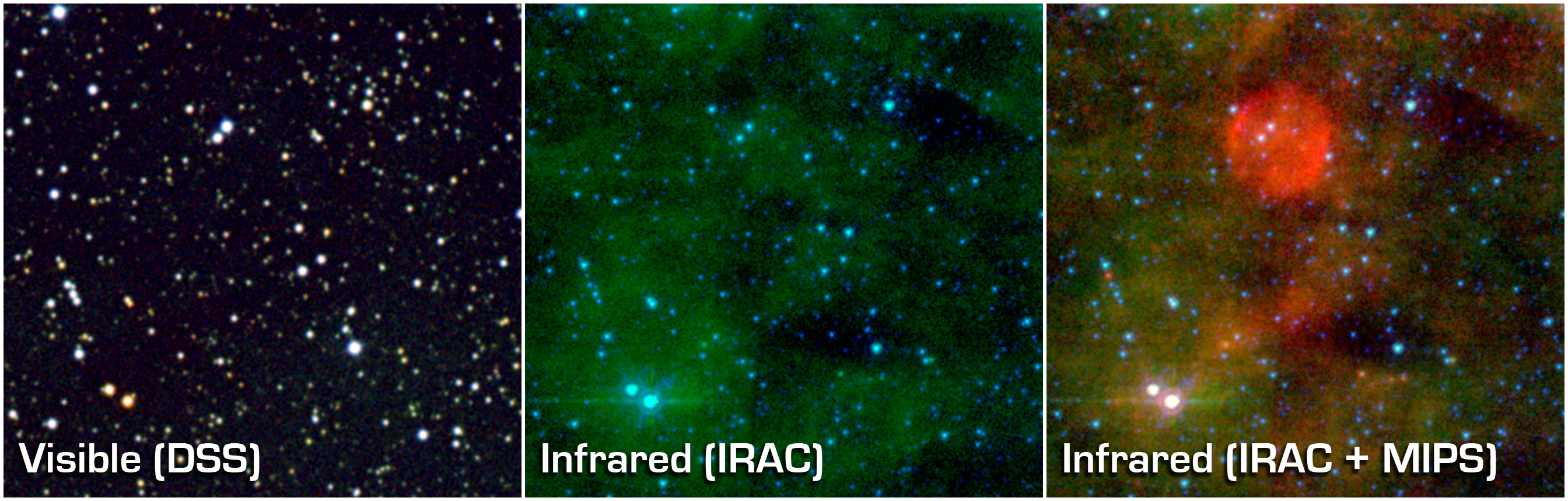
Image (click to enlarge): Unlike most supernova remnants, which are detectable at a variety of wavelengths ranging from radio to X-rays, this source only shows up in mid-infrared images taken by Spitzer’s multiband imaging photometer. Credit: NASA/JPL-Caltech/NASA Herschel Science Center/DSS.
The other candidate: a planetary nebula, but Morris and team have discounted that idea. Says Morris, “There are various flavors of planetary nebulas; however, these objects normally have a bright star in the middle, a lot of dust, and a big range of chemistry. Our object shows none of this.” Adding to the supernova theory are the traces of oxygen found with Spitzer’s infrared spectrograph. Supernovae are often surrounded by oxygen released from their cores. At 25 times the mass of our Sun, this supernova, if confirmed, would be one of the smallest ever found in our galaxy.

0 Comments