
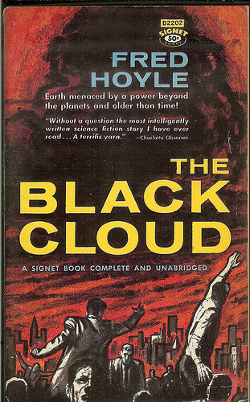
One of the first science fiction novels I ever read was The Black Cloud, by astrophysicist Fred Hoyle. I remember that one of my classmates had smuggled it into our grade school and soon we were passing it around covertly instead of reading whatever it was we had been assigned. In Hoyle’s novel, scientists discover that the cloud, which approaches the Solar System and decelerates, may be a life-form with which they can communicate. My young self was utterly absorbed by this book and I suspect it will hold up well to re-reading.
What brings The Black Cloud to mind is recent work using data from the Green Bank Telescope in West Virginia, where scientists have been studying an enormous gas cloud some 25,000 light years from Earth near the center of the Milky Way in the star forming region Sagittarius B2(N). This cloud is not, of course, behaving as entertainingly as Hoyle’s, but it’s offering up information about how interstellar molecules that are intermediate steps toward the final chemical processes that lead to biological molecules can form in space.
Although we’ve found interesting molecules in interstellar gas clouds before, the new work suggests that the chemical formation sequences for these molecules actually occurred on the surface of icy grains in interstellar space. One of the molecules is cyanomethanimine, which scientists believe is part of the process that produces adenine, one of four nucleobases forming the ‘rungs’ in the DNA lattice. The other is ethanamine, thought to play a similar role in the formation of alanine, one of twenty amino acids in the genetic code.
The biological interest is the suggestion that life’s building blocks are widely available, as noted in one of the two papers on this work:
One important goal of the field of astrobiology is the identification of chemical synthesis routes for the production of molecules important in the development of life that are consistent with the chemical inventory and physical conditions on newly formed planets. One mechanism for seeding planets with chemical precursors is delivery by outer solar system bodies, like comets or meteorites… These objects can be chemical reservoirs for the molecules produced in the interstellar medium during star and planet formation. The chemical inventory of these objects includes the molecules that are directly incorporated from the interstellar medium and molecules subsequently formed by chemical processing of the interstellar species…
What we’re after, then, is an understanding of the process by which interstellar molecules can undergo further change relevant to the formation of life. The paper continues:
This subsequent chemical processing can synthesize larger, more complex molecules that are more directly relevant to prebiotic chemistry from the simpler molecules that can be formed in the interstellar medium. The identification of molecules in the interstellar medium is a key step in understanding the chemical evolution from simple molecular species to molecules of biological relevance and radio astronomy has played the dominant role in identifying the chemical inventory of the interstellar medium…
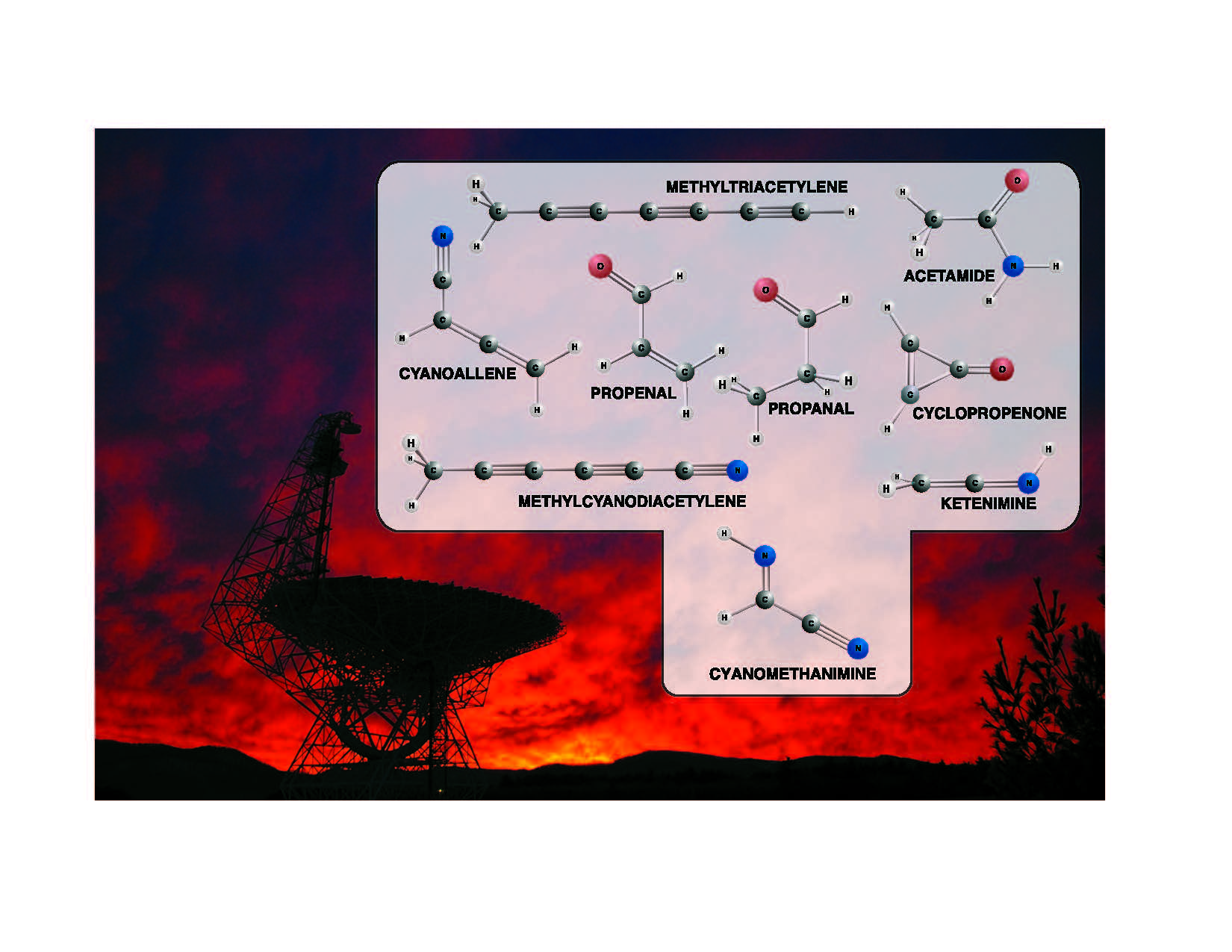
Image (click to enlarge): The Green Bank Telescope and some of the molecules it has discovered. Credit: Bill Saxton, NRAO/AUI/NSF.
The region under study, Sgr B2(N), turns out to be incredibly rich for this kind of work. According to the scientists, about half of the 170 molecules that have been detected in space were first found in this region. The team was able to measure the characteristic radio emission signatures of the rotational states of cosmic chemicals, using radio emission studies of cyanomethanimine and ethanamine and comparing these to the data generated by the Green Bank Telescope. “Finding these molecules in an interstellar gas cloud means that important building blocks for DNA and amino acids can ‘seed’ newly-formed planets with the chemical precursors for life,” says Anthony Remijan, of the National Radio Astronomy Observatory (NRAO).
The papers are Loomis et al., “The Detection of Interstellar Ethanimine (CH3CHNH) from Observations taken during the GBT PRIMOS Survey,” accepted in Astrophysical Journal Letters (preprint) and Zaleski et al., “Detection of E-cyanomethanimine towards Sagittarius B2(N) in the Green Bank Telescope PRIMOS Survey,” also accepted at Astrophysical Journal Letters (preprint). See this NRAO news release for more.


There is even a short video recap of this -https://www.youtube.com/watch?v=Ggm-vSfHiBQ
And this one:
http://www.youtube.com/watch?v=w5N273yW9a8
Sugar Molecules in the Gas Surrounding a Young Sun-like Star
A team of astronomers has found molecules of glycolaldehyde — a simple form of sugar — in the gas surrounding a young binary star, with similar mass to the Sun, called IRAS 16293-2422. This is the first time sugar been found in space around such a star, and the discovery shows that the building blocks of life are in the right place, at the right time, to be included in planets forming around the star. The astronomers used the Atacama Large Millimeter/submillimeter Array (ALMA) to detect the molecules.
This video starts with a broad panorama of the spectacular central regions of the Milky Way seen in visible light. It then zooms in to the Rho Ophiuchi star-forming region in infrared light, highlighting IRAS 16293-2422. Finally, we see an artist’s impression of glycolaldehyde molecules, showing glycolaldehyde’s molecular structure (C2H4O2).
Release Date: 29 August 2012
Read more: http://www.eso.org/public/news/eso1234/
Credit:
ALMA (ESO/NAOJ/NRAO)
Nick Risinger (skysurvey.org)
S. Guisard (www.eso.org/~sguisard)
L. Calçada (ESO) & NASA/JPL-Caltech/WISE Team
Music: Disasterpeace
This work is important and essential, but Iwish there was more (any?) focus on the larger issue of thermodynamics…that is , coming up with a plausible and testable theory for the formation of biopolymers full stop. Catalysts are not “directional” and a warm soup of precusors will remain so until some means of sequestering more complex molecules into a protected environment is at play.
Perhaps there are naturally occurring mixed-phase systems involving polar and non-polar solvents such that a nacent polymer is drawn away and segregated from a thermodynamically hostile environment…dare I suggest ammoniated water::methane? Listen…did your hear that? The subtitanean oceans of Titan are calling…heh.
I was 16 when the Black Cloud came out. I remember me and my SF buddies really loved it, even tho I can’t remember if the idea , or something like it had been done by Campbell’s boys.
It was Hoyle’s best SF novel , tho I loved the idea in A for Andromeda (even if John Elliot was the co-author). Carl Sagan borrowed some ideas from that book for Contact, I doubt Hoyle had any problems with that.
Never could get into Hoyle’s later output of SF he was so out classed by a generation of superior writers.
I can remember being a fan of his non fiction about astronomy. Sir Fred had me searching the university stacks for the journal articles about Steady State Theory. Story I heard was that he and Herman Bondi and Tommy Gold were all in the same class at Cambridge that was taught by Sir James Jeans and he gave them a lecture about Steady State theory…. but seems Jeans never did much with it. After the war Bondi , Gold and Hoyle got together and talked about it in detail. Seems all three were going to publish a joint paper but Hoyle wanted to add some modeling that Gold and Bondi did not want. So two papers in the same journal.
I was a devotee of steady state until empirical measurements proved otherwise.
One thing Sr Fred was involved with one of the greatest scientific thunderbolts of the 20th century…. that is the B squared F H paper.
^ E. M. Burbidge, G. R. Burbidge, W. A. Fowler, and F. Hoyle (1957). “Synthesis of the Elements in Stars”. Reviews of Modern Physics 29 (4): 547
That one was worth 4 nobles , only Willy Fowler got one.
For the sake of completeness, the Star Trek animated series episode from 1973 titled “One of Our Planets is Missing” deals with a huge intelligent interstellar cloud that consumes planets and initially has no idea that tiny living creatures exist on them.
http://en.memory-alpha.org/wiki/One_of_Our_Planets_Is_Missing_(episode)
The first Star Trek film from 1979 also had an intelligent machine entity called V’Ger enveloped in a massive space cloud 82 AUs across.
So the case for exobiology strengthens.
Leading us back to the Fermi paradox…
@ AA Jackson – didn’t Sir Fred also think he had detected cellulose in space which he then used to support his claim of extra terrestrial life?
I recently listened to the audio book of the Black Cloud (I also read it as a teenager) and was impressed by how well the story stood up after all this time.
@Alex
“@ AA Jackson – didn’t Sir Fred also think he had detected cellulose in space which he then used to support his claim of extra terrestrial life?”
Well he an Chandra Wickramasinghe studied a lot of controversial things. Odd if one reads those papers papers they are not crack-pottery…. but Sir Fred sure was confrontational, he railed about ‘closed box’ thinking when , to me, seemed he was practicing exactly that!
His rejection of Earth-based abiogenesis was odd, to the point of having creationists claim he was an atheist who condoned Intelligent Design, which I know he in no way would have approved.
For being one of best astrophysicists of his time, he sure had a blind spot for ‘big bang’ theory , he was not alone, but his arguments for interpretations of the CMB passed my understanding.
He did stand up for Jocelyn Bell and the Nobel for pulsars.
This and other things are thought to have worked against his ever getting a Nobel, which he really deserved for original contributions.
The Black Cloud was also one of the first sci-fi stories I heard. My father read it to me when I was under ten. I’m pretty sure it was the one who made ??me a sci-fi and stargazer freak. There were not many sci-fi books translated into Danish at that time and only one state television channel that was on a few hours each day, so it was a mind blower for a kid like me. Thanks for reminding me about it, I have to try to read it again.
Addition to the story. Lab tests suggest that cosmic rays may be the cause how complex chemicals in icy dust may react to complex organic compounds especially dipeptides.
http://phys.org/news/2013-03-evidence-comets-seeded-life-earth.html
Alex Tolley, I know of no claim by Hoyle that he detected cellulose in space. What he did claim along those lines was
a) a high cellulose content would account for the adsorption profile of interstellar dust grains that any other candidates put forward until that time.
b) Massive quantities of cellulose could be synthesised in the stellar out flows of carbon stars given a tiny initial amount as a catalyst.
Years later he claimed the absorption profile of freeze dried bacteria (whose surface is largely a cellulose cell wall) was so close to that of some interstellar dust grains that you might put it in that detection type category if you so desire.
What I feel that many miss about Hoyle’s reworking of Arrhenius’ radio-panspermia theory is that his version can only happen on a massive scale. Either most comets are chocked fill of dead bacteria, or he is nearly certainly wrong. His theory is extremely easy to test for. So Jackson, that explains (to my mind) why Hoyle got a little tetchy when he was ignored.
That also brings me back to coacervate’s comment that catalysts are not directional. Hoyle had already stated that those interstellar chemicals were more likely the breakdown products of bimolecular not their precursors.
05 June 2013
Text and Images:
https://www.llnl.gov/news/newsreleases/2013/Jun/NR-13-06-02.html
LIFE ON EARTH SHOCKINGLY COMES FROM OUT OF THIS WORLD
Early Earth was not very hospitable when it came to jump starting life. In fact, new research shows that life on Earth may have come from out of this world.
Lawrence Livermore scientist Nir Goldman and University of Ontario Institute of Technology colleague Isaac Tamblyn (a former LLNL postdoc) found that icy comets that crashed into Earth millions of years ago could have produced life building organic compounds, including the building blocks of proteins and nucleobases pairs of DNA and RNA.
Comets contain a variety of simple molecules, such as water, ammonia, methanol and carbon dioxide, and an impact event with a planetary surface would provide an abundant supply of energy to drive chemical reactions.
“The flux of organic matter to Earth via comets and asteroids during periods of heavy bombardment may have been as high as 10 trillion kilograms per year, delivering up to several orders of magnitude greater mass of organics than what likely pre-existed on the planet,” Goldman said.
Goldman’s earlier work is based on computationally intensive models, which, in the past, could only capture 10-30 picoseconds of a comet impact event. However new simulations, developed on LLNL’s supercomputers Rzcereal and Aztec, Goldman used much more computationally efficient models and was able to capture hundreds of picoseconds of the impacts — much closer to chemical equilibrium.
“As a result, we now observe very different and a wider array of hydrocarbon chemical products that, upon impact, could have created organic material that eventually led to life,” Goldman said.
Comets can range in size from 1.6 kilometers up to 56 kilometers. Comets passing through the Earth’s atmosphere are heated externally but remain cool internally. Upon impact with the planetary surface, a shock wave is generated due to the sudden compression. Shock waves can create sudden, intense pressures and temperatures, which could affect chemical reactions within a comet before it interacts with the ambient planetary environment. An oblique collision where an extraterrestrial icy body impacts a planetary atmosphere with a glancing blow could generate thermodynamic conditions conducive to organic synthesis. These processes could result in significant concentrations of organic species being delivered to Earth.
The team found that moderate shock pressures and temperatures (approximately 360,000 atmospheres of pressure and 4,600 degrees Fahrenheit) in a carbon-dioxide-rich ice mixture produced a number of nitrogen-containing heterocycles, which dissociate to form functionalized aromatic hydrocarbons upon expansion and cooling. These are thought to be prebiotic precursors to DNA and RNA base pairs.
In contrast, higher shock conditions (about 480,000 to 600,000 atmospheres of pressure and 6,200-8,180 degrees Fahrenheit) resulted in the synthesis of methane and formaldehyde, as well as some long-chain carbon molecules. These compounds are known to act as precursors to amino acids and complex organic synthesis. All shock compression simulations at these conditions have produced significant quantities of new, simple carbon-nitrogen bonded compounds upon expansion and cooling, which are known prebiotic precursors.
“Cometary impacts could result in the synthesis of prebiotic molecules without the need for other ‘special’ conditions, such as the presence of catalysts, UV radiation, or special pre-existing conditions on a planet,” Goldman said. “This data is critical in understanding the role of impact events in the formation of life-building compounds both on early Earth and on other planets and in guiding future experimentation in these areas.”
The research will appear on the cover of the June 20 issue of The Journal of Physical Chemistry A.
Contact:
Anne Stark
+1 925-422-9799
stark8@llnl.gov
What caused the Cambrian explosion?
The “Cambrian explosion” marked the rapid appearance of many animal phyla that persist today, and began about 570 million years ago (mya). Life itself appeared in the fossil record as simple cyanobacteria—”blue green algae”—about 3.6 billion years ago (bya); the first “true” cell with a nucleus probably arose about 2 bya; and the first multicellular organism between 1 and 2 bya.
Full article here:
http://whyevolutionistrue.wordpress.com/2013/06/20/what-caused-the-cambrian-explosion/
To quote:
And new explanations continue to arise. One, proposed by geologists Robert Gaines and Shanan Peters, was just published as a short note in New Scientist, which, sadly, is behind a paywall. But I can summarize it briefly.
Being geologists, Gaines’ and Peters’ (G&P’s) hypothesis is geological, and rests on the observation that the geological strata reveal a huge section of missing rock, called the “Great Unconformity,” that may represent a billion lost years of Earth’s history.
G&P suggest that it is the weathering of this crystalline rock layer that gave the impetus to the Cambrian explosion. This erosion is likely to have filled the oceans with mienerals: calcium, magnesium, silicon dioxide, phosphates, and bicarbonates.
Eventually the accumulation of these minerals in the ocean might have permitted the already-present but simple life forms to cross the threshold of biomineralization: the incorporation of environmental elements into hard parts like shells, exoskeletons, bones, and teeth. It’s costly to make these parts, since it involves the use of metabolic pathways that can divert energy from reproduction, and perhaps the absence of minerals before the Great Weathering would have prohibited the evolution of hard parts. But the sudden influx of these compounds could have made the evolution of biochemical pathways for mineralization feasible, and their acquisition advantageous. Hard parts, like shells and exoskeletons, are useful in many ways: protecting you from the environment or predators, providing support, allowing larger body size, and so on.