
Back in my flying days, I found myself becoming absorbed with meteorology, enough to wind up teaching the subject in various flight school settings. I was no expert, but looking for clues on flying conditions in the next few hours by studying cloud formation and movement was fascinating. In all that time, the one cloud phenomenon I always wanted to see but never did was the noctilucent cloud, an unusual, lovely formation made up of ice particles that occurs at extremely high altitudes.
‘Noctilucent’ means ‘night-shining,’ and that’s just what these clouds do when they’re illuminated by sunlight from below the horizon. Space Shuttle launches have been found to generate them as the vehicle pumps about 300 metric tons of water vapor into the thermosphere, the layer of atmosphere beginning at about ninety kilometers above the surface, just above the mesosphere. Photographs of such clouds show a unique beauty, though it’s one that might also seem eerie, at least in certain settings.
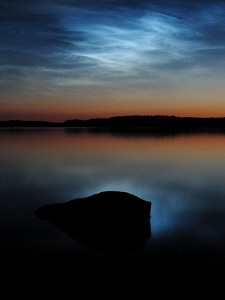
For just after the huge explosion that occurred in Siberia in 1908 night skies shone brightly for several days across Europe, particularly Britain, fully three thousand miles away. The Tunguska Event leveled 830 square miles of forest land and has been ascribed to various causes, but a new study concludes that the bright skies following the explosion are a clue to the true culprit, a comet. Those Shuttle-induced noctilucent clouds are the key.
Image: Noctilucent clouds over Lake Saimaa in Finland. Credit: Mika Yrjölä.
Michael Kelley (Cornell University), who led this work, likens it to figuring out a 100-year-old murder mystery. Kelley thinks the evidence strongly supports the comet theory. Such a comet would have started to break up at roughly the same altitude as the release of the exhaust plume from the Space Shuttle. Moreover, water particles from launches have been found to travel as far as the polar regions, where they form noctilucent clouds after settling into the mesosphere.
The Shuttle plume, in other words, parallels what we would expect from a comet, but the wild card has been how water vapor could travel large distances without diffusing. We’re talking about moving this material thousands of kilometers, and quickly. Noting that there is no model that would predict this movement, Kelley calls the result “totally new and unexpected physics.”
Such new physics would involve, the researchers believe, so-called ‘two dimensional turbulence’ — counter-rotating atmospheric eddies packed with extreme energy, powerful enough that when the water vapor becomes involved with them, it travels at more than 90 meters per second. The problem is that the structure of winds in the boundary areas between the mesosphere and the thermosphere is not well understood. Noctilucent clouds may be giving us clues to the nature of this tricky region.
The paper is Kelley et al., “Two-dimensional turbulence, space shuttle plume transport in the thermosphere, and a possible relation to the Great Siberian Impact Event,” in press at Geophysical Research Letters. More in this Cornell University news release.



Re: [meteorite-list] Tunguska Blast a water rich comet: clusters of similar
craters, very like Carolina Bays, in New Mexico, east of Las Vegas and
southeast of Estancia: Rich Murray 2009.06.25
About 8 miles SE of Las Vegas, NM, via Google Maps and Google Earth, note
McAllister Lake, Crane Lake, and others with white deposits, by road 201, S
of SR 104, part of a Federal bird park.
Also, 20 miles E along State Road 104, then NE 1 mile on CR C 53A, to note a NS crater about a mile long, with a about 100 m shallow white rock road
quarry at the S end right at the N edge of the road, with no fences or
livestock or No Trespassing signs — it is easy to walk along the west edge
on the red sandstone bedrock and find that the layers are progressively
cracked and blasted over as refrigerator size chunks, with apparent dark
high temperature glazing, beside the shallow central depression. There are
rocks and chunks of the red sandstone up to 1 m size lying about in the
fields for miles, as well as many more similar features in the area.
SE of Albuquerque, just SE of Estancia, mostly N of 60 and the railroad, and
crossing it, is a NS cluster of shallow craters with white minerals,
Laguna Del Perro, and similar craters within 10-20 miles, long interpreted
as late Pleistocene wind erosion features — intermittent playa lakes.
These features seem very similar to the million or so Carolina Bays, from
Maryland to Louisiana, for which a recent paper by experts claims evidence
to be from a huge ice dominant comet that fragmented high over Southern
Canada in 12,900 BP, causing the demise of Clovis culture and of large
mammals.
I would like help in getting my rock samples from New Mexico features
analyzed.
Rich Murray
1943 Otowi Road, Santa Fe, NM 87505 505-501-2298 rmforall@comcast.net
Ahaan… The Tunguska event always interested me! Are there any documentary DVDs related to it?
The noctilucent clouds are better explained by the methane-explosion model for Tunguska. First an earthquake-generated mega-release of methane, then a serendipitous bolide to ignite it. The resultant conical shock wave would generate overpressures on the ground below, and at great westward distances, identical to those of a much more energetic spherical blast wave. Thus a 5MT conical detonation mimics the 20MT of conventional Tunguska estimates, which assume a spherical blast.
See, for example
http://www.ias.ac.in/currsci/aug252001/399.pdf
http://www.geocities.com/CapeCanaveral/Cockpit/3240/tunguska.htm
http://www.springerlink.com/content/7162704030482730/
Noctilucent Clouds Over Germany
Credit & Copyright: Christoph Rollwagen
Explanation: Sometimes it’s night on the ground but day in the air. As the Earth rotates to eclipse the Sun, sunset rises up from the ground. Therefore, at sunset on the ground, sunlight still shines on clouds above. Under usual circumstances, a pretty sunset might be visible, but unusual noctilucent clouds float so high up they can be seen well after dark.
Pictured above last week, a network of noctilucent clouds cast an eerie white glow after dusk, beyond a local field near Potsdam, Germany. Although noctilucent clouds are thought to be composed of small ice-coated particles, much remains unknown about them.
Satellites launched to help study these clouds include Sweden’s Odin and NASA’s AIM. Recent evidence indicates that at least some noctilucent clouds result from freezing water exhaust from Space Shuttles.
http://antwrp.gsfc.nasa.gov/apod/ap090624.html
Cometary airbursts and atmospheric chemistry: Tunguska and a candidate Younger Dryas event
Authors: Adrian L. Melott (Kansas), Brian C. Thomas (Washburn), Gisela Dreschhoff (Kansas), Carey K. Johnson (Kansas)
(Submitted on 6 Jul 2009)
Abstract: We estimate atmospheric chemistry changes from ionization at the 1908 Tunguska airburst event, finding agreement with nitrate enhancement in GIS2PH and GISP2 ice cores and noting an unexplained accompanying ammonium spike. We then consider the candidate Younger Dryas comet impact. The estimated NOx production and O3 depletion are large, beyond accurate extrapolation. A modest nitrate deposition signal exists in ice core data. The predicted very large impulsive deposition might be visible in higher resolution data.
Ammonium has been attributed to biomass burning, and found coincident with nitrate spikes at YD onset in both the GRIP and GISP2 ice cores. A similar result is well-resolved in Tunguska ice core data, but the Tunguska forest fire was far too small to account for this. Direct input of ammonia from a comet into the atmosphere is consistent with the spike for the candidate YD object, but also inadequate for Tunguska.
An analog of the Haber process with hydrogen contributed by the cometary or surface water, atmospheric nitrogen, high temperatures, pressures, and the possible presence of catalytic iron from a comet could in principle divert a variable fraction of the reaction products to ammonia, accounting for ice core data in both events.
Subjects: Earth and Planetary Astrophysics (astro-ph.EP); Atmospheric and Oceanic Physics (physics.ao-ph); Geophysics (physics.geo-ph)
Cite as: arXiv:0907.1067v1 [astro-ph.EP]
Submission history
From: Adrian Melott [view email]
[v1] Mon, 6 Jul 2009 18:35:53 GMT (101kb)
http://arxiv.org/abs/0907.1067
Noctilucent Cloud Storm Panorama
P-M Hedén (Clear Skies, TWAN)
Explanation: Noctilucent or night-shining clouds lie near the edge of space. From about 80 kilometers above Earth’s surface, the icy clouds can still reflect sunlight even though the Sun itself is below the horizon as seen from the ground.
Usually occurring at high latitudes in summer months, the diaphanous apparitions are also known as polar mesospheric clouds and may be connected to global change in the lower atmosphere.
This impressive 360 degree panorama made from 34 separate images captures an impressive display of noctilucent clouds all over the sky. It was recorded last month from Vallentuna, Sweden. The photographer reports that the display was like a noctilucent cloud storm, one of the best he’s ever witnessed.
http://apod.nasa.gov/apod/ap090711.html
Lunar semimonthly signal in cloud amount
Authors: Nikolay Pertsev (1), Peter Dalin (2,3) ((1)A. M. Obukhov Institute of Atmospheric Physics, Russian Academy of Sciences, Moscow, Russia, (2) Swedish Institute of Space Physics, Kiruna, Sweden, (3) Space Research Institute of Russian Academy of Sciences, Moscow, Russia)
(Submitted on 21 Jul 2009)
Abstract: Based on NASA satellite infrared and visible range measurements, cloud amount ISCCP_D1 summer nighttime data, representing the tropospheric cloud activity at Central Russia are examined over 1994-2007, and the lunar signal in the cloud amount was extracted.
The ISCCP_D1 database was used to confirm previous results of Pertsev, Dalin and Romejko (2007) on the large importance of lunar declination effect compared to the lunar phase effect. Since this database provides much more information than it was used in that previous investigation, it has become possible to separate the lunar phase effect and the lunar declination effect in cloudiness.
The relative cloud amount tends to grow with a change of lunar phase from a quadrature to the New Moon or Full Moon and with increasing of the lunar declination by absolute value. The both effects are statistically significant, the second one is a little stronger.
Comments: 10 pages, 2 figures (included in the text)
Subjects: Atmospheric and Oceanic Physics (physics.ao-ph); Geophysics (physics.geo-ph)
Report number: IFARAN-09-07
Cite as: arXiv:0907.3643v1 [physics.ao-ph]
Submission history
From: Nikolay Pertsev [view email]
[v1] Tue, 21 Jul 2009 16:18:09 GMT (556kb,D)
http://arxiv.org/abs/0907.3643
AFP / PhysOrg, 2/15/2013:
“Tunguska, 1908: Russia’s greatest cosmic mystery”
“The stunning burning-up of a meteor over Russia on Friday that
unleashed a shockwave injuring hundreds of people appears to be the
country’s most dramatic cosmic experience since the historic Tunguska
Event of June 1908.”
More:
http://phys.org/news/2013-02-tunguska-russia-greatest-cosmic-mystery.html
http://www.technologyreview.com/view/514511/first-tunguska-meteorite-fragments-discovered/
First Tunguska Meteorite Fragments Discovered
The Physics arXiv Blog
May 2, 2013
Nobody knows what exploded over Siberia in 1908, but the discovery of the first fragments could finally solve the mystery.
The Tunguska impact event is one of the great mysteries of modern history. The basic facts are well known. On 30 June 1908, a vast and powerful explosion engulfed an isolated region of Siberia near the Podkamennaya Tunguska River.
The blast was 1000 times more powerful than the bomb dropped on Hiroshima, registered 5 on the Richter scale and is thought to have knocked down some 80 million trees over an area of 2000 square kilometres. The region is so isolated, however, that historians recorded only one death and just handful of eyewitness reports from nearby.
But the most mysterious aspect of this explosion is that it left no crater and scientists have long argued over what could have caused it.
The generally accepted theory is that the explosion was the result of a meteorite or comet exploding in the Earth’s atmosphere. That could have caused an explosion of this magnitude without leaving a crater. Such an event would almost certainly have showered the region in fragments of the parent body but no convincing evidence has ever emerged.
In the 1930s, an expedition to the region led by the Russian mineralogist Leonid Kulik returned with a sample of melted glassy rock containing bubbles. Kulik considered this evidence of an impact event. But the sample was somehow lost and has never undergone modern analysis. As such, there is no current evidence of an impact in the form of meteorites.
That changes today with the extraordinary announcement by Andrei Zlobin from the Russian Academy of Sciences that he has found three rocks from the Tunguska region with the telltale characteristics of meteorites. If he is right, these rocks could finally help solve once and for all what kind of object struck Earth all those years ago.
Zlobin’s story is remarkable in a number of ways. The area of greatest interest for meteor scientists is called the Suslov depression, which lies directly beneath the location of the air blast and is the place where meteorite debris was most likely to fall.
Dig into the peat bogs here and you can easily find layers that show clear evidence of the explosion. Zlobin said he dug more than ten prospect holes in the hope of finding meteorite fragments, but without success.
However, he had more luck exploring the bed of the local Khushmo River, where stones are likely to collect over a long period of time. He collected around 100 interesting specimens and returned to Moscow with them.
This expedition took place in 1988 and for some unexplained reason, Zlobin waited 20 years to examine his haul in detail. But in 2008, he sorted the collection and found three stones with clear evidence of melting and regmalypts, thumblike impressions found on the surface of meteorites which are caused by ablation as the hot rock falls through the atmosphere at high speed.
Zlobin and others have used tree ring evidence to estimate the temperatures that the blast created on the ground and says that these were not high enough to melt rocks on the surface. However, the fireball in the Earth’s atmosphere would have been hot enough for this.
So Zlobin concludes that the rocks must be fragments of whatever body collided with Earth that day.
Zlobin has not yet carried out a detailed chemical analysis of the rocks that would reveal their chemical and isotopic composition. So the world will have to wait for this to get a better idea of the nature of the body.
However, the stony fragments do not rule out a comet since the nucleus could easily contain rock fragments, says Zlobin. Indeed he has calculated that the density of the impactor must have been about 0.6 grams per cubic centimetre, which is about the same as nucleus of Halley’s comet. Zlobin says that together the evidence seems “excellent confirmation of cometary origin of the Tunguska impact.”
Clearly there is more work to be done here, particularly the chemical analysis perhaps with international cooperation and corroboration.
Then there is also the puzzle of why Zlobin has waited so long to analyse his samples. It’s not hard to imagine that the political changes that engulfed the Soviet Union in the year after his expedition may have played a role in this, but it still requires some explaining.
Nevertheless, this has the potential to help clear up one of the outstanding mysteries of the 20th century and finally determine the origin of the largest Earth impact in recorded history.
Ref: http://arxiv.org/abs/1304.8070: Discovery of Probably Tunguska Meteorites at the Bottom of Khushmo River’s Shoal