Centauri Dreams
Imagining and Planning Interstellar Exploration
Detection of a Habitable Zone Planet with an Atmosphere
If we couldn’t figure out what to call CD-35 2722B b, which I assume is the correct way to refer to the planet-sized object in this red dwarf / brown dwarf/ gas giant system, another planet has a bit of a definitional problem as well. LHS 1140 b is an interesting super-Earth orbiting a red dwarf in Cetus in its habitable zone. Some 49 light years out, this planet is almost 6 times Earth’s mass and boasts a radius 1.7 times larger. Receiving 42 percent of the stellar radiation that Earth does, its surface temperatures allow the presence of liquid water.
But exactly what kind of planet is this? Is it an airless, rocky world, an ocean planet, or even a mini-Neptune? We can probably rule out the latter because its mass would be low for that category, and we can also, contrary to some press reports, not consider it in any way, shape or form ‘Earth-like.’ But thanks to new work out of Harvard and the Carnegie Institution for Science, we can now declare that it does have an atmosphere.
This is a useful finding because rocky planet atmosphere detection has been conspicuously difficult. What you gain with studying M-dwarf planets is the low contrast between a relatively dim star and a planet’s light, but you’re also dealing with a category of star prone to violent flare activity. Every M-dwarf in the galaxy is a young star compared to its likely lifespan, given that these stars, perhaps 85 percent of the stellar population, have lifetimes that can reach well beyond a trillion years.
Pulling a signal from water or carbon dioxide out of spectrographic data is problematic because these volatiles species would be expected in the lower levels of a planet’s atmosphere, a tough catch for any observatory. But helium escape is another matter. In detecting helium at LHS 1140 b, the new work, demonstrates that an atmosphere is indeed present, whether this is a water world or not.
Young M-dwarfs are notorious for violent flare activity, a problem not only because flares can obscure the signal of a transiting planet, but also because they can potentially scrub nearby planets of their atmospheres entirely. In this case the flares have helped us: The escaping helium is thought to be driven by bombardment of the upper atmosphere from the star’s X-ray and extreme ultraviolet (XUV) activity.
Helium escape is especially valuable because it is observable from the ground, unlike the classic hydrogen (Lyman-alpha) escape signature. We’re seeing the residue of a process that can play out over gigayears: lighter hydrogen escapes preferentially over time — a loss we can’t easily observe directly — leaving behind a helium-enriched upper atmosphere that we can detect.
The paper may even tell us something about the ‘cosmic shoreline,’ the dividing line between an orbit where an atmosphere can be sustained and one where it cannot. Indeed, this work, conducted using the WINERED spectrograph at Las Campanas Observatory in Chile, shows that the inner world at LHS 1140 is evidently airless, with the ‘shoreline’ located between the two worlds.
From the paper:
The cosmic shoreline is a proposed boundary that separates airless rocky planets from those that retain atmospheres for billions of years. The two planets in the LHS 1140 system are on either side of the proposed cosmic shoreline. Our non-detection of helium absorption by LHS 1140 c is consistent with the previously measured dayside emission, which indicates that the planet has little to no atmosphere. Therefore, this system is consistent with the proposed position of the cosmic shoreline.
Moreover, we seem to be tracking a phenomenon that changes in short order. Co-author Shreyas Vissapragada (Carnegie Science Observatories) comments:
“After much careful analysis and consideration of the spectra, we determined that helium was escaping from LHS 1140 b’s atmosphere in 2024 due to heating from stellar X-rays and extreme ultraviolet radiation. However, our 2025 observations revealed no escaping helium, so the atmospheric escape appears to be variable. It is a rare privilege to witness the atmosphere of an extrasolar planet change on such short, human timescales!”
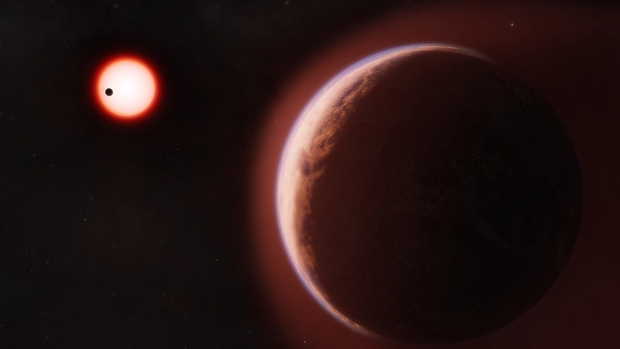
Image: In this artist’s rendering, the exoplanet LHS 1140 b is shown in the foreground, surrounded by a helium-rich atmosphere. Another nearby rocky planet orbits the same cool red dwarf star in the distance. This new study provides the strongest evidence yet that LHS 1140 b has retained an atmosphere. Credit: Carnegie Science.
Colin Cherubim (Harvard University), lead author of the paper in Science, points out that this is the first detection of an atmosphere on a rocky planet in the habitable zone of any star. Nice work, as Cherubim’s team had predicted precisely this mechanism in the LHS 1140 system. Escaping gases may indeed be a useful tool as we press on with more detailed investigations of planetary atmospheres on smaller, more Earth-like worlds.
The paper is Cherubim et al., “Helium escaping from the atmosphere of a nearby rocky exoplanet orbiting in a habitable zone,” Science 16 July 2026. Full text.

Moon or Planet? The Awkward Case of CD-35 2722B
Problems of definition will long be with us as we take ever closer looks at exoplanets. But they’re suddenly on everyone’s mind because of the detection of what some are calling an ‘exomoon’ in the system CD-35 2722, found in the constellation Columba. The primary in this system is an M-dwarf thought to be 50–200 million years old. I imagine there is no shortage of flare activity on this star, although the paper doesn’t get into that. The interesting finding in this work just published in Nature is expressed in its title: “Planetary-Mass Exosatellite Detected Around a Star’s Substellar Companion.”
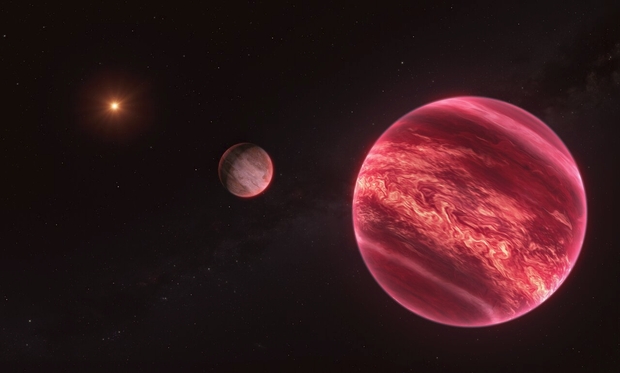
Image: This illustration shows the system around the star CD-35 2722, with the newly found moon-like object at the centre. The star –– the point source to the left –– has about half the mass of our Sun, and it is orbited by a brown dwarf, the reddish-brown object seen here in the foreground (right). The brown dwarf has about 37 times the mass of Jupiter: too massive to be a planet, but not massive enough to have sustained nuclear fusion like stars. This brown dwarf is, in turn, orbited by a newly discovered object at least as massive as Jupiter, seen at the centre of this image. This new object, found with ESO’s Very Large Telescope (VLT), is difficult to label. It behaves like a moon in the sense that it orbits an object that orbits a star. But this ‘moon’ is massive enough to be a planet, and the object it orbits, a brown dwarf, is neither a planet nor a star. Credit: ESO.
So is this the first solid detection of a ‘exomoon’? I can’t describe it as that, and ‘exosatellite’ is an awkward coinage. What we have here is an M-dwarf orbited by a brown dwarf about 30 times the mass of Jupiter. It is the brown dwarf, not the star, that is being orbited by a third object, evidently a gas giant with a minimum mass of 0.743 Jupiter masses. How this arrangement drives orbital mechanics of any other objects in this system (none have yet been found) is well worth pondering. For now, we see again the problem of definition.
Kevin Hoy (Universidad Diego Portales, Chile) is lead author of the paper on this work:
“This system is somewhat hard to define using Solar-System-based words like ‘planet’ and ‘moon’. The exosatellite is clearly massive enough to be a planet, but it does not orbit a star, though it orbits an object that orbits a star. Being the third wheel in this system makes us want to call it a moon, even if it is nothing like the small, rocky moons we have in our system.”
I think this discovery is straightforward. The object around brown dwarf CD−35 2722B fully qualifies as a planet. Brown dwarfs cannot sustain stable hydrogen fusion in their core for any length of time, so that they’re basically ‘failed stars’ that are cooling down throughout their lifetimes. Even if we demand that the term ‘star’ be defined by hydrogen burning, then whatever category we create to include brown dwarfs is clearly one that can sustain planets around it.
I’m seeing a lot of chatter about this detection, but let’s leave ‘exomoon’ out of the discussion. Anyway, it’s also interesting to see that brown dwarf CD−35 2722B has been directly imaged, as reported in 2011 in The Astrophysical Journal (citation below). Directly imaged planets are still a rarity.
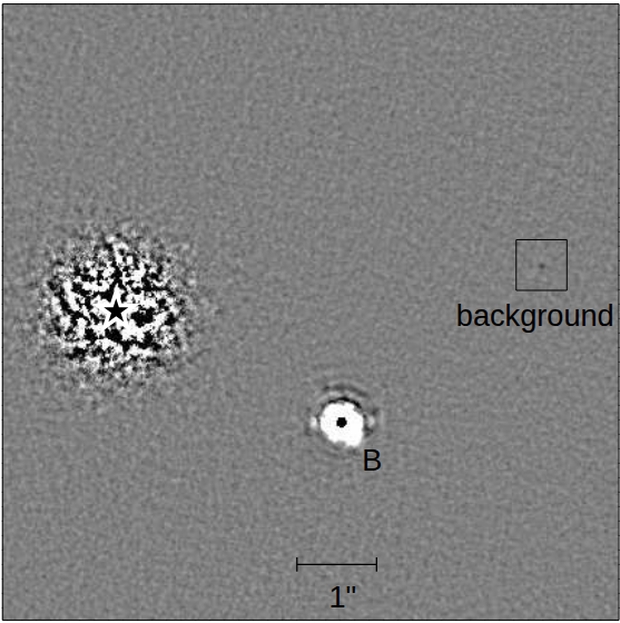
Image: The discovery image of CD-35 2722B, the brown dwarf in this intriguing system. Credit: Wahhaj et al. 2011, ApJ 729, 139.
So this is an intriguing find, and it also points to our continuing inability to locate what could indisputably be called an ‘exomoon,’ though the HD 206893 system continues to be interesting as a possibility for further research. Until we have a confirmed exomoon, though, this odd configuration will have to do. It reminds me as well that as our explorations continue, we still find how unusual our own Solar System is. Looking for commonality between different star systems, we find over and over again that any facile Copernican notion that we live in an ordinary stellar environment continues to be proven wrong.
Indeed, just what constitutes an ‘ordinary’ stellar system? The beauty of this work is that we seem to find surprises almost everywhere we turn.
The paper is Hoy et al., “Planetary-mass exosatellite detected around the substellar companion of a star,” Nature 16 July 2026. Full text. The discovery paper for CD-35 2722B is Wahhaj et al., “The Gemini NICI Planet-Finding Campaign: Discovery of a substellar L dwarf companion to the nearby young M dwarf CD−35 2722. The Astrophysical Journal 729(2), (2011), 139. Full text.
New Propulsion Systems for Deep Space Smallsats
Building the infrastructure we will need for interstellar exploration requires an imaginative look at today’s technologies as applied to distant targets. Indeed, we can leverage the scientific interest in, say, an orbit around each of the ice giants to explore launch capabilities through beamed energy, but we will also need to consider how we can use economical smallsats to provide stationkeeping nodes in such studies. Advances in miniaturization and the growing sophistication of CubeSats all point in the same direction. We can exploit our early flybys by fleshing out an observational smallsat matrix around targets at system’s edge to form a robust data and communications network.
The thing that is going to vitalize the development of small satellite packages is a new kind of propulsion system of the sort recently developed at MIT. The problem is easily stated: A small spacecraft – think suitcase size or less – has to maximize payload while ensuring flexibility in adjusting trajectory or tweaking orbital parameters. Chemical thrusters can give you rapid maneuvers and orbital insertion while electrical thrusters can produce low-thrust for long-haul cruise purposes or stationkeeping. Both systems are bulky, which has led to the kind of trade-off that is holding back smallsats for longer deep space missions.
The MIT work, discussed in a recent paper in the Journal of Propulsion and Power, describes a way to combine both types of thruster by extending existing ‘electrospray’ thrusters into the realm of chemical propulsion. Electrospray technology was used successfully on the LISA Pathfinder mission in 2015, which was essentially a demonstrator mission to study the detection of gravitational waves. The tiny thrusters could produce thrust in minute increments that allowed the spacecraft to maintain position without introducing vibrations. Observations that are ‘jitter-free’ become possible..
The basic electrostatic thruster can be the size of a small coin or a computer chip. An electric field acts on a propellant – a conductive liquid – which is being fed to each thruster, the latter sitting on top of a reservoir of the propellant.
Let’s pause for a moment on the conductive liquid, which the paper refers to as an ‘ionic liquid. ‘ I’m seeing these described as a liquid salt at room temperature. The liquid is made up of negative and positive ions without a neutral solvent, which makes the fluid electrically conductive. In other words, there is no need to ionize the propellant. The idea is simply to pull the ions out of the ionic liquid using an electrical field. A storage benefit also accrues: These liquids are non-evaporative and can be stored without pressurized tanks or seals. The electric field charges a specified amount of ions, which are then channeled out of the reservoir through the thruster tips as a spray.
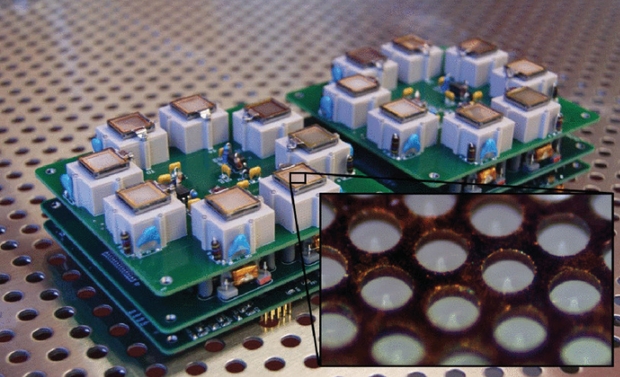
Image: These four flight unit electrospray thrusters were delivered by MIT Space Propulsion Laboratory to NASA for the upcoming Green Propulsion Dual Mode (GPDM) mission. Insert: The emitter arrays. Image credit: Amelia Bruno.
So we know that electrospray thrusters work. Moreover, the method is scalable, allowing thrusters to work in tandem for larger missions. Being able to combine this technology with more powerful chemical methods dramatically extends the possibilities for missions to other planets without the thrust penalty of conventional electrical propulsion systems. Amelia Bruno (MIT Department of Aeronautics and Astronautics) is lead author of the new paper:
“If you can have chemical and electrical propulsion in one small package, it’s the best of both worlds. This opens the door for small satellites to do even more science, more observations, and more interesting missions, all on a smaller and cheaper platform.”
The step forward here is the discovery that a chemical propellant can work with the same system and deliver higher levels of thrust when needed. It’s two propulsion methods working off the same tank of propellant. MIT has introduced a ‘green’ monopropellant developed originally by the US Air Force for chemical propulsion. Called ASCENT (Advanced Spacecraft Energetic Non-Toxic), the ionic liquid propellant is free of the health hazards of hydrazine for those working with it – hence the ‘green’ in the above reference. In this case, green means lower overall costs with fewer environmental liabilities.
The flight demonstrator that grows out of this is called the Green Propulsion Dual Mode (GPDM) mission. Scheduled for launch in November of this year, the mission is to be the first in-space checkout of this form of propulsion, testing the switching from chemical combustion mode to electromagnetic acceleration mode. A single propellant tank will feed the chemical thruster as well as the array of four electrospray thrusters. A Falcon 9 launch vehicle will deploy the 6U CubeSat with the new propellant onboard as a secondary payload.
Recent tests have shown that electrospray thrusters fueled with ASCENT operate successfully over periods lasting up to 100 hours and although the propellant was originally designed for chemical propulsion, it turns out to be just as efficient as the various ionic liquids the team has experimented with in their electric thrusters. Thus a single tank of fuel aboard a CubeSat can be used to produce both chemical and electrical propulsion in a compact system. No previous satellite has ever been designed with a shared propellant tank.
Paulo Lozano is a professor of aeronautics and astronautics at MIT:
“We could send CubeSats to Mars, or the asteroid belt, where they could make the journey slowly, using electrospray thrusters. You could then use your chemical thrusters to quickly move to look at interesting features. You could have a lot more flexibility to do a lot more things.”
Marshall Space Flight Center leads the the Green Propulsion Dual Mode mission, with MIT supplying hardware and subsystems, along with Georgia Tech. The NASA Small Spacecraft & Distributed Systems (SSDS) program manages the GPDM project. Keep an eye on this program.
The paper is Bruno et al., “Performance Characterization of Electrospray Thrusters with Energetic Ionic Liquid Monopropellant,” Journal of Propulsion | Power published online 31 May 2026 (abstract). Also available is Tong et al., “Mission Architecture for the Green Propulsion Dual Mode Mission,” presented at the 38th Annual Small Satellite Conference and available here.
What the Comments Taught Me: A Reply on Self-Replicating Probes
Self-replicating probes continue to be a controversial subject, just as they were when Frank Tipler up the ante on Michael Hart by invoking them as a way of further tightening the tension of the Fermi Paradox. After all, Tipler had discovered an economic edge. Any civilization that wants to colonize the galaxy is going to expend vast resources, but if self-replication is available, that culture need only create the first probe, and let subsequent ones harvest resources as needed. Self-replication or not, the galaxy gets filled up in only a fraction of the current age of the Milky Way, but the economic stimulus provides yet another tightening of the Fermi knot. I hadn’t thought about all of this in connection with actual probe designs, but Peter Marinko’s article on the matter clearly touched a nerve, judging from the messages I’ve been getting about it. When Peter wrote recently with his thoughts on reader reactions, I asked him for permission to run it as a regular post rather than a comment, because I think this is a lively question and would like to see us continue to explore it.
by Peter Marinko
My previous post here, “A Metallurgist’s Doubts About Self-Replicating Probes,” argued that von Neumann probes are constrained less by physics than by process-chain closure and materials aging. The discussion that followed sharpened my thinking more than the original post did, and I want to begin by paying some of that debt.
On carbon: Adam Crowl supplied the numbers I should have had at hand: carbonaceous chondrites run some 3–5% organics, dormant comets are thought to be coated in hydrocarbon-rich asphalt, and Freitas’s study considered Titan — an organics-drenched world — alongside the Moon. Alex Tolley added the wider inventory: aromatics, CO, CO₂, CH₄, hydrogen-rich giant atmospheres, and tholins — the reddish-brown organic polymers, first named by Sagan, that form when ultraviolet light and charged particles work on simple molecules like methane and nitrogen, and that coat Titan, Pluto, and many cometary surfaces.
I accept the correction. Carbon is not scarce in the cosmos. But availability is not accessibility: 3–5% organics dispersed through a chondrite is a feedstock concentration problem, and concentration is exactly the step that has no gravity, no water, and no atmosphere to help it. What the correction really did was promote carbon from an afterthought to a criterion — as the reader will see below, three independent process chains now demand it.
On refractories: Alex Tolley and John both pointed to the same escape: induction heating with magnetic levitation, melting metal without touching a crucible at all. This is a genuinely good answer, and I concede it for the class of operations it covers — melting and casting nickel-iron, which asteroids supply free of charge. But it is not free, and the price is paid in the currency this study cares most about. A levitated melt has its entire surface exposed, and it radiates as T⁴. A crucible is not merely a container; it is insulation. Remove it and the induction coil must continuously replace radiative losses that a lined furnace would simply have prevented. In an exergy ledger, that is a permanent tax on every kilogram melted.
Nor does levitation cover reduction. Extracting metal from oxide requires a hot, chemically aggressive, contained environment, and containment is where linings live. Here I owe the discussion a nuance from my own field that I should have raised myself: melting is not the only route. Iron oxide can be reduced in the solid state, producing iron powder which is then pressed and sintered to finished shape — this is how Höganäs in Sweden has made metal powder for decades, and it is how tungsten-carbide drill inserts are produced. Powder metallurgy skips the melt entirely, which is a real advantage for a probe: no crucible, no tapping, no casting. But it does not escape the problem. Solid-state reduction needs long tunnel furnaces, a reducing atmosphere of hydrogen, carbon, or carbon monoxide, and sustained high temperature — and those furnaces need linings too. The refractory bootstrap survives every route I know how to draw.

Image: PG: I sometimes wonder what John von Neumann would say if he could see the length and depth of the debate over self-replicating interstellar probes. To my knowledge, he never considered self-replication in the context of star systems and certainly not colonizing an entire galaxy. We could use his insights today: What are we missing? Credit: Physics Today, although this old photo is widely available and I don’t know its origin.
Abelard Lindsey, writing from inside the industry, put the honest bound on it: difficult, but perhaps a decade or two of development. That is a fair estimate, and it belongs in the ledger as a research task rather than a wall.
On semiconductors: Lindsey and I are in violent agreement: this is the hard one, and he notes it must be solved on Earth as well before AI becomes cheap. “Building chips rather than carving them,” as he puts it, is the holy grail. I have no better idea, and I am not going to pretend otherwise.
On the mother-factory: Tolley’s most interesting move was to propose a way around closure rather than through it: a factory ship that travels star to star, spawning non-replicating probes from local resources, populating the galaxy more slowly but without ever needing full self-reproduction. I want to be clear that this is a good idea — and also that it concedes my central point. A mother-factory does not close the loop; it carries the fraction it cannot produce, and expands until that stock is exhausted. It converts an infinite-generation architecture into a finite one, and the number of generations it buys is precisely the vitamin inventory divided by the vitamins per copy. That is not a refutation of the closure argument. It is the closure argument, written as a mission design. The right question becomes: how many nodes does the stock buy? That number is computable, and Hephaistos is built to compute it.
On life: The deepest challenge came from Henry Cordova and Elisee Reclus, and it deserves more than a nod, because it attacks my framing rather than my arithmetic: robust self-replicating systems demonstrably exist, cover the Earth, and arose without design. If biology can do it, why not machines?
Here is my answer, and it is the reason I am not moving the goalposts. Life is not a counterexample to the closure problem; life is what closure looks like when you pay its actual price. A cell does not manufacture bearings to micron tolerance, does not need vacuum, does not require phase-pure silicon or reference metrology, and above all does not need to specify its output. It tolerates enormous error, discards most of its offspring, and lets selection curate the survivors — over billions of years, in a medium (liquid water, at moderate temperature, with an atmosphere and a gravity well) that supplies concentration and transport for free. Biology bought replication by abandoning precision, determinism, and speed, and by spending geological time as its currency.
A von Neumann probe cannot make that trade. It must arrive at a specified place, build a specified artifact to specified tolerances, and do so in decades. The moment we relax those requirements enough for a biological strategy to work — accept vast error, accept mostly-failed offspring, accept deep time — we no longer have an engineering project; we have seeded a biosphere and lost the ability to say what it will become. That may be a defensible thing to do. It is not the thing anyone is proposing when they invoke probes crossing the galaxy in a few hundred thousand years.
So I take the biological objection seriously, and my conclusion from it is not optimism but a sharper statement of the problem: self-replication is cheap if you can pay in error and time, and murderously expensive if you must pay in precision and schedule. The exergy ledger below is an attempt to price the second option honestly.
Where this goes next:
Skepticism is cheap. The honest next step, for a critic who spent a career in industrial process engineering, is to try to make the thing work — on paper, with real process chains and mass balances — and see exactly where it breaks.
That is what I am now attempting, in a study I am calling Project Hephaistos, after the god who forged automata for Olympus: a virtual self-replicating probe, audited line by line, where every assumption and every capitulation is logged in public. Two ledgers run through it. The Vitamin List records every component the probe cannot make for itself, with masses attached. The Exception Ledger records every problem I have deliberately set aside. I expect the second document to be the more valuable of the two.
In a future post I will set out the mission architecture, and the first trade study: whether it is better to send a probe slowly, with today’s technology, and let it fight fifty millennia of aging — or quickly, at a tenth of light speed, and let it fight the interstellar medium. Both, it turns out, are running the same race against the same opponent. Only the costume changes.
My thanks again to everyone who wrote in. Keep it coming — the ledger has room.
A Metallurgist’s Doubts About Self-Replicating Probes
Frank Tipler jolted the astrophysics community in 1980 when he introduced self-replicating interstellar probes into discussion of the Fermi Paradox. The mathematical model of self-replication came from John von Neumann, and was codified in 1966 (after von Neumann’s death) by Arthur Burks in Theory of Self-Reproducing Automata (1966). SF fans will also know of Fred Saberhagen’s berserker novels and short stories (the first appeared in 1963). I’ve found an even earlier SF reference but will leave that for a future post. Right now I want to introduce Peter Marinko, who today weighs in on self-replication and the problems therein. Based in Uppsala, Sweden Peter holds an M.Sc. in metallurgy and has a career background in industrial process engineering. He has studied SETI under Erik Zackrisson at Uppsala University, and his current work explores the thermodynamics of technological civilizations — including a manuscript on high-exergy technospheres and the longevity of detectable civilizations, currently under peer review at the International Journal of Astrobiology. A preprint is available on Zenodo.
by Peter Marinko
Discussions of von Neumann probes — here and elsewhere — tend to treat replication as a systems problem: the probe arrives, mines local material, and builds a copy of itself. The hard part is usually assumed to be propulsion, navigation, or AI. As someone who has spent a career in metallurgy and industrial process engineering, I would like to suggest that the hardest part is the one that gets a single sentence: “mines local material and builds a copy.”
Let me raise four concrete problem areas, in increasing order of difficulty.
1. Beneficiation without gravity, water, or atmosphere
“Asteroid mining” is a misleading phrase. Mining is the easy part; the problem is beneficiation — concentrating useful elements out of undifferentiated regolith. Every terrestrial concentration process relies on things an asteroid lacks: gravity-driven sedimentation, water-based flotation, density separation in fluids, atmospheric combustion. Electrostatic and magnetic separation in microgravity are conceivable in principle, but neither has been demonstrated at industrial scale, and both work poorly on the fine, cohesive, electrostatically charged dust that dominates regolith.
2. Reduction metallurgy without an industrial hinterland
All terrestrial metal production rests on an invisible foundation: carbon or hydrogen as reducing agents, fluxes, and — critically — refractory materials for the furnaces. Refractories are the forgotten enabling technology of civilization. A furnace lining must itself be manufactured, at high temperature, in a furnace. Bootstrapping this loop from raw regolith, with fully closed chemical cycles (no atmosphere to vent to, no water to waste), is a chicken-and-egg problem that no study I am aware of has worked through at the level of actual process flowsheets.
3. The closure problem, honestly accounted
The classic NASA study (Freitas et al., 1980) assumed ~90–96% “closure” — the fraction of its own components a system can reproduce — with the remainder supplied as “vitamins” from home. But the missing few percent are not marginal; they are precisely the hardest items: semiconductors, precision bearings, sensors, and insulation. Consider something as unglamorous as wire insulation. Virtually all electrical insulation on Earth is organic polymer, resting on a petrochemical industry, resting in turn on a biosphere that spent hundreds of millions of years concentrating carbon. Inorganic alternatives (glass fiber, ceramics, mica) exist but are brittle, heavy, and require entirely different process chains to apply to fine conductors. A modern semiconductor fab is arguably the most complex artifact humanity has built, drawing on tens of thousands of specialized inputs. Shrinking that into a 500 kg seed — or even Freitas’ original 100-ton seed — is not an engineering detail. It may be the entire problem.
4. Aging over interstellar timescales
Even a probe that could replicate must first arrive functional after a voyage of tens of thousands of years. We have essentially no empirical data on machine longevity beyond ~50 years (Voyager, surviving on redundancy and switched-off instruments). Over interstellar timescales, materials face cumulative radiation damage and lattice defects, embrittlement and transmutation; creep and solid-state diffusion (solder joints, thin films and interfaces are only kinetically frozen, not thermodynamically stable); tin and zinc whisker growth; outgassing and cold welding in vacuum. The repair systems age too. Replication must outrun degradation — and degradation never sleeps.
A thermodynamic framing
These four problems share a common structure. A self-replicating probe is, in effect, a miniaturized high-exergy technosphere that must rebuild its entire exergy cascade — from raw, unconcentrated feedstock to precision components — at every node, before its own irreversible degradation catches up. The feasibility question is then not “does physics forbid it? (it does not) but “can accessible exergy per node sustain full process closure faster than irreversible losses accumulate?
This is the same ratio, I would argue, that governs the longevity of detectable civilizations generally — a question I explore in a recent preprint on the thermodynamics of technological civilizations. But the probe case is a cleaner test, because the system boundary is sharp and the accounting is (in principle) tractable.
Questions for discussion
1. Has anyone attempted an actual process flowsheet — not a block diagram — for closing even a simple metallurgical loop (say, iron from chondritic material to finished machine parts) without terrestrial inputs?
2. Is there a credible inorganic-only pathway for electrical insulation and semiconductor packaging?
3. What is the realistic closure fraction if “vitamins” are disallowed — and does the seed mass then grow beyond anything launchable?
4. Are there materials strategies (amorphous metals? self-annealing designs?) that could plausibly survive 10,000+ years of transit?
My suspicion, as a practitioner, is that von Neumann probes are constrained not by the laws of physics but by process-chain closure and materials aging — both, at root, thermodynamic limits. If that is right, it bears directly on the Fermi paradox: the galaxy may be quiet not because nobody tried, but because replication is harder than arithmetic suggests.
I would be glad to be proven wrong on any specific point above — ideally with a flowsheet.
New Horizons: Pushing Toward the ‘Termination Shock’
Mission planning for any future star probe will adjust not only for conditions in the interstellar medium but also the Solar System’s outer reaches. Let’s confine ourselves for now to conditions in the outer heliosphere. Currently we have precisely one spacecraft operating here. New Horizons has only reached 65 AU from the Sun, while Voyager 1 exited the heliopause in 2012 at 121 AU, and Voyager 2 crossed in 2018 at about 119 AU. New Horizons won’t have sufficient power to keep taking data as it makes its own crossing in the 2040s, but from its current position in the Kuiper Belt we can look back at what the spacecraft has reported so far about the solar wind and the local interstellar medium.
New Horizons’ Solar Wind Around Pluto (SWAP) instrument is the key here, examining how the solar wind slows as we leave the inner system behind. A new study from Southwest Research Institute (SwRI) points out what happens as this stream of hot ionized hydrogen and helium nuclei fills the heliosphere. The wind’s speed varies, some 300 to 500 kilometers per second from sources near the solar equator and up to 600-800 km/s from regions near the corona.
You would expect this ‘wind’ to cool as it begins to push against the interstellar medium, and indeed it does, forming the termination shock that both Voyagers have penetrated and crossed, and toward which New Horizons now moves. It’s at the termination shock that we see a sharp drop in the solar wind speed that indicates the outer boundary, the heliopause, is approaching. New Horizons should still be functional when it reaches the termination shock, conceivably as early as the end of this decade. Voyager 1 found it at 94 AU, Voyager 2 at 84 AU, reminding us how malleable the heliosphere is as its outer boundaries adjust to the onset of interstellar plasma.
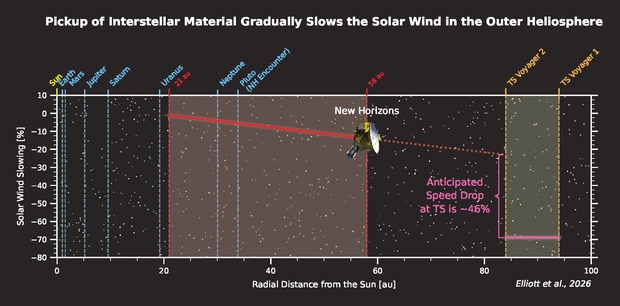
Image: An SwRI-led study sheds light on the deceleration of the solar wind as it journeys away from the Sun and interacts with and picks up interstellar material. NASA’s New Horizons spacecraft measured the solar wind as it traveled from just beyond Uranus’ orbit into the outer Kuiper Belt (red shaded region), detailing the gradual slowdown caused by interactions with interstellar materials (red line). Credit: SwRI.
We can learn a great deal as we accumulate data on solar wind interactions in the outer heliosphere. SwRI’s Heather Elliott led the study. Says Elliott:
“Eventually, the solar wind reaches the outer boundaries of the heliosphere — the sphere of influence where the solar wind affects the space environment — where it interacts with incoming interstellar material. The shape and properties of these heliospheric boundaries control the amount of Galactic Cosmic Rays (GCRs) that can enter our solar system and reach Earth. Therefore, the data from New Horizons combined with observations from other missions, such as IBEX, IMAP and Voyager will enhance our understanding of the edge of the solar system.”
So far, the data have been useful as New Horizons keeps moving outward. Along the way, the solar wind begins to run into neutral gas particles that have entered the heliosphere from the outside interstellar medium. The interaction with the solar wind, in which these atoms become ionized, adds mass to the solar wind, Elliott adds. And that is the mechanism for slowing the wind down.
In previous years, we have learned that between 30 and 43 AU, the solar wind has slowed 5 to 10 percent in comparison to its value near Earth. This is from data not only from New Horizons but also Voyager 2. Assuming New Horizons is still operational when it hits the termination shock, we would expect to see a sharp drop in the speed of the solar wind. In fact, Voyager 2 found a 46 percent drop in speed at the termination shock at its distance of 84 AU.
And note this from the paper:
The drop in speed in the Voyager 2 TS [termination shock] measurements was dramatic. At the Voyager 2 TS crossing, the speed went from ∼320 down to ∼140 km s−1 a few days after the crossing, corresponding to a ∼ 56% speed reduction across the TS (J. D. Richardson & E. C. Stone 2009). A sudden speed drop of 56% would be large and steep enough to readily confirm that NH crossed the TS. Unlike Voyager 2, the SWAP instrument on NH also measures interstellar hydrogen pickup ions, such that the modification of the TS by the interstellar pickup ions will be measured at the upcoming NH TS crossing.
As a sidenote, it’s worth remembering that there is no clear boundary here. Indeed, the shape of the entire heliosphere flexes and churns in response to ambient conditions and thus is partially dependent on the clouds of interstellar material the Sun is moving through at the time. At present, we are in the whimsically named ‘Local Fluff,’ part of the Local Interstellar Cloud, and near or perhaps already edging into a region called the G-Cloud, a prominent citizen of which is the system called Alpha Centauri. In any case, we’ve learned from the IBEX (Interstellar Boundary Explorer) satellite that the interactions on the heliosphere paint a picture of a dynamic, changing shape as opposed to the smooth ‘bubble’ that is often depicted in artist renderings of the heliosphere.
IBEX and its successor satellite IMAP (Interstellar Mapping and Acceleration Probe) carry an interesting message of their own: We can continue to learn without having an actual set of instruments on the scene. In sharp contrast to New Horizons, these two spacecraft work by remote sensing, detecting energetic neutral atoms (ENAs) produced in the interaction of the solar wind with neutral atoms at the heliopause. So we have one satellite in a highly elliptical Earth orbit (IBEX) and another at the L1 Lagrange point, both of them helping us to understand conditions at the termination shock and beyond.
As Elliott pointed out in that first quote above, conditions in the heliosphere’s boundary with the LISM matter if for nothing else because of the dangers posed by Galactic Cosmic Rays (GCRs), leading to issues of spacecraft design both for manned as well as unmanned missions. It’s good to know that New Horizons is on the case and will remain so, but for how long? What I’m hearing is that the spacecraft’s Radioisotope Thermoelectric Generator (RTG) should be able to keep observations and return of data robust through the end of this decade, but as with the Voyagers, we’re moving toward the end of active life.
What will replace our one source in the outer heliosphere? The need for resources in and beyond the Kuiper Belt should have us moving toward mission designs and propulsion options that go beyond chemical methods. Sail missions like the Solar Gravitational Lens mission now being developed at the Jet Propulsion Laboratory continue to intrigue me, particularly as we begin to explore assembly options enroute to deliver the largest possible payload. We will need precursor ‘sundiver’ missions as we test out these technologies.
The paper is Elliott, “The Gradual Slowing of the Solar Wind in the Outer Heliosphere,” The Astrophysical Journal, Vol. 1001, Number 1 (3 April 2026). Full text.