
The conference of the Division for Planetary Sciences of the American Astronomical Society continues in Louisville. Among the papers presented at today’s Advanced Propulsion session were three of particular interest for interstellar advocates.
Les Johnson, who heads up NASA’s In-Space Propulsion Technology Program, gave an overview on the technology portfolio now being examined. “Some of the most promising technologies for achieving these goals use the environment of space itself for energy and propulsion and are generically called, ‘propellantless’ because they do not require on-board fuel to achieve thrust,” Johnson wrote in a precis of the talk. “Propellantless propulsion technologies include scientific innovations such as solar sails, electrodynamic and momentum transfer tethers, aeroassist, and aerocapture.” Both solar sails and aerocapture are candidates for flight validation as early as 2008.
Two other presentations of particular note: “Solar Sail Propulsion: A Simple, Propellantless, Rapidly Maturing Technology, ” E. E. Montgomery, L. Johnson, R. M. Young, J. B. Presson (NASA MSFC), C. Adams (Gray Research, Inc.), and…
“Emerging Propulsion Technologies,” J. A. Bonometti (NASA MSFC). This one examines so-called ‘tether-based propulsion,’ another propellantless concept that taps the Earth’s magnetic field and solar power to propel spacecraft. Think of miles of cable rotating like an enormous sling, scooping up spacecraft and flinging them into higher orbits.
Here’s more on Momentum-Exchange Tether Propulsion (MXER) from the project home page:
Momentum-exchange tether propulsion transfers momentum from one object to another by briefly linking a slow-moving object with a faster one. Much the same way ice skaters play “crack the whip,” the slower object’s speed could be dramatically increased as momentum and energy is transferred to it from the faster object. Similarly, a spinning tether facility in an elliptical Earth orbit might snare slower-moving spacecraft in low-Earth orbit and throw them into much higher-energy orbits.
NASA researchers currently are developing the technologies needed to realize this advanced form of propulsion. The “Momentum-Exchange Electrodynamic Reboost” tether propulsion system, or MXER tether, could use momentum-exchange to transfer satellites from low-Earth orbit to geosynchronous transfer orbit — an elliptical orbit stretching from 200 miles out to 22,300 miles above the equator — and beyond. After throwing the payload, the MXER tether would then use energy collected from solar panels to drive electrical current through the tether. The Earth’s magnetic field would push against the current and reboost the tether’s orbit, restoring the energy that was transferred to the payload.
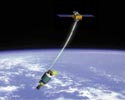 MXER would use a tether some 100 to 150 kilometers (62 to 93 miles) in length, made from a lightweight, insulated conductive material that could carry electrical current as needed to reboost the tether. This stuff is tricky, but the Web page cited above provides some helpful animations. And check this fact sheet from Marshall Space Flight Center on tether concepts (PDF warning).
When I talked to Les Johnson at Marshall Space Flight Center in Huntsville about MXER, he pointed out how early in the game we still are: “Rendezvous and capture are big issues for MXER,” Johnson said. And so is the accuracy with which you release the payload on the right trajectory. How do you do that on a big non-rigid structure that’s rotating? There are lot of problems still to be resolved… I would put MXER at the same level of understanding right now that we have of the plasma sail. But is this promising technology? Absolutely.”
Tethers Unlimited (Bothell, WA), from whose Web page the above image is drawn, is deeply involved in this work; TUI was founded in 1994 by Robert Forward and Robert P. Hoyt, and was the place where Forward spent the last of his seemingly inexhaustible energy before his untimely death in 2002. Tethers don’t help us with interstellar propulsion, but they do point to where the action is: finding ways to circumvent the mass ratio problem by leaving the fuel behind. Hence the beauty of the solar sail (and laser-pushed lightsail) — the spacecraft has no need for bulky fuel supplies and can carry more payload.
A complete schedule of upcoming talks at the Louisville conference is here.

0 Comments