
New photos from the Very Large Telescope at Paranal in the Chilean Andes have made it possible to measure the mass of a young object orbiting the star AB Doradus A. The low-mass companion to the star has been under study since the early 1990s, when the characteristic wobble of the parent star suggested a faint companion, either a planet or a brown dwarf. Using a high-contrast camera equipped with adaptive optics, the University of Arizona’s Laird Close has now brought home photographs and measurements of the companion known as AB Dor C (click on the image to enlarge).
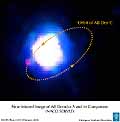 Image: ESO PR Photo 03/05 is an enhanced, false-colour near-infrared image of AB Dor A and C. The faint companion “AB Dor C” – seen as the pink dot at 8 o’clock – is 120 times fainter than its primary star. The tiny separation between A and C, only 0.156 arcsec, is smaller than a one Euro coin seen at 20 km distance. Nevertheless, the new NACO SDI camera was able to distinguish it as a “redder” dot surrounded by the “bluer” light from AB Dor A. The orbit of AB Dor C around AB Dor A is shown as a yellow ellipse. It takes 11.75 years for the 93 Jupiter-mass companion to complete this orbit.
AD Doradus A is 48 light years away, its nearness to Earth an advantage in trying to detect faint, young objects. And this object is faint indeed, 120 times fainter than its parent (Hubble tried to detect it but failed). Its current position is approximately 2.3 AU from AB Doradus A, and it completes an orbit every 11.75 years. By relating the object’s location to the star’s known wobble, Close’s team could calculate its mass, which turns out to be roughly one-tenth the mass of the host star, or 93 times more massive than Jupiter. That puts AB Dor C just above brown dwarf territory. A brown dwarf is considered a failed star, too small for normal stellar fusion.
What’s intriguing about these findings — and this is the first time anyone has been able to measure the mass of a young, low-mass object this close to a star — is that AB Dor C’s mass challenges our views of brown dwarfs. As Close puts it: “We were surprised to find that the companion was 400 degrees (Celsius) cooler and 2.5 times fainter than the most recent models predict for an object of this mass. Theory predicts that this low-mass, cool object would be about 50 Jupiter masses. But theory is incorrect: this object is indeed between 88 to 98 Jupiter masses.”
If objects previously identified as brown dwarfs are in fact more massive than previously believed, then they must be low-mass stars rather than brown dwarfs. Also put into question are extrasolar planets not associated with any star, which may turn out to be not ‘free-floating planets’ but small brown dwarfs. Refining the mass model thus changes our view of both the stellar and planetary population.
Source: Close, Lenzen et.al. “A dynamical calibration of the mass-luminosity relation at very low stellar masses and young ages,” Nature 433, 286-289 (20 Jan 2005). An abstract is available here. For more on the adaptive optics camera used in this work, check here.
0 Comments