
Surprise at Enceladus

by | Mar 19, 2005 | Outer Solar System

How does a moon that would fit within the state boundaries of Arizona manage to hold an atmosphere? That’s the question following Cassini’s most recent flyby of Enceladus. The spacecraft found magnetic field oscillations that scientists now attribute to ionized water vapor. The odd magnetic field signature has shown up on both Cassini flybys, the second of which, on March 9, came to within 500 kilometers of the Saturnian moon’s surface.
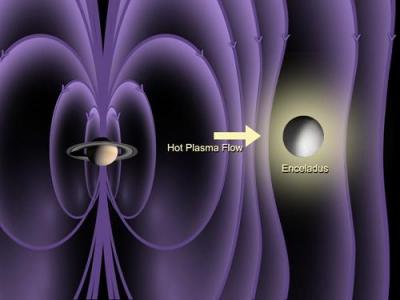
Atmosphere of Enceladus diagrammed

Image: This artist conception shows the detection of an atmosphere on Saturn’s icy moon Enceladus. The Cassini magnetometer instrument is designed to measure the magnitude and direction of the magnetic fields of Saturn and its moons. During Cassini’s two close flybys of Enceladus — Feb. 17 and March 9 — the instrument detected a bending of the magnetic field around Enceladus. Credit: NASA/JPL.

Because Enceladus is too small to hold an atmosphere for long, a continuous source of replenishment is suspected. The most likely candidate: volcanoes or geysers, which have been found elsewhere in the Solar System on Jupiter’s moon Io and Neptune’s moon Triton. “Enceladus,” says Dr. Fritz Neubauer, co-investigator for the Cassini magnetometer, and a professor at the University of Cologne in Germany, “could be Saturn’s more benign counterpart to Jupiter’s dramatic Io.” And ‘ice volcanoes’ could explain the remarkably high reflectivity of the moon as ice particles are continuously deposited on the surface. Enceladus reflects 90 percent of the light that hits it.

More on the Enceladus findings in this JPL news release.

0 Comments

Now Reading

Charter

In Centauri Dreams, Paul Gilster looks at peer-reviewed research on deep space exploration, with an eye toward interstellar possibilities. For many years this site coordinated its efforts with the Tau Zero Foundation. It now serves as an independent forum for deep space news and ideas. In the logo above, the leftmost star is Alpha Centauri, a triple system closer than any other star, and a primary target for early interstellar probes. To its right is Beta Centauri (not a part of the Alpha Centauri system), with Beta, Gamma, Delta and Epsilon Crucis, stars in the Southern Cross, visible at the far right (image courtesy of Marco Lorenzi).

Recent Posts

On Comments

If you'd like to submit a comment for possible publication on Centauri Dreams, I will be glad to consider it. The primary criterion is that comments contribute meaningfully to the debate. Among other criteria for selection: Comments must be on topic, directly related to the post in question, must use appropriate language, and must not be abusive to others. Civility counts. In addition, a valid email address is required for a comment to be considered. Centauri Dreams is emphatically not a soapbox for political or religious views submitted by individuals or organizations. Human comments only, please -- cut and paste from AI will not be acceptable. A long form of the policy can be viewed on the Administrative page. The short form is this: If your comment is not on topic and respectful to others, I'm probably not going to run it.


Advanced Propulsion Research

Beginning and End

Archives