
All the observing time on comet Tempel 1 as the Deep Impact spacecraft approaches is really paying off. Scrutinized by ground and space-based telescopes, the comet was seen to emit a small outburst of materials on June 14. Now Deep Impact has seen a much more massive ejection of ice and other particles that occurred on June 22. Although six times larger than the earlier one, the new outburst dissipated quickly, within about half a day.
Intriguingly, the spectrometer aboard Deep Impact showed that the amount of water vapor in the coma doubled during this event, while the amount of other gases, including carbon dioxide, increased even more. From a University of Maryland news release, quoting Michael A’Hearn, who leads the Deep Impact mission:
“Outbursts such as this may be a very common phenomenon on many comets, but they are rarely observed in sufficient detail to understand them because it is normally so difficult to obtain enough time on telescopes to discover such phenomena,” said A’Hearn. “We likely would have missed this exciting event, except that we are now getting almost continuous coverage of the comet with the spacecraft’s imaging and spectroscopy instruments.”
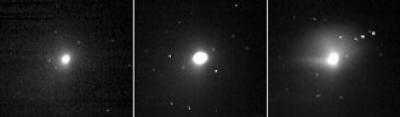
And the wonderfully named Jessica Sunshine, who works on the project for Science Applications International Corporation, noted that seeing significant activity twice in one week suggests that outbursts are common as comets heat up during their approach toward the inner Solar System. At this point, Tempel 1 is near perihelion, the point in its orbit at which it is closest to the Sun.
Image: Raw images taken by the medium resolution imager on the Deep Impact spacecraft. The images were acquired between June 22 and June 24, 2005. A brightening by a factor of about 5 and a rapid decay to baseline brightness were observed on June 22. As the comet moves through space, background stars pass in and out of the field of view. Cosmic rays hitting the spacecraft’s detector give an appearance of flickering. This is an artifact of space cameras that can be removed. Credit: NASA/JPL-Caltech/UMD.
Centauri Dreams‘ take: This mission is already producing superb science, with the spectrometer providing a solid analysis of the material these outbursts have ejected even at this distance. The prognosis for a successful encounter on July 4 is promising indeed. The crater that results from the collision of Deep Impact’s 820 pound impactor is expected to span hundreds of feet, with an accompanying ejection of ice, dust and gas that will reveal the primordial materials beneath. All told, we should know much more about the early Solar System after the Deep Impact collision.
And note what A’Hearn says about observing time above. While the improvements to ground-based telescopes have been extraordinary, observing rare phenomena with them is always subject to the intense demand for telescope time. There is no substitute for a spacecraft’s instruments on the scene when it comes to continuous observation.
About the spectrometer: Deep Impact’s instrument measures not visible but infrared light. But the principle is the same: take light that is scattered by materials like the dust and gas of the comet and break it into its spectrum. Doing this, you can determine the composition of the materials being ejected. The ‘flyby’ spacecraft will use medium and high resolution imagers along with the spectrometer to return data from the event.
A movie of the recent cometary outburst can be found here. The University of Maryland conducts the overall Deep Impact mission, with mission operations handled at the Jet Propulsion Laboratory.

0 Comments