
No one knows quite what to expect when the Deep Impact probe slams into comet Tempel 1, but countless amateur astronomers plan to be watching to see if the comet brightens following the collision. And it might, given the amount of material that could be dislodged by the event. A telescope or set of binoculars will probably be required, although dedicated skywatchers can still see the spot in the sky where the big event will occur even without the aid of such equipment.
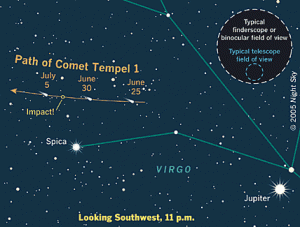 The time of impact is 1:52 EDT (0552 GMT) on the morning of July 4, a time when the comet will be best placed for viewing from the American southwest, although Kelly Beatty, executive editor of SKY & TELESCOPE magazine, is now saying that anyone west of the Mississippi has a good chance of seeing it. From a news release just issued by the magazine, here is where to look:
After dark, find Jupiter shining high in the southwest. It’s the brightest “star” in that part of the sky (brighter Venus sets in the west-northwest during dusk). Off to Jupiter’s left, by somewhat more than the width of your fist seen at arm’s length, is the fainter star Spica. The impact with the comet will happen a couple of finger-widths above Spica.
Image: You can find Comet Tempel 1 in binoculars or a telescope by looking near the planet Jupiter and the star Spica, as shown here. Night Sky illustration by Steven A. Simpson.
If you want to track the Deep Impact event on the Web, Kitt Peak National Observatory will offer a live feed starting about an hour before the event and extending 45 minutes afterward. The feed will consist of still images of the comet along with a frequently updated movie made up of individual frames. Each frame will be a 30-second exposure taken with an electronic CCD imager attached to the 20-inch Ritchey-Chretien telescope in the Kitt Peak Visitor Center observatory. You’ll be able to see the live comet feed here.
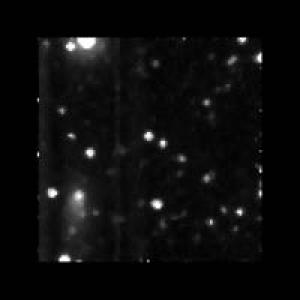 Also on the Deep Impact front, the European Space Agency’s Rosetta spacecraft is now tracking the comet visually. Rosetta’s navigation camera system was used to make the image shown here, which is actually a composite of 20 exposures of 30 seconds each. You can see the comet at the bottom left of the picture; it’s the faint object with the fuzzy tail. The faintest stars in this image are 13th magnitude; even the bright star to the upper left is 8th magnitude. Tempel 1 is at the detection limit of the cameras (image credit: ESA).
Rosetta, incidentally, is worth keeping an eye on. In ten years, it will have its own close encounter with the nucleus of comet 67P/Churyumov-Gerasimenko. Along the way, it will visit the asteroids Steins and Lutetia.

0 Comments