
The theories behind solar sailing go back a long way — some would trace them to the days of Kepler. But papers on actual mission design began to emerge only in the 1950s, when ‘Russell Saunders’ (the pseudonym of aeronautical engineer Carl Wiley) wrote a sail description for a 1951 issue of John Campbell’s Astounding Science Fiction. That paper was followed by Richard Garwin’s more technical analysis in a 1958 issue of the journal Jet Propulsion.
 Now another paper from that era has surfaced and is available online. T.P. Cotter’s “An Encomium on Solar Sailing” was produced in 1958 as an informal report for Los Alamos (originally no more than an office memorandum), and was issued in more comprehensive form in 1973. Cotter described his intent as not to break new ground but to fill in the details of the solar sail idea through an actual design, an unmanned sail mission to Mars.
The Cotter sail is a flat, circular disk some 10-4 cm thick and 500 meters in diameter. It is made of a plastic film coated on one side with 20 or 30 micrograms per square centimeter of aluminum. The sail is made in panels with reinforced seams to prevent tears. Pulling a 250 kg payload, the sail would be set spinning shortly after deployment. Here’s Cotter’s description of that process:
The capsule consists of two parts connected through a universal joint, and provided with a motor which now causes the sail package and the main part of the load to start counterrotating. At the appropriate times the collapsed structural backbone is extended, the capsule cases are jettisoned and the vehicle blossoms forth under centrifugal force… The sail is spinning at the rate of one revolution in two minutes. The load, two-thirds of which is suspended in three pods by wires at 50 meters from the axis of spin, is counter-rotating at a rate of 10 revolutions per minute. The vehicle as a whole has zero net angular momentum.
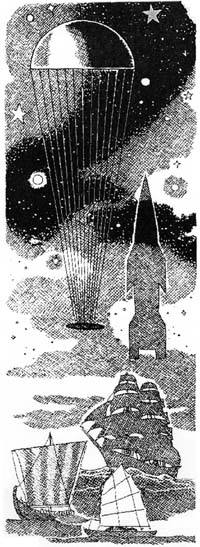
Image: The artwork for Carl Wiley’s article “Clipper Ships of Space,” which ran in 1951 in Astounding Science Fiction. Wiley’s was the first scientific paper on the topic of solar sailing and mission design.
Cotter notes that the ‘indefinitely sustained thrust’ of the sail simplifies interplanetary navigation enormously, for course correction capability is always present using a sail. “The penalty for a non-optimum trajectory or an actual navigational error is only to the flight time, which is hardly the case for a rocket operating with a small fuel margin.”
The Cotter paper is “An Encomium on Solar Sailing,” Report No. LA-5231-MS, May 1973. As I understand it, this was once a restricted access paper at Los Alamos, now declassified and made available through the Web site of the Federation of American Scientists. The two other papers mentioned above are Carl Wiley (Russell Saunders), “Clipper Ships of Space,” Astounding Science Fiction, May 1951, pp. 135ff and “Richard Garwin, “Solar Sailing: A Practical Method of Propulsion within the Solar System,” Jet Propulsion 28 (March 1958), pp. 188-90.

0 Comments