
Gravitational lenses of the sort discussed in yesterday’s post are now widely discussed. The idea that gravity can bend light may seem counterintuitive but we’ve seen numerous demonstrations of the effect, starting with the famous eclipse studied by Arthur Eddington in 1919. Hoping to test Einstein’s general theory of relativity, Eddington traveled to the island of Principe, off the coast of West Africa. There, despite initially cloudy skies, he was able to take the crucial photograph that verified Einstein. Stars in the Hyades Cluster that should have been blocked by the Sun were revealed in the image, offset by an amount close to that predicted by Einstein.
Some have questioned whether Eddington’s equipment was sufficiently precise to make accurate readings, but whatever the case, the bending of light as a result of gravity has stood up. Among the various images that show this effect in deep space, none is as dramatic as the one below. Here we’re looking at multiple bluish images of a galaxy which actually is found behind the foreground galactic cluster seen in yellow roughly in the center of the image. Look for images of this galaxy at 4, 8, 9 and 10 o’clock around the center of the cluster. There may be still other artifacts of the background galaxy elsewhere in the image. The cluster and the dark matter surrounding it are acting as a gravitational lens, one captured dramatically in this Hubble photograph.
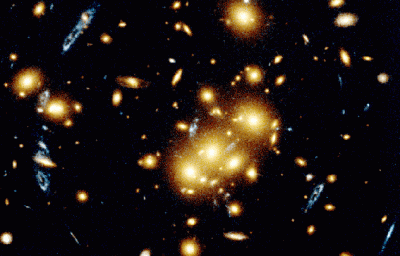
Image: A background galaxy viewed as multiple images, the effect of gravitational lensing caused by the foreground cluster of galaxies. Credit: W.N. Colley and E. Turner (Princeton University), J.A. Tyson (AT&T Bell Labs, Lucent Technologies), Hubble Space Telescope, and NASA.
Now ponder the possibilities for a spacecraft using the Sun’s gravity as a lens. At 550 AU, the probe could be positioned to examine a multitude of objects in various wavelengths, with unprecedented magnification provided by the lensing effect. FOCAL, the mission to the gravity focus championed by the Italian space scientist Claudio Maccone, could become one of the most significant space missions ever flown if we can overcome key technical and cultural challenges to make it happen. We’ll be examining those challenges in coming weeks.
0 Comments