
The Best View of Proxima Centauri

by | Dec 10, 2005 | Exoplanetary Science

Proxima Centauri is not exactly an imposing star. In fact, this tiny M-class red dwarf would not be noticeable even in the skies near Centauri A and B except for its huge parallax, an indication to local sky-watchers that it was in the vicinity and moving fast. Some astronomers have suggested that Alpha Centauri may, in fact, not be a triple-star system after all, that Proxima is simply an independent star passing through the neighborhood. But the jury is still out on that one.
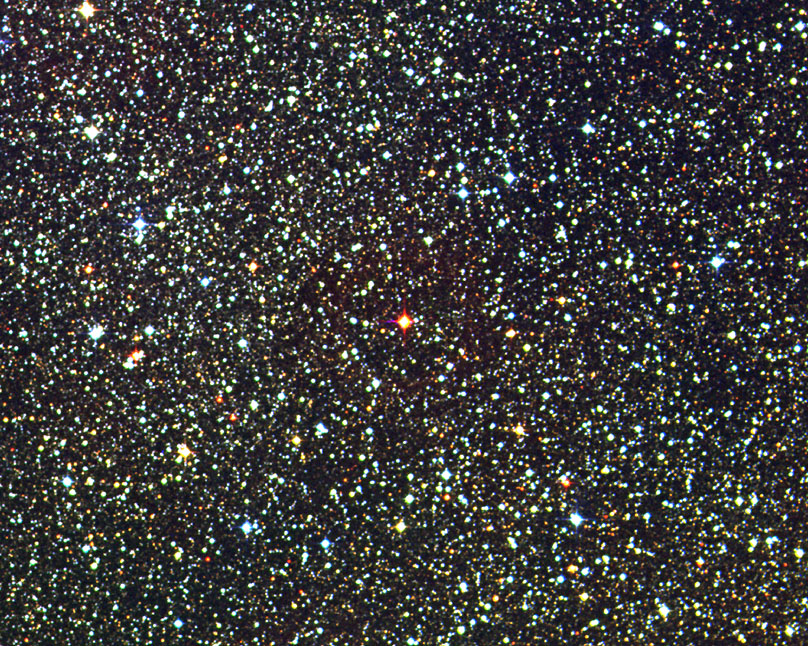
Proxima Centauri

Image credit & copyright: David Malin, UK Schmidt Telescope, DSS, AAO.

Nonetheless, the interest Proxima exerts is almost hypnotic, because at 4.22 light years, it is the closest of all known stars (Centauri Dreams leaves open the possible, and in my view likely, discovery of a red or brown dwarf even closer). The image above (click for a closeup) was selected by the good people at Goddard Space Flight Center as Astronomy Picture of the Day last week, and it’s the best image I’ve ever seen of the tiny star. You’ll find it in the dead center of the picture, a red flare star that invites curiosity and, we may hope, a future probe.

If the question of Proxima’s real position in the Alpha Centauri system intrigues you, the paper to consult is Robert Matthews and Gerard Gilmore, “Is Proxima Really in Orbit About Alpha CEN A/B?” Royal Astronomical Society Monthly Notices 261, no. 2 (1993), pages L5-L7.


0 Comments

Trackbacks/Pingbacks

  1. Centauri Dreams » Blog Archive » Viewing Alpha Centauri - [...] Last Saturday’s image of Proxima Centauri raised questions for several readers, who asked where Centauri A and B were…

Now Reading

Charter

In Centauri Dreams, Paul Gilster looks at peer-reviewed research on deep space exploration, with an eye toward interstellar possibilities. For many years this site coordinated its efforts with the Tau Zero Foundation. It now serves as an independent forum for deep space news and ideas. In the logo above, the leftmost star is Alpha Centauri, a triple system closer than any other star, and a primary target for early interstellar probes. To its right is Beta Centauri (not a part of the Alpha Centauri system), with Beta, Gamma, Delta and Epsilon Crucis, stars in the Southern Cross, visible at the far right (image courtesy of Marco Lorenzi).

Recent Posts

On Comments

If you'd like to submit a comment for possible publication on Centauri Dreams, I will be glad to consider it. The primary criterion is that comments contribute meaningfully to the debate. Among other criteria for selection: Comments must be on topic, directly related to the post in question, must use appropriate language, and must not be abusive to others. Civility counts. In addition, a valid email address is required for a comment to be considered. Centauri Dreams is emphatically not a soapbox for political or religious views submitted by individuals or organizations. Human comments only, please -- cut and paste from AI will not be acceptable. A long form of the policy can be viewed on the Administrative page. The short form is this: If your comment is not on topic and respectful to others, I'm probably not going to run it.


Advanced Propulsion Research

Beginning and End

Archives