
Gas giant moons like Europa offer the tantalizing hint of life-sustaining conditions, with oxygen supplied by their abundant ices. But without sufficient heat, how is the oxygen to be coaxed from their frozen surfaces? So far, the explanation has been that high-energy particles bombarding such a moon’s surface could help to release the gas, which would have already been molecularly bound with hydrogen.
But a study at the Pacific Northwest National Laboratory suggests a different explanation. Simulating high-energy bombardment of a moon’s surface, researchers there found that the process is much more complex. “We found that a simpler two-step could not account for our results,” said PNNL staff scientist Greg Kimmel. “Our model is a four-step process.”
Here’s how a PNNL news release explains what’s going on:
First, the energetic particle produces what is known as a common “reactive oxygen species” called a hydroxyl radical, or OH. Next, two OH molecules react to produce hydrogen peroxide. Third, another OH reacts with the hydrogen peroxide to form HO2 (hydrogen coupled to two oxygen atoms), plus a water molecule. And, finally, an energetic particle splits an oxygen molecule from the HO2.
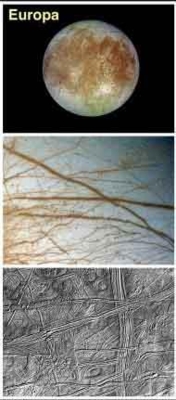
Image: Distant Europa and its frozen surface. New clues are emerging about the composition of such distant moons. Credit: NASA.
This work was presented at the annual meeting of the American Chemical Society on Monday. It tells us more about the processes at work on such distant satellites, but until we get a spacecraft with a full science package onto the surface of one of these moons, we’ll still face daunting questions about their chemistry. And with recent NASA budget cuts — and growing constraints on ESA’s finances — such a mission once again seems a long way off (although the DAWN mission to Ceres and Vesta seems to have won a reprieve, thanks to progress on resolving the spacecraft’s xenon fuel tank problems).


0 Comments