
Here’s something to think about, or better, try to visualize on an evening when there’s good celestial viewing outside. A typical globular star cluster holds several hundred thousand stars. Out on the periphery of such systems, the stars are relatively widely spaced. But move into the center and you’ll find stars packed thousands of times tighter than in our Sun’s neighborhood. Imagine the view in such a place — 10,000 stars closer to us than Alpha Centauri turning the night ablaze.
The Hubble Space Telescope paints this picture of conditions in the globular clusters that surround the Milky Way. And as part of these findings, the scientists involved say that such clusters sort out their stars on the basis of mass. You can imagine that in that tightly packed center, close encounters, collisions and mergers between stars would not be uncommon. The result: heavier stars sink toward the cluster’s core, while lighter ones move eventually to the periphery, a process never before witnessed but long suspected to occur.
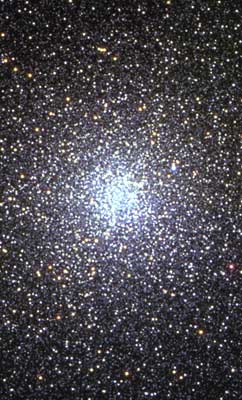
The cluster in question is 47 Tucanae, a dense southern hemisphere object. Astronomers have been able to measure accurate speeds for 15,000 stars at its center, some of them a type called ‘blue stragglers’ that are thought to be the result of stellar collisions. Twice as massive as normal stars, they’re also found to move more slowly than their lighter counterparts. Seven years of measurements went into this work, the largest sample of velocities ever gathered for any globular cluster in our Galaxy.
Image: The 47 Tucanae globular cluster. Credit: Very Large Telescope/European Southern Observatory, R. Kotak and H. Boffin (ESO).
The work, by Georges Meylan (Ecole Polytechnique Federale de Lausanne) and collaborators appears in the September Astrophysical Journal Supplement Series. And it would be helpful to me if any of you know of science fiction settings involving globular clusters. I’m always curious about how writers portray unusual places but am having trouble coming up with many examples here. Talk about an exotic locale!
The first one that comes to mind is Asimov’s short story, “Nightfall”. It takes place on a planet in revolving around one of a sort of mini cluster of five stars, where all 5 suns only set in unison once every few millenia, with disasterous psychological results for the civilisation. I’m not sure if it’s a full fledged globular cluster– but it’s an interesting idea.
The full story is available for online at this link:
http://doctord.dyndns.org:8000/Stories/Nightfall.htm
Wouldn’t the radiation in a globular cluster be too intense for life as we know it to survive?
The bigger problem would be stellar close encounters that would disrupt planetary orbits.
Hi there,
Another SF story that comes to mind is Poul Anderson’s “Starfog”, although it is purposely set in an unusual globular cluster.
The mention of “Nightfall” reminds me that about six months ago I found a nice copy of the September 1941 issue of Astounding in which Asimov’s tale first ran. You hardly ever find pulps in bookstores any more, but there it was tucked amidst a sea of old paperbacks — an amazing catch!
Haven’t run into the Anderson story before, but I appreciate the tip and will seek it out.
I’ve always been entranced by globular clusters, and the stunning vistas that must be visible from their core. Yet it’s rather sad to think on how these clusters are almost certainly sterile; not merely because of the extreme environment for planetary systems inside of them, but because their great antiquity means that their stars all formed long before the heavy elements became common. As far as I understand it, their internal dynamics prevent the accumulation of clouds of enriched dust that lead to second and third generation stars in the plane of the galaxy. The stars neatly fall into two classes: stars that are almost as old as the universe; and the rare “blue stragglers” that form from stellar collisions. With meager sources of oxygen and carbon, the only planets are likely to be ancient, hydrogen and helium rich gas giants. That’s assuming that such planets could form without the rocky, icy cores that are assumed in some models to have predated Jupiter and Saturn.
In “The Other End of Time” by Frederik Pohl adbuctees from several intelligent species are put on a planet in the middle of a globular cluster in an environment shielded from radiation. Several paragraphs describe the vista and the consequences of being there.
I’ve got both those issues of “Astounding”/”Analog” – I’ll have to read the stories now too.
One problem with the “Nightfall” scenario is that the collective light of the stars will wash out dimmer stars so not as many are seen in the sky as you might expect – too much ‘sky-glow’ to compete with. The remaining nearby stars and brighter giants will still be amazing.
I’d love to see a Jon Lomberg take on the view at the heart of one of these clusters (www.jonlomberg.com). It would have to be breathtaking.
H.E.S.S. upper limit on the very high energy gamma-ray emission from the globular cluster 47 Tucanae
Authors: HESS collaboration: F. Aharonian, et al
(Submitted on 2 Apr 2009)
Abstract: Observations of the globular cluster 47 Tucanae (NGC 104), which contains at least 23 millisecond pulsars, were performed with the H.E.S.S. telescope system. The observations lead to an upper limit of F(E>800 GeV) < 6.7e-13 / cm^2 s on the integral gamma-ray photon flux from 47 Tucanae.
Considering millisecond pulsars as the unique potential source of gamma-rays in the globular cluster, constraints based on emission models are derived: on the magnetic field in the average pulsar nebula and on the conversion efficiency of spin-down power to gamma-ray photons or to relativistic leptons.
Comments: 5 pages, 2 figures, accepted for publication in A&A
Subjects: High Energy Astrophysical Phenomena (astro-ph.HE); Galaxy Astrophysics (astro-ph.GA)
Cite as: arXiv:0904.0361v1 [astro-ph.HE]
Submission history
From: Andre-Claude Clapson [view email]
[v1] Thu, 2 Apr 2009 11:10:16 GMT (33kb)
http://arxiv.org/abs/0904.0361