
Gamma-ray bursts (GRBs), those titanic explosions in distant galaxies that some consider to be the most powerful events since the Big Bang, can be more luminous than anything else in the universe, at least for a while. But their moment in the spotlight is brief, less than a second to as much as a few minutes, and questions about their origins abound. Astronomers expecting speeds close to the 300,000 km/s of light itself for the material exploding from these bursts have now been vindicated by measurements made at the European Southern Observatory’s La Silla facility.
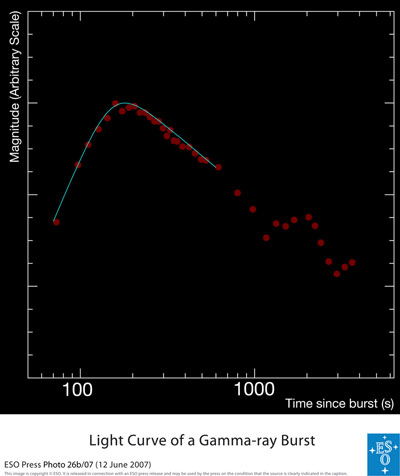
Image: Light curve of the gamma-ray burst of 7 June 2006, GRB 060607A. The red dots are the data obtained with the REM telescope observing the afterglow (in the near-infrared H-band) of the burst from 73 seconds after the explosion. The blue line is a fit to the data, allowing the astronomers to determine the peak of the light curve and so, derive the velocity of the material. (c) ESO.
Space-to-ground coordination is needed to examine GRBs like the two under study, which were first detected by the Swift satellite and followed up by La Silla’s robotic Rapid-Eye Mount (REM) telescope on April 18, 2006 and again on June 7 of that year. The two bursts, some 9.3 and 11.5 billion light years away respectively, created an afterglow visible at optical and near-infrared wavelengths, the result of exploding material ramming into surrounding gas. Direct measurements of the velocity of the exploding material arrived at a value of 99.9997% of the speed of light.
“Matter is thus moving with a speed that is only different from that of light by three parts in a million,” says Stefano Covino, co-author of the study. “While single particles in the Universe can be accelerated to still larger velocities – i.e. much larger Lorentz factors – one has to realise that in the present cases, it is the equivalent of about 200 times the mass of the Earth that acquired this incredible speed.”
Longer-duration gamma-ray bursts like these are thought to be the result of the explosion of massive stars; shorter duration GRBs may originate in collisions between neutron stars and black holes. The paper is Molinari et al., “REM observations of GRB060418 and GRB060607A: the onset of the afterglow and the initial fireball Lorentz factor determination,” Astronomy & Astrophysics 469, L13-L16 (2007), with abstract available online.

That’s a gamma factor of 400, which is pretty impressive. According to solutions of General Relativity for high-speed masses, the gravity of a fast moving mass becomes repulsive and enhanced by a factor of {gamma}^5… thus multiplied about 10 trillion times in this case. Thus the “cannon ball” ejected by the GRB’s central engine is plowing into the surrounding ISM with a repulsion beam equivalent to the gravity of 2 quadrillion Earths. No wonder we see such a massive out-pouring of gamma-rays!
This article seems to be relating to GRBs in that the energies required for non-particulate “stuff” (not “matter) would certainly be involved and thus pertain to our understanding of GRBs.
http://tinyurl.com/2louu7
Makes my head hurt.
Edg
Hi Edg
“Non-particle” matter seems pretty weird, but it’s application to GRBs is a stretch.
Adam,
I’m no physicist, and I show it constantly whenever I delve into this kind of thingy, but doesn’t it make sense that if a GRB is able to toss so much mass out at almost perfect light speed, that we’d also have an enriched presence of these kinds of non-particulates “by the ton?”
I mean, if I put my neutrino-capture experiment’s target in the path of a GRB “ray,” should I get a wholebunchalotta more neutrinos in that ray than, say, from the radiation of an “ordinary” star?
Seems to me we get a very enriched stream in a GRB and could expect our capture device to register a lot more hits.
I thought the article showed a basis for thinking that a GRB is much more than just the radiation that’s viewable by our present tech. How this all relates to Dark Matter and Dark Energy, well, I don’t know nuttin’.
Also, I’ve posted here several times about what I labeled the “virtual field,” and this article seems to verify that such does exist on the periphery of our present tech’s abilities to sense it, and that GRBs might be a place to sneak a look “over the event horizon” of this situation and maybe begin to find a basis for physics to get comfortable with non-real-but-could-be-real aspects of laws of nature.
I was hoping someone here might be able to take my hand and say, “There, there, don’t you mind, these things are well understood by better minds than yours, but the short-bus answer to your curiosity about non-particulates is blah blah blah, etc.” Lacking such responses here, I’ll have to google the thing until I get to my saturation point, but if anyone can toss me a bone on all this, I’d be appreciative.
Edg