
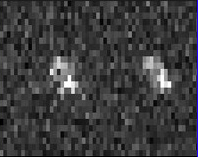
The 70-meter Goldstone antenna in the Mojave Desert has begun observations of 2007 TU24, the asteroid that will pass 538,000 kilometers from the Earth on January 27-28. Early indications are that the object is asymmetrical, with a diameter of approximately 250 meters. Close pass by the Earth is to occur on January 29 at 0833 UTC, with no chance of a strike. Says JPL’s Steve Ostro:
“With these first radar observations finished, we can guarantee that next week’s 1.4-lunar-distance approach is the closest until at least the end of the next century. It is also the asteroid’s closest Earth approach for more than 2,000 years.”
Image: These low-resolution radar images of asteroid 2007 TU24 were taken over a few hours by the Goldstone Solar System Radar Telescope in California’s Mojave Desert. Image resolution is approximately 20-meters per pixel. Next week, the plan is to have a combination of several telescopes provide higher resolution images. Credit: NASA/JPL-Caltech.
Now we can anticipate more detailed observations from the Arecibo Observatory, whose radar is the most sensitive in the world, allowing still closer readings on the asteroid’s size. With an imaging mode that offers resolution to 7.5 meters, scientists there should also be able to map the object’s surface in some detail. That’s useful information as we wait for the kind of detailed exploration a dedicated asteroid mission will one day make possible. Arecibo’s Mike Nolan looks forward to an observing session of the kind rarely afforded to those who study asteroids:
“Because it’s coming so close, we’ll get our highest quality imaging…We have good images of a couple dozen objects like this, and for about one in 10, we see something we’ve never seen before. We really haven’t sampled the population enough to know what’s out there.”
And this is worth thinking about: Nolan points out that although objects like 2007 TU24 pass near the Earth every five years on average, astronomers rarely get enough advanced notice to run rigorous observing sessions on them. Finding, classifying and cataloguing such objects is obviously vital, as is continuation of Arecibo’s planetary radar program. Far less helpful is the e-mail hoax making the rounds claiming yet another NASA cover-up, this one of 2007 TU24’s supposedly impending impact. Astronomy.com’s Daniel Pendick has seen that one, but also a far more interesting new video on planetary defense.

Email and other Internet hoaxes certainly doesn’t help reliable information getting around, but NASA doesn’t help its own cause at times.
Case in point is the recent “Bigfoot” or whatever rock shadow on a four year old photo from the rover Spirit.
The hoax went around for a couple of weeks before NASA said anything.
So they went for the old rock thing to debunk it. But why didn’t anyone ask whether it was a growth of moss or a small cactus?
Life is life, right?
OK, it was off topic some, but you get my point.
It took me a while to realise that that Steve Ostro’s ‘guarantee’ up there was only supposed to apply to 2007 TU24…
Hi dad2059 and Malte;
It would be neat if NASA upon looking for and cataloging NEOs would actually sooner rather than later send probes and manned missions to the these objects for the purposes of prospecting for rare metals and isotopes. I am curious as to what they would find.
Thanks;
Jim
Jim: I’ve always been a huge advocate of sending missions to NEOs, just for those reasons.
Of course the initial costs are huge because one has to take their own air and water. If one chooses an NEO suspected to have volatles, the pay-off is huge.
Trying to work out of a “hole” (gravity well) is harder than micro-gravity I would think. Plus it’s a good investment for private industry, who I would guess be the first to discover this as a business model.
An image from Arecibo Observatory:
http://www.nasa.gov/topics/solarsystem/features/asteroid-20080129.html
Another close call by a space rock, this time by one the
size of an SUV just 84,000 miles past Earth. It was detected
only two days ago.
Details here:
http://www.universetoday.com/2008/02/07/another-asteroid-passes-close-to-earth/