
Give a young star two or three million years and planets are likely to emerge from the dust and gas surrounding it. But note the wild card shown in the image below, the danger of proximity to more massive stars. In the image, several stars not so different from our Sun at that stage of its evolution are shown with streams of material flowing away from them. We’re seeing their outer disk material blown away by nearby class O stars, while inner materials might still survive to form rocky, terrestrial worlds close to the parent star.
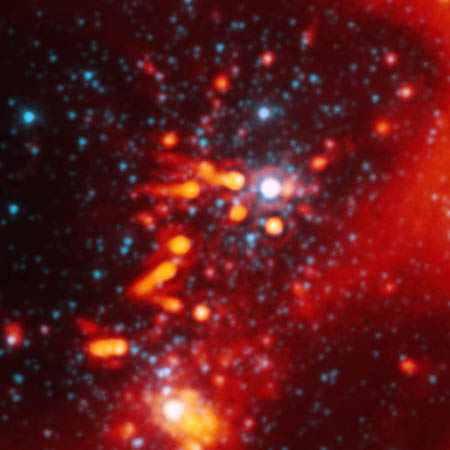
Image: This image from NASA’s Spitzer Space Telescope shows the nasty effects of living near a group of massive stars: radiation and winds from the massive stars (white spot in center) are blasting planet-making material away from stars like our Sun. The planetary material can be seen as comet-like tails behind three stars near the center of the picture. The tails are pointing away from the massive stellar furnaces that are blowing them outward. Credit: NASA/JPL-Caltech/Harvard-Smithsonian CfA.
This is a star forming region known as W5, 6500 light years from us in the constellation Cassiopeia, as seen in a composite of infrared data from the Spitzer Space Telescope. The massive stars involved are each about twenty times as massive as the Sun; the stars they are swamping with radiation and solar wind are about one light year away. And in astronomical terms, we’re looking at a short-lived phenomenon. JPL’s Xavier Koenig, lead author of a recent paper on this work, says these much abused disks will be gone in a million years.
It’s interesting to speculate on our Sun’s own origins given images like these. Surely it was born into a massive star-forming cloud which, over the eons, was dispersed as the stars it spawned moved away from each other. These are disruptive environments that eventually put the brakes on further star formation, but not before producing multiple stellar generations, as shown in the second infrared image of W5 from Spitzer below. Koenig and team have been studying W5 extensively with regard to this ‘triggering’ phenomenon.
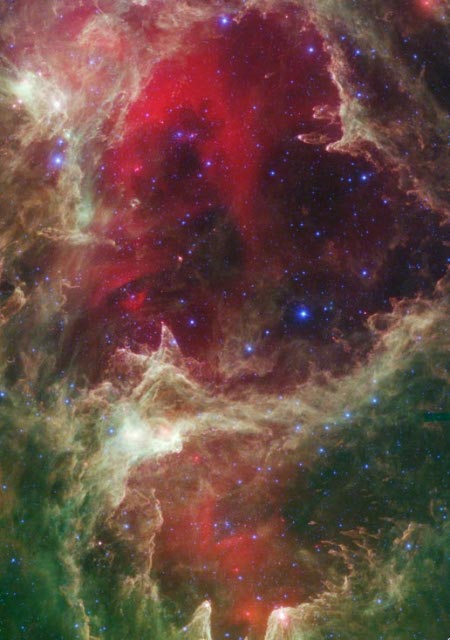
Image: Generations of stars can be seen in this new infrared portrait from NASA’s Spitzer Space Telescope. In this wispy star-forming region, called W5, the oldest stars can be seen as blue dots in the centers of the two hollow cavities (other blue dots are background and foreground stars not associated with the region). Younger stars line the rims of the cavities, and some can be seen as pink dots at the tips of the elephant-trunk-like pillars. The white knotty areas are where the youngest stars are forming. Red shows heated dust that pervades the region’s cavities, while green highlights dense clouds. Credit: NASA/JPL-Caltech/Harvard-Smithsonian CfA.
The paper on disk disruption is Koenig et al., “Dusty Cometary Globules in W5,” accepted for publication in Astrophysical Journal Letters (abstract). An earlier paper on ‘triggered’ star formation through the effects of massive stars is “Clustered and Triggered Star Formation in W5: Observations with Spitzer,” Astrophysical Journal Letters Volume 688, Number 2 (December 1, 2008), pp. 1142-1158. Available online.

“These are disruptive environments that eventually put the brakes on further star formation”
I didnt get that one..from what I have read, the birth and death of stars is a cyclic process. The materials thrown away after the death of a star is used again for the creation of new stars, except when black holes are formed which suck stellar materials into them..
Good question, amalbose. Here’s a bit of the Koenig paper that explains this — remember we’re talking about massive stars here:
August 19, 2009
Violence Rocks the Cosmic Cradle
Written by Nancy Atkinson
Star cluster RCW 38. Credit: ESO
We humans like to coddle and cuddle our young, protecting them in comfy, quiet nurseries where they will come to no harm. But what kind of treatment do infant planetary systems receive? They get bombarded with powerful winds and blazing heat, and pummeled by short-lived, massive stars that explode as supernovae.
New images released today delve into the heart of a cosmic cloud, called RCW 38, crowded with budding stars and planetary systems. Although this is a hostile place, it makes a pretty picture, and new solar systems are in the process of forming in the same kind of environment from which our home may have evolved.
“By looking at star clusters like RCW 38, we can learn a great deal about the origins of our Solar System and others, as well as those stars and planets that have yet to come”, says Kim DeRose, first author of s new study that appears in the Astronomical Journal.
Full article and image here:
http://www.universetoday.com/2009/08/19/violence-rocks-the-cosmic-cradle/