
Yesterday’s story on IBEX is now complemented by images from the Ion and Neutral Camera, part of the Magnetospheric Imaging Instrument on the Cassini orbiter. The Cassini data confirm the fact that the heliosphere isn’t shaped the way we’ve always thought. The assumption up to now has been that the collision of the solar wind with the interstellar medium would create a foreshortened nose in the direction of the Solar System’s motion, and an elongated tail in the opposite direction.
Both IBEX and Cassini argue otherwise. Stamatios Krimigis (Applied Physics Lab, Laurel, MD) notes the import of these findings:
“These images have revolutionized what we thought we knew for the past 50 years; the sun travels through the galaxy not like a comet but more like a big, round bubble. It’s amazing how a single new observation can change an entire concept that most scientists had taken as true for nearly fifty years.”
Amazing and invigorating, for we’re opening up serious new ground here. Put together, what Cassini and IBEX are telling us is that particle pressure and magnetic field density are what dominate the interaction between the interstellar medium and the heliosphere. We’re getting a look at how a solar system moves through the space around it through twin imaging programs that map an otherwise invisible boundary.
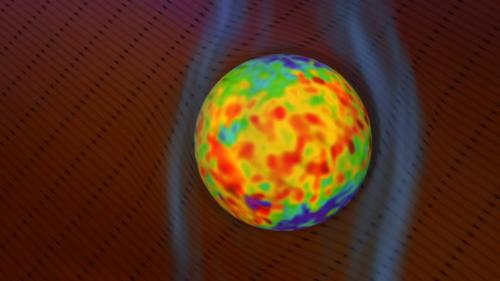
Image: The shape of our solar system moving through the interstellar medium was previously thought to be comet-shaped, with a head pointed into the stream, and a tail flowing downstream. New observations show the shape actually resembles something more like a slippery ball (the hot particles that exert pressure) moving through smoke (the interstellar magnetic field). As the “ball” moves through the “smoke,” the smoke bends and parts to let the ball through, then resumes its previous shape after the ball has passed on. At present, this is only hypothetical: New models will be motivated by these measurements, and will provide a more physically accurate basis for the interaction of the heliosphere with the interstellar medium. Credit: NASA/JPL-Caltech/JHUAPL.
Cassini has been mapping energetic neutral atoms not only near Saturn but across the entire sky. These ENAs, discussed yesterday, are produced by energetic protons that interact with the magnetic field of the interstellar medium. For more on ENAs, I turn to Mike Gruntman’s AstronauticsNow site (thanks to Centauri Dreams reader Carl for the tip). Gruntman is a professor of astronautics at USC, an author, and a mission co-investigator on IBEX. Of ENAs he writes:
The interaction between charged and neutral particles is a common phenomenon in space plasmas. Whenever an energetic ion undergoes a charge exchange process in a collision with a neutral background atom, an energetic neutral atom – ENA – is born. Ion-electron recombination and neutral atom acceleration by the solar gravitation may also contribute to an ENA population under certain conditions. ENAs are ubiquitous in space environment and their study opens a new window on various phenomena in space plasmas with a promise (already partially realized) to qualitatively improve our understanding of global magnetospheric and heliospheric processes.
Gruntman goes on to note that recording ENA fluxes as a function of observational direction allows us to create a global image, which is what we are doing with the interactions at our system’s edge. It’s a method that is paying off handsomely, as Edmond Roelof, a co-investigator on the Magnetosopheric Imaging Instrument, points out:
“Energetic neutral atom imaging has demonstrated its power to reveal the distribution of energetic ions, first in Earth’s own magnetosphere, next in the giant magnetosphere of Saturn and now throughout vast structures in space-out to the very edge of our sun’s interaction with the interstellar medium.”
You can see an animation showing the interstellar medium flowing past the heliosheath here (the heliosheath is a secondary bubble around the heliosphere formed by the interstellar medium’s interactions with the latter). Also note five papers published in Science Express this week on IBEX and Cassini, including Krimigis et al., “Imaging the Interaction of the Heliosphere with the Interstellar Medium from Saturn with Cassini,” (October 15, 2009). Abstract available.



To All,
Forgive this rather simplistic question, but are we actually seeing the “real” Interstellar Medium beyond our Sun’s Heliosphere or are we actually seeing Alpha Centuauri’s Heliosphere moving in tandem with our own with perhaps a “diluted” Interstellar Medium between us? I have seen some data indicating that the “real” Interstellar Medium for either Sol or Alpha Centuari only exists beyond the approximately 4.3 lighr years that separates us and that the Interstellar Medium at say 7 Light years out looks allot different then what we find at say 2-3 light years out in the direction of Alpha Centauri.
Kenneth
I guess this is the generally accepted view:
http://en.wikipedia.org/wiki/File:Solarmap.png
Kenneth: well that might be the case in the direction towards Alpha Centauri (I don’t think this structure is particularly well aligned with the Alpha Centauri direction though… but I may well be wrong about this), but what about in the direction away from the Alpha Centauri system?