
We’ve long speculated about astrobiology on planets around stars like the Sun, and lately the thinking has moved to M-class dwarfs and whether or not they could be circled by habitable planets. But what about massive stars, classes A and B, where we’re looking at two to fifteen times the mass of the Sun? New work from the Harvard-Smithsonian Center for Astrophysics (CfA) and the National Optical Astronomy Observatory (NOAO) tells us that planets form readily around such stars, leading Xavier Koenig (CfA) to tell a press conference at the AAS meeting this week in Washington, “We see evidence of planet formation on fast forward.”
Make no mistake, massive stars present a challenging environment for planet formation. Their disks may be packed with useful material for building worlds, but the intense stellar radiation and winds from these stars work to destroy the disks in relatively short order. Koenig and colleagues looked at the star-forming region W5, some 6500 light years away in the constellation Cassiopeia, using data from the Spitzer Space Telescope and the Two Micron All-Sky Survey (2MASS). They were looking in the infrared for evidence of dusty disks in a target list of over 500 A and B stars.
The result: About one in ten of the stars examined show signs of dusty disks, and of these, fifteen showed signs of the kind of central clearing of the system that would indicate the presence of a young gas giant. Says Lori Allen (NOAO):
“The gravity of a Jupiter-sized object could easily clear the inner disk out to a radius of 10 to 20 astronomical units, which is what we see.”
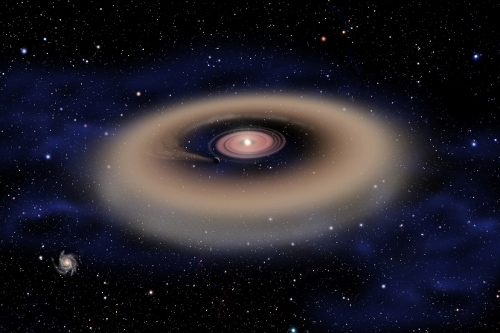
Image: This artist’s conception shows a Jupiter-sized planet forming from a disk of dust and gas surrounding a young, massive star. The planet’s gravity has cleared a gap in the disk. Of more than 500 stars examined in the W5 star-forming region, 15 show evidence of central clearing that may be due to forming planets. Credit: David A. Aguilar, CfA
These are young stars, some two to five million years old, and it’s significant that most of them have already lost the raw materials they need to form planets. A and B stars, it seems, must form their planets quickly or they won’t form them at all. And if planet formation around such stars can be seen as a balancing of forces — plentiful ingredients, devastating solar winds — the chances for astrobiology seem to enjoy no such counterbalancing effect. Stars like these live for ten to 500 million years before they run out of fuel, an all too brief window for the development of complex life forms.

More evidence that planet formation can proceed very rapidly around massive stars: the star BD+20 2457 has two orbiting companions, of at least 21 and 13 Jupiter masses. The formation timescale for these objects is constrained by the very short lifetime of the parent star, and the configuration indicates that in some environments, planet formation can produce objects that exceed the deuterium fusion limit.
“the star BD+20 2457 has two orbiting companions, of at least 21 and 13 Jupiter masses”
Hmmm… what if they get ejected from their parent stars, forming free-floating brown dwars? How significant would planetary ejection be in the regards to the total number of brown dwarfs in the galaxy?
HD156668b
Announced at the 215th AAS meeting by Eta-Earth Survey: m sin(i) = 4.15 Earth masses
http://www.universetoday.com/2010/01/07/second-smallest-exoplanet-found/#more-49920
Point taken about planets, potential places for life to start, and time available for evolution.
But, since we lack all knowledge of potential ETIs, I wouldn’t write off systems around massive stars. Some ETIs may like to colonize these places for all we know, even if they’re unlikely to originate in these systems. SETI searches should look everywhere, even in empty space, since we’ve got little idea about what habitats (including for alien machine intelligences) are desirable over the long term by what may be a very divsersified mix of critters.
“an all too brief window for the development of complex life forms.”
Based on what ?
One example, the only one we have but still one example. Could it be that our example (earth) is a very unlucky planet. Placed where the bombardment of meteors is/was extremely high, not big enough to protect from repetitive glaciation events and so on. We routinely think were on the “best of worlds” but we could as easily be on the “the worst of (inhabited) worlds”.
“Stars like these live for ten to 500 million years before they run out of fuel”
Not all large stars have such as pathetic life expectancy. Diminutive class-A stars such as Sirius A could potentially live for a billion or so years. late F stars (which would be smaller than A stars but still many times the size of our sun) could even last for several billion years. I have read that stars in the area of 100 solar masses could have a belt of hundreds of small terrestrial world in the habitable zones. While such stars would surly detonate within several million years after their formation, if a similar, albeit less extensive configuration were to exist around small A or F class stars, complex life may indeed by a possibility.
bear in mind that this is just speculation on my part.