
The same issue of Nature that carried Ian Crossfield’s weather map of Luhman 16B, published yesterday, also featured a paper from Francesca DeMeo on planetary systems in chaos. Specifically, DeMeo (a Hubble postdoctoral fellow at the Harvard-Smithsonian Center for Astrophysics), looks at main belt asteroids in terms of their composition and history. Her findings reveal an early system nothing like the relatively sedate situation we see today, with small, rocky worlds near to the Sun and gas giants on much more distant orbits.
Indeed, the migration of giant planets produced what DeMeo likens to “flakes in a snow globe” as asteroids were disrupted and interplanetary debris was thrown into new trajectories. The dynamical processes thus unleashed may have played a huge role in Earth’s development.
Working with data from the Sloan Digital Sky Survey, DeMeo teamed with Benoit Carry (Paris Observatory) to chart more than 100,000 asteroids throughout the Solar System, finding that especially among the smaller objects in the main belt, the diversity is much more pronounced than astronomers had realized. A simple progression from wet to dry as asteroids get closer to the Sun appears to be ruled out, and so-called ‘rogue’ asteroids — ones that formed in a dry environment and are now beyond the snow line, for example — may be more common than previously thought, an effect that is most evident in the population of smaller asteroids.
“It’s like Jupiter bowled a strike through the asteroid belt,” says DeMeo. Everything that was there moves, so you have this melting pot of material coming from all over the solar system.”
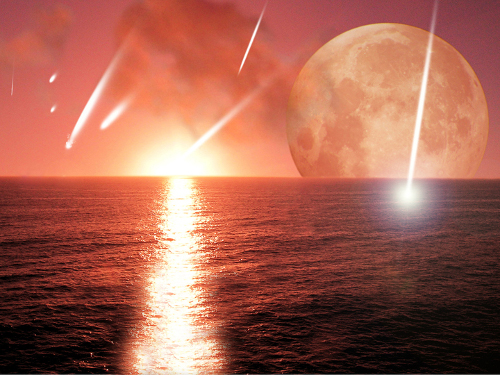
Image: Astronomers have theorized that long-ago asteroid impacts delivered much of the water now filling Earth’s oceans, as shown in this artist’s conception. If true, the stirring provided by migrating planets may have been essential to bringing those asteroids into play. Credit: David A. Aguilar (CfA).
Planetary migration may have brought Jupiter as close to the Sun as Mars is now, scouring the asteroid belt to leave little more than a tenth of one percent of its original population. Such migrations would have stirred the entire system, so that objects collected in the asteroid belt with origins as varied as close solar orbits to the distant realm of Neptune. And if this is the case, this shake-up of interplanetary materials may have delivered much of the water found in today’s oceans to Earth. This may be a key mechanism for bringing volatiles from beyond the snow line to warm but dry rocky worlds as planets capable of supporting life emerge elsewhere.
The paper is DeMeo and Carry, “Solar System evolution from compositional mapping of the asteroid belt,” Nature 505 (30 January 2014), pp. 629-634 (abstract).


This brings me to some considerations:
– The relative scarcity of giant planets (in wider orbits, not being hot Jupiters) could then mean that, even if a star has a terrestrial planet in the HZ, it could still be a waterless world.
– The presence of a very large/dense asteroid belt, such as has been found for several solar type stars, especially low-metallicity ones (Tau Ceti among them) could imply the absence of such giant planets.
– Combining the above: the abundant compact planetary systems, consisting of terrestrials, mini-Neptunes and Neptunes, could then largely be dry and lifeless worlds.
For more understanding of the mechanism behind this mixing, one can read the papers by Hal Levison and A. Morbidelli. Their first paper “Origin of the cataclysmic Late Heavy Bombardment period of the terrestrial planets” in 2005 can be found in Nature, 436 ,466. Later papers are listed and some available at www-n.oca.eu/morby/Ref_list.html
The structure of the Oort cloud is testament to the chaos that was everywhere in the early solar systems construction. The inner solar system should not be any different.
http://naasbeginners.co.uk/AbsoluteBeginners/Pictures_files/Oort_Cloud.jpg
http://www.universetoday.com/108825/young-planets-migrated-in-double-star-systems-model-shows/
Young Planets Migrated In Double-Star Systems, Model Shows
by ELIZABETH HOWELL on JANUARY 31, 2014
Binary star systems are downright dangerous due to their complex gravitational interactions that can easily grind a planet to pieces. So how is it that we have found a few planets in these Tattooine-like environments?
Research led by the University of Bristol show that most planets formed far away from their central stars and then migrated in at some point in their history, according to research collected concerning Kepler-34b and other exoplanets.
The scientists did “computer simulations of the early stages of planet formation around the binary stars using a sophisticated model that calculates the effect of gravity and physical collisions on and between one million planetary building blocks,” stated the university.
“They found that the majority of these planets must have formed much further away from the central binary stars and then migrated to their current location.”
You can read more about the research in Astrophysical Journal Letters. It was led by Bristol graduate student Stefan Lines with participation from advanced research fellow and computational astrophysicst Zoe Lienhardt, among other collaborators.
http://iopscience.iop.org/2041-8205/782/1/L11/
The image is indeed a shocking one. Granted that migrating planets have stirred up the smaller bodies of the Solar System. But how did they ever rotate the Moon into its own mirror image?
Stephen A.