
A 1.8 meter telescope at the summit of Haleakal? on Maui is the first instrument in use at the Pan-STARRS (Panoramic Survey Telescope & Rapid Response System) observatory. Pan-STARRS recently completed a digital survey of the sky in visible and infrared wavelengths that began in May of 2010, a project that surveyed the entire sky visible from Hawaii over a period of four years, scanning it 12 times in each of five filters. The result is a collection of 3 billion separate sources, including not just stars and galaxies but numerous transient, moving and variable objects. All told, we’re dealing with about 2 petabytes of data.
Now we learn that data from the survey is being made available worldwide. Ken Chambers, director of the Pan-STARRS observatories, comments:
“The Pan-STARRS1 Surveys allow anyone to access millions of images and use the database and catalogs containing precision measurements of billions of stars and galaxies. Pan-STARRS has made discoveries from Near Earth Objects and Kuiper Belt Objects in the Solar System to lonely planets between the stars; it has mapped the dust in three dimensions in our galaxy and found new streams of stars; and it has found new kinds of exploding stars and distant quasars in the early universe.”
How heartening it is to see extensive information on more than 3 billion sources now becoming publicly available. The catalog of four years of observations is being rolled out in two phases, the first being the release of the ‘Static Sky,’ which presents the average of each of the observing epochs. For every object, in other words, we get an average value for its position, brightness and colors — it will also be possible to get the stack image in each of the observed colors, while galaxies will include further information. Next year, the plan is to release the full database giving information and images for each individual epoch.
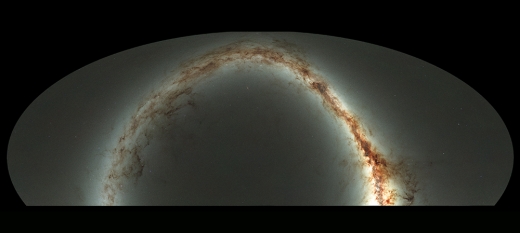
Image: This compressed view of the entire sky visible from Hawaii by the Pan-STARRS1 Observatory is the result of half a million exposures, each about 45 seconds in length, taken over a period of 4 years. The shape comes from making a map of the celestial sphere, like a map of the Earth, but leaving out the southern quarter. The disk of the Milky Way looks like a yellow arc, and the dust lanes show up as reddish brown filaments. The background is made up of billions of faint stars and galaxies. If printed at full resolution, the image would be 2.4 kilometers long, and you would have to get close and squint to see the detail. Credit: Danny Farrow, Pan-STARRS1 Science Consortium and Max Planck Institute for Extraterrestial Physics.
As Centauri Dreams readers know, our focus here has been predominantly on objects relatively near to the Sun — one of our purposes, after all, is to consider interstellar probes and their potential targets. On that score, we learn this from Thomas Henning (Max Planck Institutes for Astronomy, Heidelberg):
“Based on Pan-STARRS, researchers are able to measure distances, motions and special characteristics such as the multiplicity fraction of all nearby stars, brown dwarfs, and of stellar remnants like, for example white dwarfs. This will expand the census of almost all objects in the solar neighbourhood to distances of about 300 light-years.”
There is definitely an exoplanet component here. Henning continues:
“The Pan-STARRS data will also allow a much better characterization of low-mass star formation in stellar clusters. Furthermore, we gathered about 4 million stellar light curves to identify Jupiter-like planets in close orbits around cool dwarf stars in order to constrain the fraction of such extrasolar planetary systems.”
In terms of protecting our planet, Pan-STARRS devoted part of its four-year survey to searching for hazardous asteroids, an effort that proved so successful that following the end of the survey, NASA began using the telescope and its 1.4 Gigapixel camera (GPC1) for further asteroid investigations. Researchers believe that over 90 percent of near-Earth objects larger than 1 kilometer have already been found, making the current focus of the Near Earth Object program the discovery of objects larger than 140 meters. Clearly, Pan-STARRS can help.
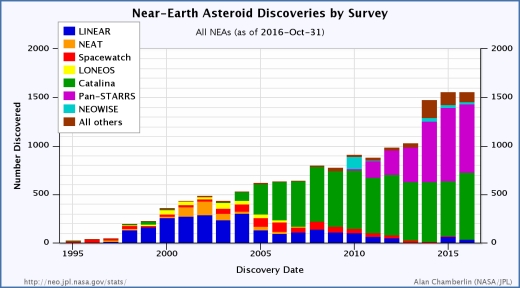
Image: Contributions of various astronomical surveys to the discovery of near-Earth asteroids, showing totals for NEAs of all sizes. Credit: Alan B. Chamberlin/Jet Propulsion Laboratory/NASA.
From a much broader perspective, PAN-STARRS has mapped our galaxy at a level of detail the MPIA is saying has never been achieved before, offering ‘a deep and global view’ of a significant fraction of the Milky Way’s plane and disk, areas that surveys generally avoid because of the complexity of these dense and dusty regions. In M31, the closest neighboring galaxy, the survey has detected several microlensing events and numerous Cepheid variables. The next step, according to this MPIA news release, is to measure redshifts of galaxies and other cosmological objects to analyze the distribution of galaxies in three dimensions, data that can provide constraints on our standard cosmological model.
The data from the first part of the Pan-STARRS survey is being archived at the Space Telescope Science Institute (STScI) in Baltimore and can be accessed through MAST (Mikulski Archive for Space Telescopes) using the Pan-STARRS1 link.

Something about views of our Milky Way such as the one posted above just … tickle … delight … spring forth hope within me so strong I can’t help but sit back in my chair and thank my lucky stars to be witnessing such events, even as an armchair quarterback. It is so heartening the level of commitment to exploration many of you have. Absolutely amazing.
And here I was contemplating buying a 6′ binocular Scope, for retirement
activities, and PanStarrs, makes short work of wide deep field viewing.
I know what I want to search for in this database.
the closest 100 F8-K8 type stars that are less than 5 x10^9 years old. If only
to see their distribution.
Astronomy will always need so-called amateurs, for while the Big Boys and Girls are using the Big Instruments to do Big Things, the other celestial stuff that goes on all the time around them and us requires diligent monitoring as well. Plus observing for the sake of enjoyment and edification is reason enough to get your own telescope or binoculars.
http://www.independent.co.uk/news/science/starstruck-the-importance-of-amateur-astronomy-2109253.html
http://rosetta.jpl.nasa.gov/news/role-amateur-astronomers-rosetta%E2%80%99s-mission
I wonder if a data mining algorith similar to SETI at Home might be of some use.
I wonder if Tabby’s star dimming can be seen in this dataset, too…
GAIA’s data will also help science with Tabby’s Star (aka KIC 8462852) to either conclude or reject the hypothesis that the object(s) supposedly circling the star are actually polar spots:
http://sites.psu.edu/astrowright/2016/09/03/what-could-be-going-on-with-boyajians-star-part-ix-intrinsic-variations/
Or if TS is actually sporting a megastructure:
http://sites.psu.edu/astrowright/2016/09/02/what-could-be-going-on-with-boyajians-star-part-viii-alien-megastructures/
To quote:
“The megastructure hypothesis would find support if Gaia shows us that the star is actually much more extinguished than the reddening suggests (meaning there is a significant optical depth of geometric absorbers: the swarm of solar panels). Or if, you know, we detect those radio waves that all those panels are producing!”
There should be a small star cluster within 300 ly radius (from untrusted personal memory). Do we have any new info of that star cluster?
Why, what is so special about this star cluster?
http://www.atlasoftheuniverse.com/250lys.html
Star clusters are best places to do illegal research such as building “Planck Zero AI” ;)
Probably the best region for testing something dangerous: Quantum CTC devices. If the experiments blow up, it can be covered up due to the hardness of recovering the fingerprints. This sounds like 100% SF no doubt but we would do the same if we had advanced capabilities to do exotic tests in the far future or one can choose to blow up this Solar System and then move to other star systems.
Actually I wanted to know exactly which star cluster you are referring to. I am aware of the potential for advanced ETI to be in star clusters and why.
This is not important if you want to seek something abnormal. I have spent several years searching for a seminal paper in a Spanish Gravitational Conference/Seminar around 90-92, I wonder whether there is a way to find the list of events that include titles + abstracts.
Um… you were the one asking about a star cluster 300 light years away. I simply wanted to know which one you were referring to and why? So now the actual star cluster’s identification is NOT important “if you want to seek something abnormal.”
Enlighten me on this aspect of apparent Zen philosophy, please.
I was asking for new information of closest star cluster(s).
Zen philosophy? Lol I’m too lazy to practice. Anyway, from my bias point of view search for advanced ET is similar to looking for a sight of a postdoc in the grade school playground.
Star clusters offer great places for rapid expansion of techaliens.
They are not aliens in the literal sense, but we can learn a lot from these “other” minds:
https://www.theatlantic.com/magazine/archive/2017/01/what-the-octopus-knows/508745/
I am just surprised that we haven’t learned more about octopi by now, and how the author and the scientists she interviewed still seem surprised that these so-called creatures exhibit distinct personalities and behaviors.
Do they pass the mirror test?
Actually one octopus became quite agitated when shown itself in a mirror, as the article states. Maybe it was having a bad tentacle day, a sure sign of self-awareness.
I have asked if Pan STARRS information could be added to AladinLite and it looks like they will be looking into it.
‘Hi Michael,
Thanks for your suggestion for adding Pan STARRS in AladinLite. We are currently under discussion with STScI team and we are already working on it, but it takes time to process the entry in the pipeline.
Best regards’