
Here’s gravitational lensing with an exclamation point. A single quasar is shown in the Hubble photograph below as five star-like points. Gravitational lensing occurs when the gravitational field of a massive object bends and amplifies the light from a much further object behind it. And although we’ve had numerous examples of such lensing, this is the first time the intervening object was an entire galactic cluster.
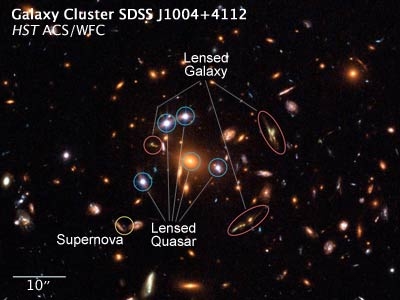
Image: Five star-like images are actually a single distant quasar. Credit: ESA, NASA, K. Sharon (Tel Aviv University) and E. Ofek (Caltech).
The cluster in question is SDSS J1004+4112, some seven billion light years away; the quaser is roughly ten billion light years distant. It took spectral data from the Keck I 10-meter telescope to demonstrate that these images were all of the same quasar. The quasar itself is the core of a galaxy, with a black hole at its center creating its intense light by interactions with nearby gas and dust. Note too in this picture the images of other distant galaxies split into multiple distorted arcs, also created by the gravitational lensing effect.
Below is a diagram that illustrates what’s happening to produce these images.
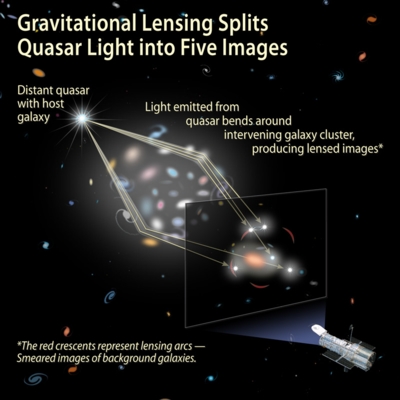
Image: Gravitational lensing diagrammed. Here the effect is caused by an entire galaxy cluster. Credit: NASA, ESA, and A. Feild (STScI).
Centauri Dreams is reminded by this work that some time ago, Italian physicist Claudio Maccone was kind enough to send along some of the original studies of the Quasat inflatable radio telescope, an idea that would evolve into his aptly named FOCAL mission design. FOCAL would be sent to our Sun’s gravity focus at 550 AU, the goal being to record exotic astronomical observations using this same lensing effect. Let me again refer you to Maccone’s The Sun as a Gravitational Lens: Proposed Space Missions (Aurora, CO: IPI Press, 2002) for more on a concept whose history and current status I hope to examine again soon.
Gravitational lensing represents the magic of the optics of the cosmos.
General relativity is not only beautiful as a theory, general relativity also provides the most amazing and beautiful form of imaging.