
Some things to keep in mind with regard to near-Earth objects: NASA is working with a Congressional mandate from 2005 that it discover ninety percent of all NEOs that are 140 meters in diameter or greater. The deadline for this task is 2020, and the interim report Near-Earth Object Surveys and Hazard Mitigation Strategies (written by a committee appointed by the National Research Council) says the surveys currently in progress are not capable of meeting this goal. The final report is to appear in December.
Now switch to Arecibo. The radio telescope there, run by Cornell University and the National Science Foundation, has run into serious funding questions. NSF must decide whether the current cooperative relationship between Cornell and NSF should continue, and whether the observatory itself should be funded. You may recall that an NSF panel recommended in late 2006 that Arecibo’s operating budget be reduced in a series of steps, ultimately taking it from $10.5 million to $4 million by 2011. Such reductions could close the observatory.
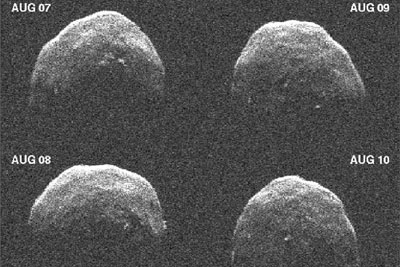
The role of Arecibo’s planetary radar in the NEO issue? That’s also spelled out in the interim report, which cites the observatory’s ‘unmatched precision and accuracy’ in detecting comets and asteroids that could hit the Earth. We still don’t know what’s going to happen with Arecibo, but the report certainly can’t hurt. Says Don Campbell (National Astronomy and Ionosphere Center):
“If the survey committee had not come out that strongly, it would have virtually ruled out any funding. [The report] was a necessary, but not sufficient condition to get funding from either NASA or NSF.”
Image: Arecibo Observatory radar images of asteroid 1992 UY4, which has a diameter of 2 kilometers, made from four days’ observation in August 2005. Credit: Lance Benner/Jet Propulsion Laboratory.
Short of sending a spacecraft to an NEO (itself a desirable outcome), the Arecibo planetary radar provides the best imaging and tracking for these objects that we have. We may argue about the likelihood of our planet being struck by any of these objects, but the idea that we would surrender this powerful tool for building and tracking the NEO inventory, now in place and functioning, seems incredible. We wait with guarded optimism to see how the funding picture develops for Arecibo. More in this Cornell University news release.



Hi Paul
Racial suicide if we let such an invaluable ‘roid scanner get shut down over measly amounts of science $$. It needs to be augmented rather than put out to pasture.
I am puzzled by the asteroid image. It seems as though the source of radar illumination is coming from 90 degrees perpendicular from where the signal is received. I can’t imagine how this would be. Does anyone know?
This venerable and storied observatory has been and is one of radio astronomy’s finest.
Kraus’s Big Ear, which received the Wow! signal, has its own cautionary tale of the end of a marvellous instrument: http://www.bigear.org/teardown.htm
Here’s the NSF site, which seems to invite new proposals: http://www.nsf.gov/
Here’s the Google Maps link to Aricebo (the dish, not the town!).
http://maps.google.com/?ie=UTF8&ll=18.344098,-66.752758&spn=0.050348,0.113211&t=k&z=14
John
“Here’s the Google Maps link to Aricebo”
You know, I used to think that Aricebo was cool because it was so big, but zooming out on the satellite image impresses me all the more at just how tiny it actually is relative to what it measures, and how amazing humans are to use such a infinitesimal device to explore the vastness of the cosmos.
John
What’s so puzzling about the images? They look like they’re being illuminated from one direction, as you’d expect, so what’s the enigma?
Hello, Tulse, and All…
“the satellite image impresses me all the more at just how tiny it actually is relative to what it measures, and how amazing humans are to use such a infinitesimal device to explore the vastness of the cosmos.”
http://www.youtube.com/watch?v=2pfwY2TNehw
wow,are we into a new month already!? where does the time go? but the above mentioned project makes alot of sense.anyone can readilly see the importance of not letting such objects “sneak up” on us! wish i had seen more on some of the “old” topics from last month but alot of that is probably my fault for not participating as much as i probably should have! best to everyone,your friend george
Adam, if it’s radar scanning from Arecibo then the illumination must be from directly overhead. Think about the geometry. Now this makes me wonder if the images are instead a radio heat map of some sort.
The image is a representation of radio waves not from the visible spectrum, right? Although the sun is a source of radio waves, my understanding is that we image asteroids by beaming very powerful radio waves at them. I believe that there was mention of this in a Centauri Dream post earlier re: accidental METI. So, if the imaged signal originated from the Earth, why is it striking it perpendicularly? I’m sure that there’s a simple explanation.
John
Hello, John,
Great question, it got me looking. I’ve not studied RADAR, but an explanation is found in this .pdf: http://www.lpi.usra.edu/books/AsteroidsIII/pdf/3004.pdf
3004.p65, page 155 in the document: ” Geometry of delay-Doppler images. The left frame is a plane-of-sky view of the low-resolution radar model of Toutatis ” (picture shows an elongated body illuminated as you might expect, from your POV).
” The right frame is a synthesized radar image of the model, arranged
so delay increases from bottom to top and Doppler increases from left to right.”(picture is similar to those in Paul’s article).
The images are synthesized artifacts showing a different aspect instead of the ‘head-on’ raw RADAR views.
Hope this helps… got me thinking about this aspect of radio astronomy!
Radar Observations and the Shape of Near-Earth Asteroid 2008 EV5
Authors: Michael W. Busch, Steven J. Ostro, Lance A.M. Benner, Marina Brozovic, Jon D. Giorgini, Joseph S. Jao, Daniel J. Scheeres, Christopher Magri, Michael C. Nolan, Ellen S. Howell, Patrick A. Taylor, Jean-Luc Margot, Walter Brisken
(Submitted on 19 Jan 2011)
Abstract: We observed the near-Earth asteroid 2008 EV5 with the Arecibo and Goldstone planetary radars and the Very Long Baseline Array during December 2008. EV5 rotates retrograde and its overall shape is a 400 /pm 50 m oblate spheroid. The most prominent surface feature is a ridge parallel to the asteroid’s equator that is broken by a concavity 150 m in diameter. Otherwise the asteroid’s surface is notably smooth on decameter scales.
EV5’s radar and optical albedos are consistent with either rocky or stony-iron composition. The equatorial ridge is similar to structure seen on the rubble-pile near-Earth asteroid (66391) 1999 KW4 and is consistent with YORP spin-up reconfiguring the asteroid in the past. We interpret the concavity as an impact crater. Shaking during the impact and later regolith redistribution may have erased smaller features, explaining the general lack of decameter-scale surface structure.
Comments: This paper has been accepted for publication in Icarus: this http URL
Subjects: Earth and Planetary Astrophysics (astro-ph.EP)
Cite as: arXiv:1101.3794v1 [astro-ph.EP]
Submission history
From: Michael Busch [view email]
[v1] Wed, 19 Jan 2011 23:04:20 GMT (8448kb)
http://arxiv.org/abs/1101.3794