
We know little enough about our system’s tenth planet (once called 2003 UB313 and now unofficially called Xena), but as new observations come in, we’re learning that it is a mysterious place indeed. The latest news comes from the Space Telescope Science Institute, which pegs the object’s size at five percent larger than Pluto. That would make Xena roughly 2400 kilometers in diameter, a smaller world than originally thought based on how much light it reflects.
Not exactly startling news, given Xena’s distance from the Sun and the difficulty in observing it, but the newly confirmed size means that the planet is so reflective that it bounces back fully 86 percent of the light that reaches it. No other planet can match this, and in the entire Solar System, no object other than Enceladus is so reflective. The latter is apparently constantly re-coated with ice by its active geysers.
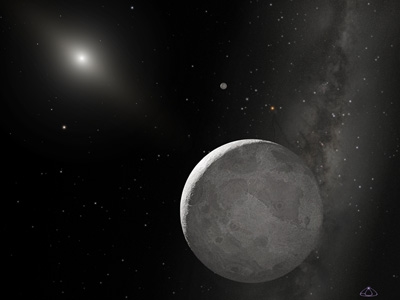
Image: An artist’s concept of Kuiper Belt object 2003 UB313 (nicknamed “Xena”) and its satellite “Gabrielle.” Ground-based observations suggested that Xena was about 30 percent greater in diameter than Pluto, but Hubble’s Advanced Camera for Surveys images, taken on Dec. 9 and 10, 2005, yielded a diameter of 1,490 miles (with an uncertainty of 60 miles) for Xena. Pluto’s diameter, as measured by Hubble, is 1,422 miles. Credit: NASA, ESA, and A. Schaller (for STScI).
So what does co-discoverer Mike Brown (California Institute of Technology) make of Xena’s reflectivity? Here’s his theory:
I think what is going on, is that the temperature of Xena – which is about minus 400 degrees Fahrenheit – causes the atmosphere to be frozen to the surface. This frozen atmosphere would make a nice, bright layer a few inches thick.
When Xena gets closer to the sun and heats up to a sultry 370 degrees below zero, the frozen atmosphere probably re-evaporates and the surface probably looks more like Pluto for a time. But Xena is currently 10 billion miles from the sun, and because of its distance is about as cold as it ever gets.
All of which makes sense, and the latest analysis of spectral data indicates that Brown’s bright, frozen atmosphere is a surface layer of methane. Xena’s orbit takes 560 years to complete, and will eventually bring the new world within 38 astronomical units of the Sun, inside the orbit of Pluto but outside Neptune’s. By contrast, Pluto reaches 50 AU during its 248-year orbit but closes to 29 AU at perihelion.
Next up for Brown’s team: continuing the study of Xena’s tiny moon Gabrielle (again, an unofficial working name as we wait for the formal name to be assigned). Roughly 250 kilometers in diameter, Gabrielle can tell us much about Xena once its orbital parameters are established, giving us an accurate reading of the planet’s mass.

To whom it may consern,
Hello my name is aliesha and i am looking for reasearch for teh planet Xena or now known as Eris. I need to know the tempeature on Eris. I am doing a class project and my whle class is doing all the planets and the astroid belt. IF you could e mail me back with some information on the planets that are in the solor system for me and my class to help us with our projects that could be great nad you can just e mail me becak to the address above.
Thanx,
ALiesha
Hi Aliesha,
Nice to hear from you. Here’s a link to a NASA site that goes through the Solar System in the kind of detail that should help you with your project:
http://solarsystem.nasa.gov/planets/index.cfm
Hope you find it useful!