
Centauri Dreams usually confines itself to the outer planets and beyond, but this photo of Mars taken by the Rosetta spacecraft’s Philae lander is just too unusual to pass up. You can see one of Rosetta’s solar arrays in the foreground, with the Syrtis region on the Martian surface some 1000 kilometers below. The lander is scheduled for a 2014 touchdown on comet 67P Churyumov-Gerasimenko. Numerous system checks are ahead as Rosetta prepares for a near-Earth swingby in November of this year.
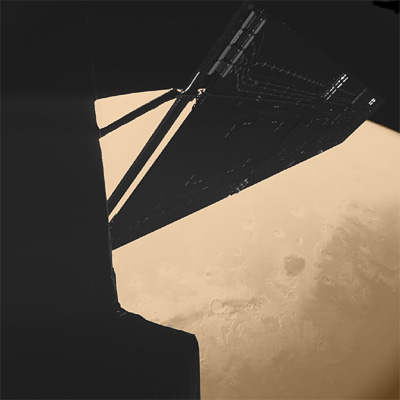
Image: Stunning image taken by the CIVA imaging instrument on Rosetta’s Philae lander just 4 minutes before closest approach to Mars. Credit: CIVA/Philae/ESA Rosetta.

At last: Rosetta’s Mars flyby photos have been released!
Jan. 24, 2012 | 14:51 PST | 22:51 UTC
On February 24, 2007, the European Space Agency’s Rosetta spacecraft passed by Mars, the second of four planetary gravity-assist flybys on its long route to a 2014 rendezvous with comet Churyumov-Gerasimenko. At the time, they released two photos from the main science camera, OSIRIS. One was a very pretty high-resolution view of Mars and the other a nifty little animation of Phobos flying over Mars.
We knew from the published Rosetta Mars flyby timeline that OSIRIS took a great many more pictures during that time, but no more OSIRIS images were ever released by ESA, until now. The OSIRIS principal investigator was notoriously tight-fisted with data, but he’s now retired, and his replacement Holger Sierks has apparently unclogged the data pipeline. At the end of November, they suddenly released a huge quantity of data covering the first two (out of three) Earth flybys, the Mars flyby, and several sets of data from cruise periods between these encounters. Such riches! The data can be found on ESA’s Planetary Science Archive, or at the Small Bodies Node of NASA’s Planetary Data System.
Full article and images here:
http://www.planetary.org/blog/article/00003340/