
What is it about Enceladus? I doubt anyone would have thought the tiny moon would weigh so heavily in our thinking about Saturn before Cassini, but now comes the news that Enceladus is distorting the planet’s magnetic field to the point that it becomes tricky to measure the length of the Saturnian day. Count the electrically charged particles originating in the moon’s geysers as the culprit — they’re actually causing Saturn’s magnetic field lines to slip relative to the planet’s rotation.
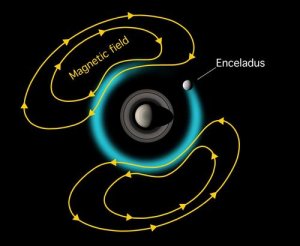
The process seems to work like this: Gas particles are ejected from the geysers on Enceladus and become electrically charged. Captured by Saturn’s magnetic field, they form a disk of plasma that wraps around the planet’s equator. The rotation of the plasma disk slows down enough due to interactions with the magnetic field that the rotation period Cassini has been measuring — based on radio emissions — is not actually the length of Saturn’s day. Instead, it’s the rate of rotation of the plasma disk.
Image: Geysers on Saturn’s little moon Enceladus are throwing off Saturn’s internal clock, making it hard to measure the length of the Saturn day. Credit: NASA/JPL.
Figuring out how long it takes a gas giant to rotate is problematic, but using regular radio signals seemed to work for Jupiter, Uranus and Neptune. Saturn’s radio period creates a problem because it acts like a pulsed signal instead of a rotating beam. Here’s a possible reason for the pulse, as explained by David Southwood (Imperial College, London):
“We have linked the pulsing radio signal to a rotating magnetic signal. Once each rotation of Saturn’s magnetic field, an asymmetry in the field triggers a burst of radio waves. We have then linked both signals to material that has come from Enceladus.”
Moreover, Saturn’s radio period seems to be changing over time, a difference of one percent between Voyager’s passage in the 1980’s and Cassini’s current measurements. Were the geysers of Enceladus more active when Voyager passed Saturn, or are we simply looking at seasonal variations as the planet orbits the Sun? Whatever the case, we now learn that an accepted marker — involving radio, magnetic field and planetary rotation — has to be reevaluated, and once again Enceladus finds itself in the thick of the controversy.
The paper is Gurnett et al., “The Variable Rotation Period of the Inner Region of Saturn’s Plasma Disk,” published online by Science (March 22, 2007), with abstract here.

The strong magnetic Field of Saturn and Enceladus’ interactions with it; is it possible that the magnetic Field is causing partial melting inside Enceladus? If the moon is a poor conductor with high resistance, cutting across the Field will generate an electrical current which will cause heating and melting.
Could any of the other moons of Saturn be disturbing Enceladus
as well, just as Io is churned up by Europa?
If this is the case, how come the other moons are not similarly
affected? Or are their geysers just not as noticable? There was
a recent report of Dione possibly having geysers like its sister.
Also, how much sodium is in the Enceladus subsurface? if there is magnetic field electrical current and tidal friction working together, salt water would be another factor.
does most of the material ejected from Enceladus remain in the magnetic fields? I wonder if there is evidence of charged particles from the magnetic fields that returns to the surface of Enceladus.
the amount of material that Dione ejects is minimal, I saw “6 grams per second”.