
We always knew the surface of Enceladus was cold, but those tantalizing plumes breaking out of the Saturnian moon’s south polar region gave hope of warmer things within. Liquid water fits with one model, pockets of which could account for the occasional geysers of ice crystals mixing with methane, nitrogen and carbon dioxide that Cassini has measured. Fill Enceladus with an internal ocean and the possibility of some kind of biology becomes an attractive study.
But an alternate take on the plumes has been on view for some time now. Coming out of the University of Illinois, it’s based on the idea that stiff compounds of ice called clathrates may cover Enceladus to a considerable depth. Whereas the warm interior model could produce such geysers, coined ‘Cold Faithful’ out of analogy to Yellowstone National Park’s Old Faithful geyser, so could the clathrate model. But the latter, dubbed ‘Frigid Faithful,’ could operate far below the freezing point of water, with obvious implications for the possibility of life.
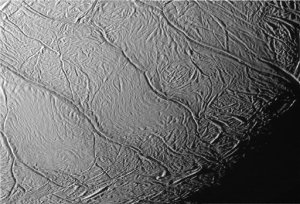
Indeed, if Susan Kieffer and Gustavo Gioia are right, their approach does a better job of accounting for what Cassini sees in the ‘tiger stripes’ region of Enceladus, where large and evidently deep fractures wound the terrain. A mild heat source (perhaps only a few tens of degrees warmer than the surrounding shell) could cause the clathrates above to become expanded and stretched. Tensile stresses become compressive, forming the ridges that encircle the tiger stripes, and then tensile again, forming further fractures that radiate northwards.
Image: The ‘tiger stripes’ of Enceladus’ south polar region. Does liquid water lurk below this surface, or can the ‘Frigid Faithful’ model explain the plumes Cassini has observed without it? Credit: NASA/JPL/Space Science Institute.
According to this model, the tiger stripes should be about 35 kilometers deep. Clathrates on their cracked surfaces would undergo decompression and dissociate explosively, thus exposing more clathrates to decompression and so on. Gaseous plumes transport heat to the surface, but this is a kind of heat advection that can take place at a nearly uniform temperature. Says Gioia, “This is indeed a frigid Enceladus. It appears that high heat fluxes, geyser-like activity and complex tectonic features can occur even if moons do not have hot, liquid or shifting interiors.”
The paper is Gioia et al., “Unified model of tectonics and heat transport in a frigid Enceladus,” Proceedings of the National Academy of Sciences (published online in advance of the print edition, with abstract here).


No sodium means no ocean beneath the ice of Enceladus?
http://news.bbc.co.uk/2/hi/science/nature/7145530.stm
Hot spot on Enceladus causes plumes
By Tony Fitzpatrick
Dec. 10, 2007 — San Francisco — Enceladus, the tiny
satellite of Saturn, is colder than ice, but data gathered
by the Cassini-Huygens Mission to Saturn and Titan has
detected a hot spot that could mean there is life in the
old moon after all. In fact, for researchers of the outer
planets, Enceladus is so intellectually hot, it’s smokin’.
The heat being generated on the moon’s south pole at a
hot spot is enough to eject plumes of ice and vapor above
Enceladus. These plumes, according to William B. McKinnon,
Ph.D., professor of earth and planetary sciences in Arts &
Sciences at Washington University in St. Louis, are this
moon’s most intriguing feature.
Hot sports on Saturn’s tiny satellite, Enceladus, could be
telltale signs of life on the frigid moon.
“The plume particles are like smoke, ice smoke,” McKinnon
said. “If you were standing on Enceladus’ surface in daylight
you wouldn’t even be able to see the plumes. The particles
are just larger than the wavelength of light, about one-
thousandths of a millimeter. Most icy bodies of this size are
geologically inert, but this is a clear indication of geological
activity. Cassini has found active venting of water vapor.
This leads to scientifically intriguing speculations and questions.”
One is: Is this active ice volcanism on Enceladus? If so, is
it due to ice sublimating, in the manner of a comet, or to a
different mechanism, like boiling water, as in Old Faithful at
Yellowstone?
The biggest question: If there is water on Enceladus, is
there life?
Full story here:
http://news-info.wustl.edu/news/page/normal/10731.html
Has anyone looked at the possibility that the heat source is due to EMF inductance; as the core (metallic? Semi-metallic? Some high resistance electrical conductor..) of Enceladus cuts accross Saturn’s magnetic field lines, strong electrical currents may flow that produce localized heating. If so, this would be good news for other moons close in by large planets as another heat source to melt water (aside from tidal and radio-geothermal energy).