
As someone who has always been interested in how we name things, the choices on Enceladus have been particularly pleasing. On the remote Saturnian moon, place names are chosen from the The Arabian Nights, which is how we wind up with Damascus Sulcus, as seen in the photo below. A sulcus is a large fracture, a ‘tiger stripe,’ as they’re called on Enceladus. The four most prominent are named Alexandria, Cairo, Baghdad and Damascus, adding yet a further tinge of exotica to a tiny world that has already shown itself to be highly unusual.
Cassini’s August 11 flyby is, as the photo shows, paying off big. The intent was to focus in on sources for the jets that spew water vapor, ice and trace organics into space — the yellow circles in the image show two particular sources of jets. What we’re after, of course, is a closer look at geological activity in the sulci, in hopes of determining whether liquid water exists beneath the surface. The new details show that the fractures are some 300 meters deep with V-shaped inner walls, surrounded by terrain littered with blocks of ice tens of meters in size.
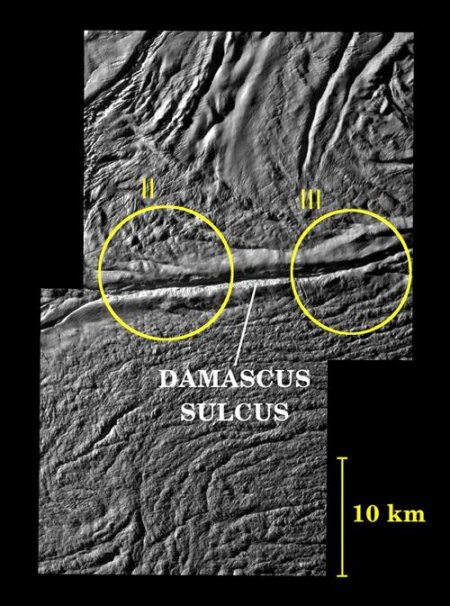
Image: Damascus Sulcus on Enceladus. One process that may be at work here is the sealing off of active vents by condensing water vapor, which then forces new jets to emerge elsewhere in the same fracture. Credit: NASA/JPL/Space Science Institute.
The method for getting the high-resolution images from this flyby was itself fascinating. Cassini was moving past Enceladus at 64,000 kilometers per hour, so it was necessary to compensate for the effects of that motion. Imaging team member Paul Helfenstein compared this to “…trying to capture a sharp, unsmeared picture of a distant roadside billboard with a telephoto lens out the window of a speeding car.” He goes on:
“Enceladus was streaking across the sky so quickly that the spacecraft had no hope of tracking any feature on its surface. Our best option was to point the spacecraft far ahead of Enceladus, spin the spacecraft and camera as fast as possible in the direction of Enceladus’ predicted path, and let Enceladus overtake us at a time when we could match its motion across the sky, snapping images along the way.”
Nice work!

Hi Paul;
The planetary geology aspects of these most recent several threads is fascinating.
I can imagine that the interesting aspects of Enceladus that we may discover this fall as well as the ongoing observation of the Martian Soil by Phoenix is going to generate a lot of interest in planetary geology and geochemistry. My hope is that these high profile missions will help jump start the global public’s interest in manned planetary space flight, especially in conjunction with the news of the VASIMR rocket and compact space based nuclear fission reactors.
I can imagine the by the 2030s or 2040s, high school students will be able to take planetary geography courses in public schools on a routine basis.
With the roughly 200 Moons that are known to exist within our solar system, one gets the feeling that the number of Moons in our galaxy may out do the number of planets perhaps by at least an order of magnitude. In line with some of the previous Tau Zero threads on extra-solar planets, such moons, especially those that are the size of Mars might be excellent locations to consider the prospects of finding life forms.
I wish Ad Astra and NASA the best of success with the planned test of the VASIMR on the ISS. It finally seems that we have a real concrete technology that can eventually enable us to sport around the solar system and beyond. It will be interesting if Mars or Earth massed rocky planets are found within the Kuiper Belt or Oort Cloud. Finding such would give us an impetus to start R&D on manned space travel hardware that could be a gateway bridging technology leading us to design, build, and launch humanities first manned starships.
Thanks;
Jim
Hi Paul
I just read Larry Niven & Edward M. Lerner’s “Fleet of Worlds” – set in the days of Beowulf Schaeffer, but focussed on a secret human colony the Puppeteers have on one of their agricultural planets. Nessus and his beau, Nike, feature prominently – Nessus being friendly to the human Colonists and leading them on a scouting mission to an Ice-Moon. Beneath that Ice-Moon they discover an intelligent species, the Gw’oth, who are a bit like colonial starfish, able to form natural parallel computing clusters by neural hookups. This enables them to simulate the environment above the ice and to preplan their development before emerging and discovering things like fire etc.
Their idea is a clever solution to the puzzle of how an obligatory aquatic ETI can develop technology. In the real Universe we should expect similar surprises – Europa and Enceladus being the first two such. But just about every ice-moon over~1,500 km in size has probably liquid layers due to radiogenic heating, especially with ammonia in the mix. Most will be too energy poor for Life, but they might be amenable habitats for colonists with a mind to remain out of sight.