
With the Kepler mission scheduled for launch this spring, we should see increasing attention in the media on the detection of terrestrial-class exoplanets and speculations on possible life upon them. But it’s easy to forget that Kepler has other important goals, taking estimates, for example, on the disposition of planets in multiple star systems, and studying the stars that have planets in orbit around them. Kepler will also be looking at planetary distribution, including ‘hot Jupiters,’ and examining their size, density and reflectivity.
A Deep Space Challenge for Bloggers
All of which is a tall order for a three and a half-year mission, but we can expect a successful run to result in an extended mission as Kepler keeps its gaze fixed on a region in space allowing it to monitor the brightness of more than 100,000 stars. Have a look at OrbitalHub‘s treatment of Kepler in the current Carnival of Space, where DJ runs through the mission parameters and examines the equipment. Looking for transits, Kepler will monitor more than 100,000 stars for the duration of the mission, with the capability of detecting terrestrial planets in Earth-like orbits. We’ll learn a great deal about the orbit, mass and temperature of many new exoplanets and may well find rocky worlds inside the habitable zone.
I’m glad to see bloggers taking on the challenge of longer posts to explain the background of developing missions like Kepler. And I notice that Ethan Siegel does much the same thing with the dark energy question at his Starts with a Bang! site. Siegel has the knack of explaining complicated things in everyday terms, as in his illustration of intrinsic brightness told in terms of 100 watt light bulbs, and the relation of that discussion to calculating cosmic distances. We use type Ia supernovae, in which a white dwarf draws mass from a companion star in sufficient amount to cause an internal collapse and subsequent explosion, as helpful distance markers and, as Siegel points out, they’ve given us evidence for dark energy.
Problems in Interstellar Propulsion Studies
What else can we do to promote education in deep space matters? I often think about this in terms of where we are in the discipline of propulsion studies. The second half of the 20th Century saw two distinct threads of interstellar propulsion concepts. The first centered on approaches workable through known physics — lightsails, magsails, beamed particle and pellet propulsion, fusion and, to the extent that we might one day learn how to create sufficient quantities of the stuff, antimatter. The second thread looks at more exotic concepts including the bending of spacetime through wormholes and the possibility of exploiting interesting and little understood quantum effects.
Both these approaches have their adherents, but interstellar propulsion research has taken place in a largely disjointed fashion, with researchers usually under-funded (if funded at all), doing this work in their spare time as they toiled at their day jobs. The recent publication of the AIAA volume Frontiers of Propulsion Science (edited by Marc Millis and Eric Davis) consolidates much current work on breakthrough concepts, and the appearance of the Tau Zero Foundation will, we hope, begin to draw the two strands of research into closer contact, seeking funding for practitioners whose peer-reviewed work includes near-term concepts where the physics is well understood and the chief problem is on the engineering (and economic!) side.
An Interstellar Agenda for Today
Uncertain economic times are doubtless going to put the brakes on many useful mission concepts, but we should continue to develop interstellar studies as a discipline by deepening our commitment to public education over the Internet. Interstellar studies also needs two things crucial to healthy debate. One is a regular journal, beginning on an annual basis, to offer a venue for current research, adding to what outlets like the Journal of the British Interplanetary Society and Acta Astronautica already do part-time. The second is the re-emergence of a Robert Forward/Eugene Mallove-style bibliography to consolidate useful papers and links in a readily available resource.
As we work on all this, public outreach will remain crucial for developing the support any robust space program needs. And so, more power to bloggers like DJ and Ethan Siegel, who along with their many colleagues around the globe continue to explain complex issues with both clarity and an insistence on scientific rigor. Getting to the stars will be a multi-generational challenge that will require long-term commitment and a willingness to look beyond the demands of the present to see the broader goal. And who knows, maybe the economic meltdown will shake us out of our complacency enough to remember that we’re building a future not just for ourselves but for our grandchildren’s children.

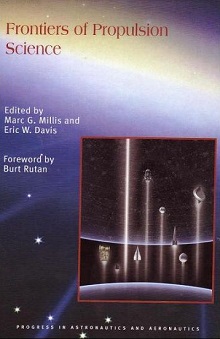
Not that I don’t think it’s worth it, but $130 is expensive for me (Frontiers of Propulsion Science). Maybe someone here will be kind enough to purchase a copy, then scan it and upload it for the sake of the propulsion community spirit.
Please forgive this rather ignorant question about the Keppler Mission, but I have to ask it. Will Keppler be able to observe the stars nearest to Sol/Terra for exo-planets such as Alpha Centauri, Tau Ceti, Epsilon Inidi, Delta Pavonis, Beta Hydri, 55 Cancri, etc or are they just to close and is Keppler going to be looking in the wrong direction especially for Alpha Centauri. The light cone showed in many illustrations for its field of view is a little confusing.
Thank You
KRH
It’s going to be a tough sell in this economic environment Paul, people tend not to think beyond the immediate in times like this.
Plus the waining interest in space programs by the youth in this country, the special interests who squawk “chemical rockets are the best we can do”, “robotic missions are cheaper and less dangerous”, “virtual reality and long-range sensing tech is faster and cheaper” and the most famous “physical interstellar travel is impossible because of immense travel times (see chem rocket rant).”
Be prepared to pack a lunch, dinner and breakfast for this struggle, it’ll be a looong one!
We’ll be lucky to have a human Mars mission by mid-century, if at all, let alone an interstellar flight!
If we do, it’ll be the Chinese or the Euro-Russians.
Peter, the price is indeed high, alas. Best way to view Frontiers of Propulsion Science is probably a university library.
Kenneth, it’s quite a good question, actually. Kepler’s gaze is fixated on the same star field to allow transit monitoring for the longest period possible. That meant choosing a field with a lot of targets, as it will be under investigation for at least 3.5 years. One of our resident astronomers can tell us, I hope, whether any of the stars you mention are in that field, although I know that Alpha Centauri isn’t, and I don’t think any of the others are.
A star map showing the Kepler field of view is available here, without the confusing 3D that is used in most of the press release images. The PDF version available from that page is probably more useful. The fields are in Cygnus and Lyra, so none of the stars you mentioned are in it. Remember the primary criteria for the Kepler field were that it could be continually observed throughout the year and having a large number of stars to observe, not for having famous nearby targets that would make good destinations for hypothetical interstellar missions.
Hopefully the mission will be extended and hopefully Kepler is able to move and look at many points in the sky. Obviously discovering a nearby rocky exoplanet is critical for an interstellar mission. I also think that it would do well to know of a nearby exoplanet for further studies which would best be done on a nearby exoplanet such as characterizing weather.
But on the bright side, just getting a better sense of the frequency of small planets would help spur interest in a future mission that would look at nearby stars for rocky planets.
The NYT Magazine almost got it -We need something new to propel the economy and We need to point out the past and futire sucesses of space tecnology-including interstellar Maybe we can learn somthing about fusion energy from building a fusion engine since we are going nowwhere with the current fusion reactors
I think for a few tens of billions we could at least deploy a laster that could blast a nano probe to 10 percent light
And Nanao tech ? I think that one is an easy sell….
I agree with Paul completely about this: even in the ages of Google Scholar & co. is such a structured bibliography an important tool.
I welcome volunteers to join in to the PI Library Rapid Prototype project – currently more or less dormant, help is needed to continue!
The Rapid Prototype should help in finding answers to several questions:
* Is there really a broad need for such a structured literature compilation?
* What kind of structure should be used? Should the original Mallove structure be adapted and enhanced, in order to take into account the developments of the last 20 years?
* What is the minimum information a library entry should contain?
Tibor