
My interest in solar sail concepts goes back to the days of Cordwainer Smith’s “The Lady Who Sailed the Soul,” a science fiction tale (Galaxy, April 1960) whose evocative conjuring of a fantastic future has always stayed with me despite far more realistic sail concepts from the pen of Arthur C. Clarke and Poul Anderson, to name but a few. But magsails — craft that operate by creating a magnetic field that can interact with the solar wind — offer possibilities just as robust, provided we can tame the propulsive effects of that wind. And this may not be easy, given the changing speed and strength of this stream of charged particles outbound from the Sun.
Moving in some cases faster than 400 kilometers per second, the solar wind seems to offer a clear path to the outer system, but we know all too little about it. That’s why I always keep an eye on attempts to measure the solar wind, including the IBEX (Interstellar Boundary Explorer) mission that examines the interactions between the solar wind and the interstellar medium. Much closer to home is a new proposal by Mason Peck (Cornell University), whose work on modular spacecraft and self-assembly has been discussed previously in these pages. Now Peck is pondering tiny spacecraft to monitor the solar wind close to home.
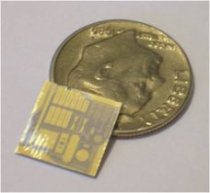
We’re talking about craft no more than 1-centimeter square, a 25-micrometer thick object that weighs less than 7.5 milligrams. This New Scientist article writes up Peck’s idea of putting a swarm of such ‘smart dust’ spacecraft at the Lagrangian point between the Earth and the Sun, where it could monitor solar wind strength and alert us to blasts of charged particles that could disrupt communications and other electronic systems here on Earth. Think of these solar wind sensors as tiny solar panels with a radio antenna. They could give us an extra thirteen minutes warning of a storm compared to NASA’s Advanced Composition Explorer. And they should give us a richer picture of the solar wind itself.
Image: Initial prototype of Peck’s candidate MII spacecraft, shown next to a dime for scale. Credit: Mason Peck/Cornell University.
But ‘swarm’ spacecraft open up intriguing possibilities in other directions. They’re essentially micro solar sails that would be highly responsive to solar radiation. In fact, they’re much like dust, as Peck explains in a paper on the subject:
Dust in the solar system experiences a surprising lifecycle. Solar pressure and electrostatic forces can compete with gravity to give very small particles highly nontraditional orbits. Some dust finds a stable orbit; some dust gently lands on the surface of planets like our own, and some dust is energetically ejected from the solar system.
Dust particles vary in size from a few molecules to 100 ?m and have a mass smaller than a few ?g. At these mass scales, the acceleration due to what would be considered perturbation forces on larger bodies can no longer be neglected. In fact, we propose that they be harnessed and manipulated in order to enable new propulsion techniques and missions. Dust’s unique behavior motivates the present study of the orbital dynamics of extremely small bodies and the development of a spacecraft capable of exploiting on these physical principles.
Inspired by the orbital dynamics of dust, Peck and colleague Justin Atchison present their goal:
We propose to fabricate this dime-sized spacecraft on a single ultra-thin substrate of silicon. This choice reduces the total mass to fewer than 7.5 mg and makes the spacecraft bus itself a solar sail, yielding a lightness number ? of 0.0175. This architecture can provide passive solar sail formations and various passive methods of changing orbital energy. We also consider augmenting this architecture with traditional CP1 sail material (? of 0.1095) to reduce transfer times further.
Peck uses the term ‘Microscale Infinite-Impulse (MII) spacecraft’ to describe objects like these, and a prowl around his Web contributions at Cornell reveals possible applications from the kind of solar wind reporting discussed here to swarm spacecraft that can perform in-orbit inspections of larger craft, or even a chain of craft that can push into the interstellar medium, reporting by relaying data back to Earth through each subsequent craft. Peck’s paper “A Passive Microscale Solar Sail,” AIAA SPACE 2008 Conference & Exposition, San Diego, CA, Sep 9-11, 2008, is the place to begin. It’s available online. Thanks to John Freeman for the pointer to the New Scientist story.


A wonderful application of such smart dust would be for solar power generation. If the antenna on those chips could be precisely phased, a sufficiently large cloud of millions of chips could collaborate to generate a tightly focussed microwave beam of the sort that SSPS designers envision to return power to Earth, but without any of the structural hardware.
Interesting ideas. I’ve heard though that very small spacecraft would be vulnerable to radiation damage. Is this right?
another potential application for graphene.
Smart dust has a certain coolness factor. Would be interesting if it could be accelerated to interstellar speeds by a near-term Solar Power Sat or some such. Imagine Smart-Dust being fired off by one of Young Bae’s Photon Thrusters…
In the paper it’s mentioned that an internal power supply (ie a battery) would be difficult to fabricate into a chipsat like this. I’m wondering how this affects the idea of a having a train, or cloud of these heading for the outer solar system. The ones still in the inner solar system wil have abundant power to relay signals to earth, but how will the ones actually in the outer solar system be powered? I know ‘difficult’ to fabricate a battery doesn’t mean it can’t be done, but does anyone have any ideas on exaclty how it could be accomplished?
Marsbug: Small amounts of power can be generated with radioisotopes. There are devices suitable for microminiaturization, such as betavoltaics and the radioisotope piezoelectric generator: http://en.wikipedia.org/wiki/Atomic_battery
That might not be enough to generate much power for communication, but again, configuring millions of free-flying emitters into a phased array could solve this problem.
Phased arrays do not have to be flat or ordered, but they do have to be large and dense to generate a tight beam. The simplest way to phase an unordered array is with a pilot beam of double the frequency directed at the swarm. Some simple phase inversion circuitry in each emitter will then amplify and reflect the beam back to the exact the spot where the pilot is coming from, focused as much as the diffraction limit allows.
Here’s a couple of images of microbatteries:
– http://www.mtbeurope.info/news/images/epimpbat-s.jpg
– http://scienceservice.si.edu/2055/003017.jpg
Thanks guys! :)
Upon reflection, I did find this article:
https://centauri-dreams.org/?p=9961
I wonder if the idea behind the NIF could be adapted for a starship application and on D-D fuel?