
Although we talk about space-based observatories ‘discovering’ planets, the actual process is much more complex. Data from CoRoT, for example, must be validated carefully to make sure that what is being observed is actually a planet. That means turning to follow-up observations by ground-based telescopes, so that the whole package of photometric and spectroscopic data can confirm the planet and help us understand the system in which it orbits. New results from the Second CoRoT Symposium in Marseille are in, adding another 10 planets to CoRoT’s roster.
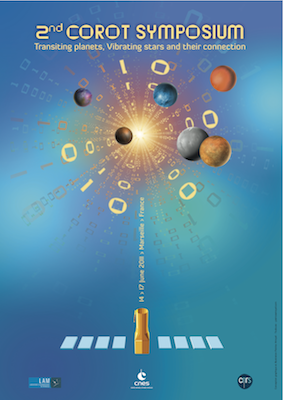
Thus we get seven ‘hot Jupiters,’ a planet smaller than Saturn (CoRoT-22b), and a pair of Neptune-mass planets (CoRoT-24b and CoRoT-24c) orbiting the same star. These gaseous planets come in a wide range of densities, from one that is roughly as dense as Saturn to higher densities comparable to Mars. It’s also an interesting mix in terms of age. CoRoT-17b is, at 10 billion years, twice as old as the Sun, while CoRoT-18b is still a juvenile at 600 million years. And we have two planets (CoRoT-16b and CoRoT-20b) on highly elliptical orbits, posing questions about the long-term survival of such orbits.
Malcolm Fridlund, ESA’s project scientist for CoRoT, comments on the finds:
“Although the study of exoplanets is relatively young, we have already reached a stage where we can characterise the details of worlds orbiting other stars, and CoRoT is making a crucial contribution to this field. With hundreds of systems observed to date, we no longer have to worry about ‘taming the beasts’ and we can dedicate our efforts to the ‘zoology’ of exoplanets, which is enormously enhancing our knowledge about planetary systems.”
Zoology indeed, a careful process of classification and analysis that we have only begun on the exoplanet front. CoRoT has now found 26 confirmed extrasolar planets, with 401 planet candidates still in the process of confirmation. While the transit data from the space observatory can measure the radius of a planet, the measurement of the planet’s mass requires ground observations using the Doppler method. We can look with great satisfaction at the results of missions like CoRoT even as we ponder the kind of space observatories we’ll need in the future, when our attention turns to nearby stars in the hopes of studying planetary atmospheres. Think TESS and PLATO, for starters.
A number of papers on the CoRoT findings are either available or have been submitted for publication, among them Sz. Csizmadia et al., “Transiting exoplanets from the CoRoT space mission – XVI. The hot Jupiter CoRoT-17b: a very old planet,” Astronomy & Astrophysics, 531, A41 (2011) — abstract available — and E. W. Guenther et al., “Transiting exoplanets from the CoRoT space mission – XIX. CoRoT-19b: a low density planet orbiting an old, inactive F9V-star,” submitted to Astronomy & Astrophysics.


CoRoT is doing great work. It is also providing very good asterioseismology data for astronomers to enjoy.
It could be said that all stars are variable, it’s just a question of how much.
Consider the finding announced by the AAS that our star may be entering a quiet phase of unknown length, somewhat suggestive of the Maunder Minimum. It surprised me, alright. Time will tell how accurate these solar astronomers forecasts are. But if true look at the bright side, no worries about dangerous power grid destroying CME events for the next few decades.
Paul, do you think the AAS annoucement might be worth an article here for discussion?
Mike, the AAS story was indeed interesting, and it may figure in something here in the near future. CoRoT will be telling us much more in the realm of asteroseismology.
Certainly interesting to see how the differing data release strategies of CoRoT and Kepler influence the perception of these missions, and the amount of followup literature.
Scientists losing hope of reviving French telescope
BY STEPHEN CLARK
SPACEFLIGHT NOW
Posted: January 4, 2013
Scientists are losing optimism in the recovery of a French planet-hunting space telescope that suddenly stopped producing science data in November.
Full article here:
http://www.spaceflightnow.com/news/n1301/04corot/