
Newly interpreted data from the New Horizons spacecraft tells us that Pluto has more water ice on its surface than we once thought. The image below tells the tale, a false-color view derived from observations by the Ralph/Linear Etalon Imaging Spectral Array (LEISA) instrument. Here we’re at infrared wavelengths and can see areas showing the spectral signature of water ice. Note the sharp contrast between the left and right sides of the image below.
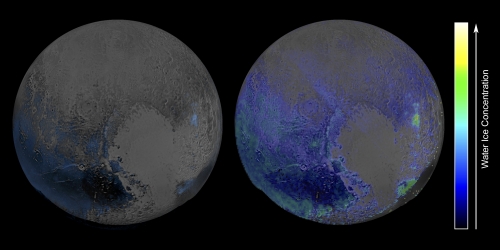
Image: This false-color image is derived from observations in infrared light by the Ralph/Linear Etalon Imaging Spectral Array (LEISA) instrument. It is based on two LEISA scans of Pluto obtained on July 14, 2015, from a range of about 108,000 kilometers. Credit: NASA/Johns Hopkins University Applied Physics Laboratory/Southwest Research Institute.
The two scans, as this JHU/APL news release explains, were taken about fifteen minutes apart and merged into a ‘data cube’ — a three-dimensional array covering the hemisphere New Horizons could see during the flyby last summer, where an image of Pluto is formed at each wavelength of light to which LEISA is sensitive. The map on the left was made by comparing LEISA spectra with a pure water ice template spectrum. When using this technique, methane ice can easily mask the spectral signature of water ice.
The result: A map sensitive only to those areas particularly rich in water or depleted in methane. On the right is an image that more fully models the various ices, showing the true extent of water ice. Interestingly, we still see little water ice in Sputnik Planum (left of Pluto’s ‘heart’) and Lowell Regio (far north on the encounter hemisphere). This would indicate that the ice ‘bedrock’ is buried beneath a thick blanket of ices like methane, nitrogen and carbon monoxide.
Infrared Views of Pluto’s Atmosphere
We’re also working with data from the LEISA instrument in the image below. Captured on July 14, 2015 at a distance of 180,000 kilometers, the image covers the full spectral range (1.25 to 2.5 microns) of the instrument. North in the image is at about the 10 o’clock position.
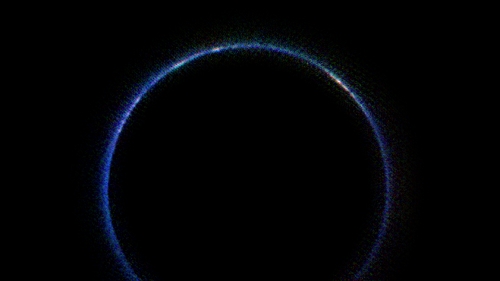
Image: This image from NASA’s New Horizons spacecraft is the first look at Pluto’s atmosphere in infrared wavelengths, and the first image of the atmosphere made with data from the New Horizons Ralph/Linear Etalon Imaging Spectral Array (LEISA) instrument. Credit: NASA/Johns Hopkins University Applied Physics Laboratory/Southwest Research Institute.
The blue ring we see in the image is the result of sunlight scattering off haze, as JHU/APL explains in this second news release:
…scientists believe the haze is a photochemical smog resulting from the action of sunlight on methane and other molecules, producing a complex mixture of hydrocarbons such as acetylene and ethylene. These hydrocarbons accumulate into small particles – a fraction of a micrometer in size – which scatter sunlight to make the blue haze.
Infrared images like these can be combined with images made at shorter wavelengths to help researchers understand the size distribution of the particles. The New Horizons team tells us that the white patches that show up around Pluto’s limb are where sunlight is bouncing off more reflective areas on Pluto’s surface. The largest of these would be the the area now being called Cthulhu Regio (the H.P. Lovecraft reference still delights me). We have much more data ahead from New Horizons, and can expect fuller views of the atmosphere in the course of the year.
A Change at the Top

I also want to note that New Horizons has a new project manager. Helene Winters takes over the role from Glen Fountain, who had been project manager since early 2004. Winters served as project manager for the Mini-RF lunar radar instrument, and most recently as project manager for the MESSENGER mission, which orbited Mercury for four years before a planned dive into Mercury’s surface last April. Winters will also continue as MESSENGER project manager through that mission’s closeout stages. Says principal investigator Alan Stern:
“Over the past 15 years New Horizons has had two of the finest project managers in the space business, the late Tom Coughlin, who helped conceive the mission, and the legendary Glen Fountain, who built New Horizons and flew us to Pluto. Helene Winters, from a new generation and with incredible experience behind her, is going to set new milestones flying the spacecraft farther, hopefully to the first ever flyby of a Kuiper Belt object and onward toward the edge of our planetary system!”
The outer system, as we’ve learned in recent days, is getting more and more interesting. As we look forward to the New Horizons KBO flyby in January of 2019, we should also keep pondering the kind of follow-up mission that New Horizons merits. We need observations of the local interstellar medium beyond the heliosphere and we also have a wide range of Kuiper Belt targets, not to mention the eventual goal of reaching the Sun’s gravity focus at 550 AU. Tune up the technologies to reach these distances and, if it’s really out there, we might just visit the hypothesized Planet Nine.



Lockheed Martin SPIDER optical system
I love DARPA!
40 page pdf infographic
https://www.nasa.gov/sites/default/files/files/Ben_Yoo_LowMassPlanarPhotonicImagingSensor.pdf
A more in depth write up;
http://www.amostech.com/TechnicalPapers/2013/Space-Based_Assets/KENDRICK.pdf
Take a look a what this could do at Europa, 17x the resolution at 10x the area, the same weight as conventional imager.
Some light loss do to design but probable will be correct once the design is improved.
Good possibility that correction for atmospheric turbulence is easily done because of the small size of sensors.
The big deal is the system should be scalable and the PIC can be mass produced, in fact Vice President Biden was at the launching of a new lab and manufacturing facility for producing these photonic devices – Military Money big time!
NASA weighing dual launches of Europa orbiter and lander – See more at:
http://spacenews.com/nasa-weighing-dual-launches-of-europa-orbiter-and-lander/
New Horizons… the craft that keeps on giving. Good to know just how much of the surface has exposed H2O after all, and mildly surprising. Let’s hope the glitches with the DSN doesn’t extend the complete downloading for too much longer.
And it looks like ‘The NH Team’ has already started mulling over a closer flyby in Jan2019 than mentioned before… it may be between two-to-three thousand km. Did I hear that correctly?
not to mention the eventual goal of reaching the Sun’s gravity focus at 550 AU.
Yes, but in which direction? We have literally millions of possible targets to examine.
Towards Planet X-9 of course! :^)
Gravity focus destination? To spy on the Alpha/Proxima Centauri star system, of course!
Are there any reports available mentioning what was the volume of water expected vs estimate of water volume found?
From what I read I’m unable to tell whether it’s 0.1% more or 1000% more.
It’s a rather important piece of information, if we’re ever to use Pluto as a service station on the outskirts of our system.
I expect Pluto to be made up substantial amounts of water ice, it is just that the other volatile materials coat it CO being one of them I bet.
Would the many, many smaller KBOs / TNOs be easier to use due to their smaller mass and therefore escape velocities?
Not saying Pluto wouldn’t or couldn’t be used as a base and resource, but if we just want the water, the abundant smaller bodies might suffice.
I’d love to see more papers on “gravscopes” of the type Maccone describes. One interesting factoid is that we don’t have to fly out to 550 AU to start experimenting with the tech. If we restrict our viewing to the ecliptic, we can use synthetic methods right now with an orbiting scope.
Here is an interesting piece on Pluto when the sun goes red giant.
http://www.exoclimes.com/topics/the-far-future-of-the-solar-system-pluto-as-an-ocean-planet/
Did Charon once have an ocean?
http://www.nasa.gov/feature/pluto-s-hulk-like-moon-charon-a-possible-ancient-ocean/
When New Horizons and SOFIA worked together to explore Pluto:
https://www.sciencenews.org/article/120-seconds-plutos-shadow
Is there any prospect of getting a flyby of Pluto’s “twin”, Eris?