
When researchers talk about ‘hot Saturns,’ it’s natural to imagine a ringed planet in a close orbit to its star, rings being Saturn’s most prominent feature. But WASP-39b hardly fits this picture. Some 700 light years from Earth in the constellation Virgo, this is a tidally locked world that is 20 times closer to its star than the Earth is to the Sun. WASP-39 itself is a G-class star of about 90 percent of the Sun’s mass. We have no evidence of planetary rings here, but we do see a planet whose temperature reaches 776 degrees Celsius, with a nightside not much cooler.
What keeps this world from being called a ‘hot Jupiter’ is its low density coupled with a large radius, some 1.27 times that of Jupiter (its density is about 0.28 times that of Jupiter). ‘Puffy’ planets like this show density levels far more like Saturn, and they orbit close to their stars, accounting for their extended atmospheres. WASP-39b’s atmosphere appears free of high-altitude clouds, allowing detailed study of its composition. Now we have word that the planet shows the signature of water vapor, three times as much as found on Saturn.
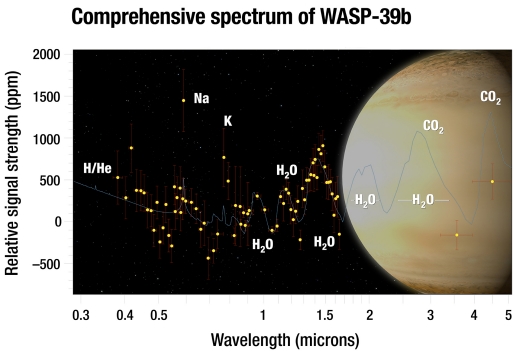
Image: Using Hubble and Spitzer, astronomers analyzed the atmosphere of the “hot Saturn” exoplanet WASP-39b, and they captured the most complete spectrum of an exoplanet’s atmosphere possible with present-day technology. By dissecting starlight filtering through the planet’s atmosphere into its component colors, the team found clear evidence for water vapor. Although the researchers predicted they would see water, they were surprised by how much water they found – three times as much water as Saturn has. Credit: NASA, ESA, G. Bacon and A. Feild (STScI), and H. Wakeford (STScI/Univ. of Exeter).
Transmission spectroscopy is the method here, analyzing light from the host star as it filters through the planet’s atmosphere during a transit. Hannah Wakeford (STscI and University of Exeter) is lead investigator on the WASP-39b work. Retrieved with the Hubble Space Telescope and the Spitzer instrument, her team’s data provide about as complete a spectrum of an exoplanetary atmosphere as current technology will allow. Says Wakeford: “This spectrum is thus far the most beautiful example we have of what a clear exoplanet atmosphere looks like.”
The formation history of worlds like these is suggested by the unexpectedly high values for water vapor. The implication is that the planet must have formed far from the star, beyond the snowline in a region where icy materials are abundant. That would mean a planetary migration into the inner system, perhaps creating havoc among smaller planets in inner orbits.
“WASP-39b shows exoplanets can have much different compositions than those of our solar system,” said co-author David Sing of the University of Exeter. “Hopefully, this diversity we see in exoplanets will give us clues in figuring out all the different ways a planet can form and evolve.”
The next move in the WASP-39b story will be to subject it to the James Webb Space Telescope, assuming a successful launch in 2019 (or perhaps later, given the recent report from the Government Accountability Office — see Marina Koren’s excellent analysis in The Atlantic for more on the problem). Once JWST is available, a more complete spectrum including atmospheric carbon will become possible, fleshing out our understanding of this unusual planet’s formation.

I didn’t think it was possible that a gas giant could migrate from a point within the snowline to the inner region near a star. Two gas giants can line up through resonance and with gravity pull each other closer and drag other gas giants through the accretion disk to a point near the star http://www.iflscience.com/space/planet-resonance-highlights-gas-giants-inwards-migration/
A far-flung exoplanet may have thrown its sibling under the bus
Phil Plait from Bad Astronomy
March 1, 2018
ith nearly 4,000 exoplanets (and counting!) having been discovered so far, a few of them are going to be, well, weird. While HIP 65426 b may not be the weirdest, it’s still pretty odd.
OK, to be fair, the planet seems like a fairly normal Jupiter-like planet. What’s peculiar isn’t what it is, but where it is: Apparently, it’s at least 14 billion kilometers from its star! That’s three times farther out than Neptune is from the Sun.
How did it get out there?
http://www.syfy.com/syfywire/a-far-flung-exoplanet-may-have-thrown-its-sibling-under-the-bus
A star like the Sun has *six* gas giants orbiting it… with two in its habitable zone
Phil Plait from Bad Astronomy
March 5, 2018
Astronomers have discovered a pretty interesting multi-planetary system orbiting a nearby star. Each of the exoplanets is apparently a gas giant, but two of them orbit the star in the habitable zone, where liquid water could exist!
To be clear, gas giants don’t have a surface — they have such tremendous atmospheres that as you go down inside them the air just gets thicker, merges into a liquid mantle, then finally gets crushed into a solid deep down near the core — but they do tend to have moons, some of them quite large. And that makes this system very interesting indeed …
The planets orbit the star HD 34445 (the 34,445th entry in the Henry Draper catalog of brightish stars). The star itself is at first glance a lot like the Sun: It’s a type G0 star, just slightly warmer and just a scosh more massive than the Sun (1.07 times as massive, to be specific).
I was surprised, however, to see it’s bigger than I expected, about 1.38 times the Sun’s diameter, and twice as luminous. I’d think those numbers would be much closer to the Sun’s, but then I saw the age and understood: It’s 8.5 billion years old, nearly twice as old as the Sun, and that means it’s starting to run out of fuel in its core. It’s starting the slow expansion into red giant territory.
Full article here:
http://www.syfy.com/syfywire/a-star-like-the-sun-has-six-gas-giants-orbiting-it-with-two-in-its-habitable-zone
Solar systems like these, where a gas giant planet migrates inward (or outward), likely with disastrous results for any inhabited terrestrial planets “in the way,” might be another–unwelcome–factor that could push a civilization to develop interstellar travel. One could, with rueful humor (at least we, on Earth, can afford to laugh at it), call this the “When Worlds Collide” scenario…
Whatever planets may do, any civilization with a decent astronomy program will know that unless their parent sun is a red dwarf, most stars will eventually die one way or another. Unless they know how to keep their star in the Main Sequence beyond its normal life span, or know some other way to remain alive and functioning as a society after their sun goes off the rails, interstellar migration is just about the only other option.
Hmm, maybe Dark Star had the right idea how to handle unstable planets after all…
https://centauri-dreams.org/2017/11/19/dark-star-and-staring-into-the-cosmic-abyss/
Hubble Finds Huge System of Dusty Material Enveloping the Young Star HR 4796A
http://spaceref.com/exoplanets/hubble-finds-huge-system-of-dusty-material-enveloping-the-young-star-hr-4796a.html