
Usually when we talk about outer planet moons with oceans, we’re looking at Jupiter’s Europa, and Saturn’s Enceladus. But evidence continues to mount for oceans elsewhere. In the Jupiter system alone, Callisto and Ganymede are likewise strong candidates, while Saturn’s Titan probably has a layer of liquid water. Pluto’s moon Charon may possess an ocean of water and ammonia, to judge from what appears to be cryovolcanic activity there. At Neptune, Triton’s high-inclination orbit should produce plenty of tidal heating that may support a subsurface ocean.
Let’s pause, though, on another of Saturn’s moons, Dione. Here we have evidence from Cassini that this world, some 1120 kilometers in diameter and composed largely of water ice, has a dense core with an internal liquid water ocean, joining Enceladus in that interesting system. But what engages us this morning is not liquid water but a set of straight, bright stripes discovered on the surface and discussed in a new paper from Alex Patthoff (Planetary Science Institute) and Emily Martin (Center for Earth and Planetary Studies, Smithsonian Institution).
The term being used for these lines is linear virgae, linear ‘stripes’ of color, that are apparently the result of interactions with Saturn’s rings and, possibly, the co-orbital moons Helene and Polydeuces (the latter follows Dione at its trailing Lagrangian point, the former orbiting at the leading L4 Lagrangian point).
“The evidence preserved in the linear virgae has implications for the orbital evolution and impact processes within the Saturnian system,” says Patthoff. “Plus, the interaction of Dione’s surface and exogenic material has implications for its habitability and provides evidence for the delivery of ingredients that may contribute to the habitability of ocean worlds in general.”
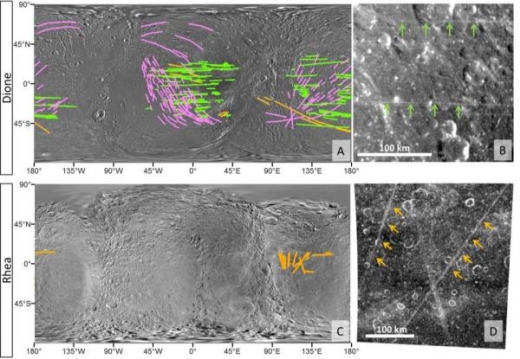
Image: Distribution of linear virgae on Dione and Rhea. Shown are the distribution of linear virgae (green) crater rays (pink) and candidate linear virgae (orange) a. Global distribution of linear virgae, crater rays, and candidate linear virgae on Dione. b. Detailed view of linear virgae (green arrows) on Dione. Image No. N1649318802 centered at 22°W, 10°N. c. Global distribution of candidate linear virgae on Rhea. d. Detailed view of candidate linear virga. Credit: A) Basemap from Roatsch et al, 2008. B) Image No. N1649318802. C) Basemap from Roatsch et al, 2012. D) Image No. N1673420688.
The linear virgae on Dione range between 10 and hundreds of kilometers in length and less than 5 kilometers in width, showing up as substantially brighter than the surrounding terrain. Interestingly, they’re also parallel and appear to overlay other surface features, an indication of their relative youth compared to surrounding topography. Patthoff again:
“Their orientation, parallel to the equator, and linearity are unlike anything else we’ve seen in the solar system. If they are caused by an exogenic source, that could be another means to bring new material to Dione. That material could have implications for the biological potential of Dione’s subsurface ocean.”
Thus we have another potential habitat for biology beneath an icy moon’s crust. Cassini imagery showed inactive fractures at Dione similar to those found at Enceladus, and the spacecraft’s magnetometer also detected a faint particle stream coming from the moon. In 2013, Noah Hammond (Brown University) and colleagues examined the Janiculum Dorsa mountain and ridgeline in Cassini data, finding that the moon’s crust seemed to have flexed beneath the mountain, an indication of a subsurface ocean and warm crust at least at the time the area formed. Why Enceladus is so active in comparison to Dione is an open question.
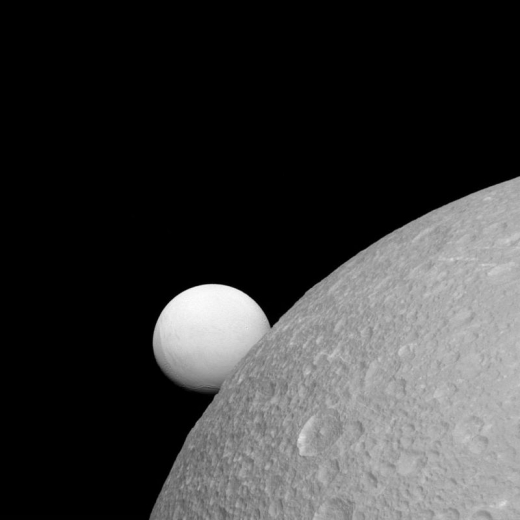
Image: Although Dione (near) and Enceladus (far) are composed of nearly the same materials, Enceladus has a considerably higher reflectivity than Dione. As a result, it appears brighter against the dark night sky. The surface of Enceladus (504 kilometers across) endures a constant rain of ice grains from its south polar jets. As a result, its surface is more like fresh, bright, snow than Dione’s (1123 kilometers across) older, weathered surface. As clean, fresh surfaces are left exposed in space, they slowly gather dust and radiation damage and darken in a process known as “space weathering.” This view looks toward the leading hemisphere of Enceladus. North on Enceladus is up and rotated 1 degree to the right. The image was taken in visible light with the Cassini spacecraft narrow-angle camera on Sept. 8, 2015. Credit: NASA/JPL-Caltech/Space Science Institute.
The paper is Martin & Patthoff, “Mysterious Linear Features Across Saturn’s Moon Dione,” Geophysical Research Letters 15 October 2018 (abstract). The Hammond paper is “Flexure on Dione: Investigating subsurface structure and thermal history,” Icarus Vol. 223, Issue 1, (March 2013), pp. 418-422 (abstract).


IMHO, Very week connection between facts.
Is there, somewhere, scientific example of relation between biologic life and nice ice line shapes?
It seams to be another one example of wishful thinking.
It’s not saying it’s evidence of life, it’s saying it’s evidence of continued delivery to the surface of Dione that could be used by life in the subsurface ocean.
Unfortunately, there is rather a lot of ice between the surface and the underlying global ocean, 99 +/- 23 km. When I read the average thickness of Antarctica’s ice cover is 1.9 km, it does give some perspective. I’m no planetary scientist, but I can’t conceive of a mechanism that would transport surface material through 99km of ice to the water beneath.
I understood well what article saying, but still cannot catch connection between “continued delivery to the surface” and life?
I suppose that every astronomer can tell us that there is lot of asteroids (meteors, comets etc.) that are sometime falling on the surface of every planet in the Solar system, so interplanetary material “delivery” continue every moment since Solar system creation. In the past “delivery” was more active…So what?
Does authors suppose that ice strips were a last break in the “life wall”? Everything else for life exists on the Dione, only material delivery was lack?
As well as I know it is even not proved that there is liquid water somewhere on Dione… but yes there is ice strips :-)
Let open minds:
Wandering, may be author means (underscore) importance of material delivery for panspermia life spread? So interplanetary material delivery could be important, but panspermia suppose that there is life somewhere on neighbor planet that has similar to Dione “wheather” conditions (i.e. dead place for “Earth life forms”).
If panspermia is the key – it will be logically suppose that Saturn orbit is rich by life … that hoping from one satellite to another and like close zero Kelvin conditions.
We’re not talking panspermia, we’re talking delivery of ‘stuff’ life uses – everything else other than water – to a world made of a lot of water where there may be very few interfaces between liquid water and ice. So sulfur, silicates, carbonaceous chrondites, all sorts that could rain down on the surface could be used IF there was life IF the stuff could get to the liquid water and then the life. Two big ifs there. I don’t know about life, but I see zero interaction between the surface and the inner ocean unless we’ve got the crust modelling completely wrong.
Ok, me too supposed that it is not about panspermia.
In connection to space-surface delivery, I suppose that during Dione existence there was delivered and collected enough (and exactly same) material, so nice ice strips are not changing much in moon’s chemical balance.
There is possible to make false conclusion, form this article that those cosmic ice strips – are important elements for life existence, we do not have any facts or evidence that proving this hypothesis.
The material delivery from surface to possible liquid water layer (if it exists at all) can be more problematic than space to surface material delivery.
Summary, If talking about beliefs only – I do not believe there is life exists on any of speculated ice moons (Europe, Ceres , Dione etc.) – there is not enough energy to support life (in form as we know it on our planet) .
In the case of possibility of non-earth-like-life-form – we simply do not know any information and parameters how it can look like (may be those life form like to eat on their breakfast metallic hydrogen or deuterium or helium-3).
Um,
Interesting article, but the image caption got to me:
“As a result, it appears brighter against the dark night sky.”
This is like totally in space, yeah? Saying “day” and “night” is soooo “on-planet” :-)
I guess it would be cool to say just “dark sky”.
Michael
There must gravitational stress operating on this moon. It is too small
to have it’s core still be a powerful engine of heating.
Rhea is close to it, but it’s probably when Titan and Rhea, and Saturn
tugs at it from both ends that more energy is gained for heating.
What wonderful treasures await those who will explore this
mini-solar system. If not defacto now, I think ESA should be the
lead on Saturn System exploration, and Jupiter system
be NASA’s Domain. They can piggy back on each others main vehicles to get more probes overall in these Jovian systems, (ala
Cassini_Huygens)
I still think the folks at unmanned spaceflight got this right when brainstorming the ridges and crater chains on Phobos.
The consensus was that these were from impact ejecta that formed rings, that orbits slowly degraded, causing the ring materials to skip and roll across the surfaces.
We see these lines and crater chains on nearly every small body in the system, so it must be something simple and easily reproduceable to observe it so often.