
We’re seeing our final images of asteroid Ryugu as the Hayabusa2 spacecraft leaves its orbit some 300 million kilometers from Earth. The Japanese Aerospace Exploration Agency (JAXA) intends to keep taking images of the receding Ryugu for several more days, after which it will be necessary to perform an attitude control maneuver to orient the craft for proper operation of its ion engines. An ion engine test period will culminate in cruise operations on December 3 to return the spacecraft to Earth.
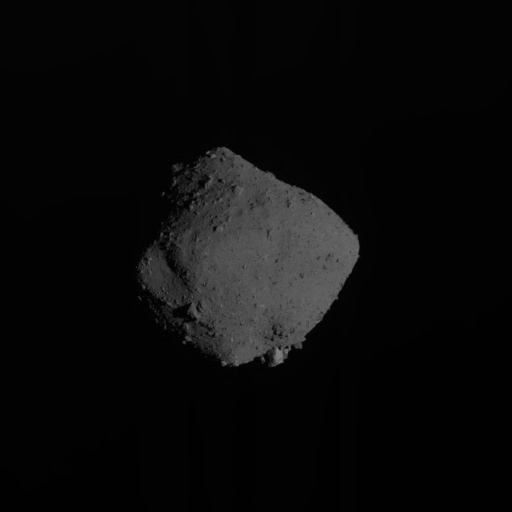
Image: Asteroid Ryugu captured with the Optical Navigation Camera – Telescopic (ONC-T) immediately after departure. Image time is November 13 10:15 JST (onboard time), 2019. Credit: JAXA, Chiba Institute of Technology, University of Tokyo, Kochi University, Rikkyo University, Nagoya University, Meiji University, University of Aizu, AIST.
Happily, we are asked to join in JAXA’s ‘Goodbye Ryugu’ campaign by sending a #Sayonara_Ryugu tweet (https://twitter.com/haya2e_jaxa), although the agency also encourages old-fashioned cards and letters (as a collector of vintage fountain pens, I rather appreciate this). The address: Hayabusa2 Project, JAXA Institute of Space & Astronautical Science (ISAS), 3-1-1 Yoshinodai, Chuo-ku, Sagamihara City, Kanagawa Prefecture, 252-5210, Japan.
Says JAXA: “5 years after launch and at the conclusion of about a year and a half of missions at Ryugu, we would love to hear your thoughts on Hayabusa2 and asteroid Ryugu.”
Departure images will be available here. As always, it’s exhilarating to see the crew at a spacecraft command center cheering, as they did after project manager Yuichi Tsuda confirmed the departure.
[Japan 13:20 JST] Today’s operation is coming to an end. We took a commemorative photo of everyone during the operation. The lively atmosphere is calm and just a few people are now in the control room. (? ISAS/JAXA) pic.twitter.com/NWTKD4ttQo
— HAYABUSA2@JAXA (@haya2e_jaxa) November 13, 2019
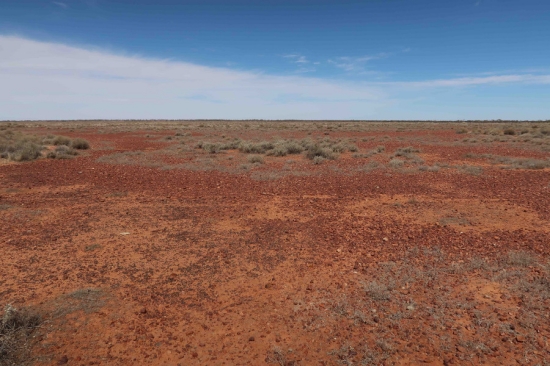
Now we think ahead to the sample return, scheduled for the end of 2020 when the Hayabusa2 re-entry capsule will be recovered at the Woomera Prohibited Area (WPA) located in the outback desert of South Australia. It’s a long way from there to here, but have a look at the candidate recovery site (image credit: JAXA). Final details are still being negotiated with the Australian government, according to Tsuda.
Remember that Hayabusa2 made two touchdowns on the asteroid, the first in February of this year, the second in July. We have surface material as well as underground samples to look forward to, and may learn valuable lessons about the distribution of carbon, organic matter and water in the Solar System. The underground materials, unaffected by radiation to which the surface was exposed, should offer insights into the formation of the Solar System some 4.6 billion years ago.
An ion engine powered space probe! I like that!
I am going to be very interested in the organics detected in the subsurface material. Will they confirm what was found in teh Murchison meteorite, or will there be new discoveries? Will there be organics on teh surface, perhaps PAHs, or will they be absent?