
3548 Eurybates is a Jupiter trojan, one of the family of objects that have moved within the Lagrange points around Jupiter for billions of years (the term is libration, meaning these asteroids actually oscillate around the Lagrange points). Consider them trapped objects, of consequence because they have so much to tell us about the early Solar System. The Lucy mission aims to visit both populations (the ‘Greeks’ and the ‘Trojans’) at Jupiter’s L4 and L5 Lagrangians when it heads for Jupiter following launch in 2021.
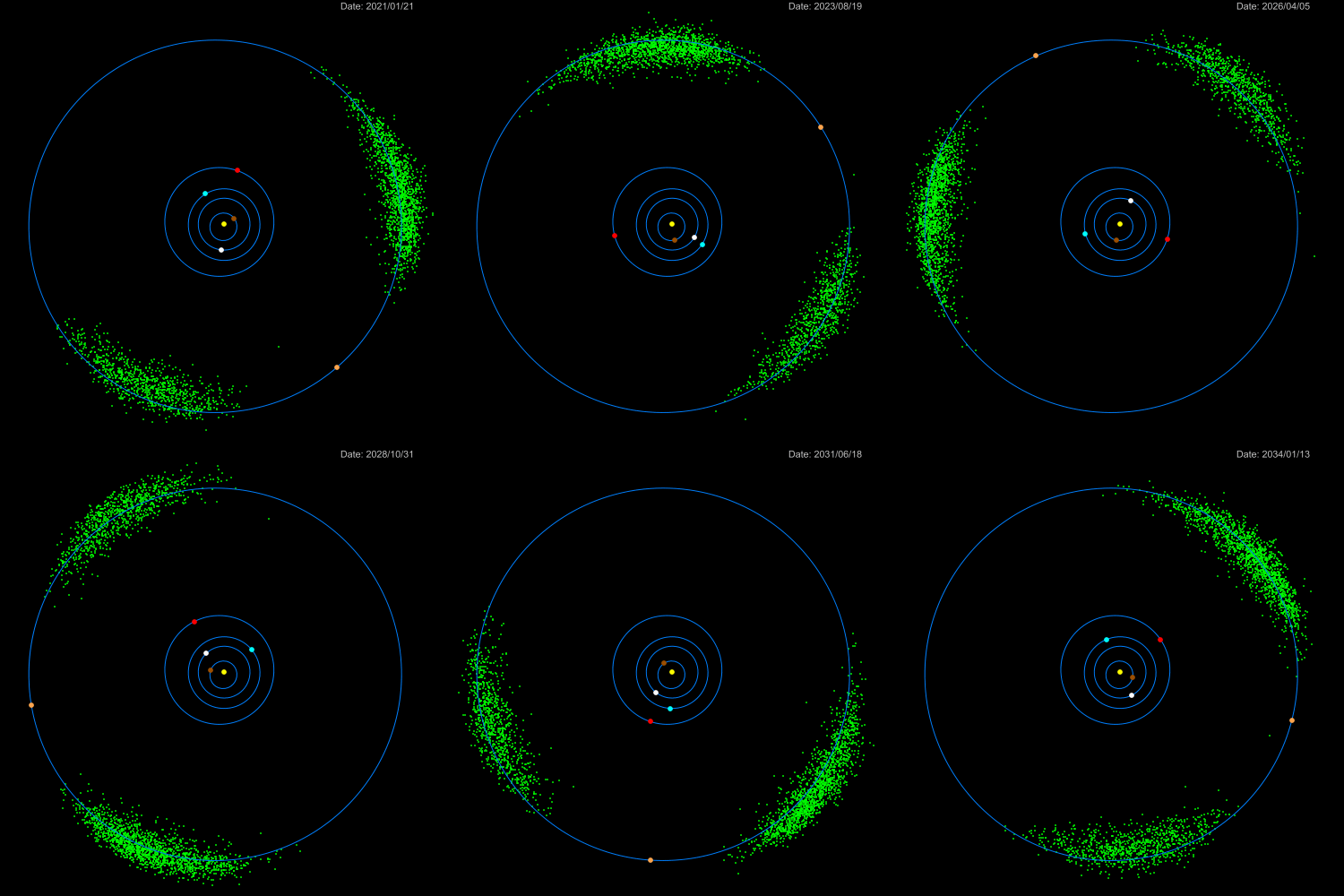
Image: During the course of its mission, Lucy will fly by six Jupiter Trojans. This time-lapsed animation shows the movements of the inner planets (Mercury, brown; Venus, white; Earth, blue; Mars, red), Jupiter (orange), and the two Trojan swarms (green) during the course of the Lucy mission. Credit: Astronomical Institute of CAS/Petr Scheirich (used with permission).
Right now the focus is on Eurybates as mission planning continues, for we’ve just learned thanks to the Hubble instrument’s Wide Field Camera 3 that this asteroid has a moon, an object more than 6,000 times fainter than Eurybates itself. According to mission principal investigator Hal Levison (Southwest Research Institute), that implies a diameter of less than 1 kilometer. The tiny moon will be among the smallest asteroids visited by Lucy, which is intended to perform flybys of six trojans, as well as a main belt asteroid along the way.
Thomas Statler is a Lucy program scientist at NASA headquarters in Washington:
“There are only a handful of known Trojan asteroids with satellites, and the presence of a satellite is particularly interesting for Eurybates. It’s the largest member of the only confirmed Trojan collisional family – roughly 100 asteroids all traceable to, and probably fragments from, the same collision.”
It took three tries with Hubble to confirm the satellite’s existence, a tricky job given the object’s faintness and unknown orbit around the much brighter Eurybates. Now the task is to figure out when it will become visible again, for Eurybates won’t be observable until well clear of the Sun, which won’t happen until June. No major changes to the existing flight planning are needed to incorporate the small moon into the mission, but refining its orbit around the asteroid will help scientists schedule the best observing time during the Eurybates encounter.
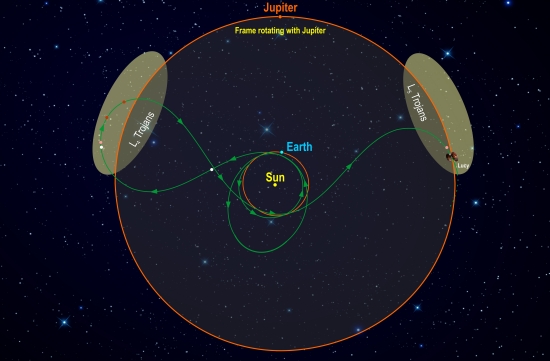
Image: This diagram illustrates Lucy’s orbital path. The spacecraft’s path (green) is shown in a frame of reference where Jupiter remains stationary, giving the trajectory its pretzel-like shape. After launch in October 2021, Lucy has two close Earth flybys before encountering its Trojan targets. In the L4 cloud Lucy will fly by (3548) Eurybates (white), (15094) Polymele (pink), (11351) Leucus (red), and (21900) Orus (red) from 2027-2028. After diving past Earth again Lucy will visit the L5 cloud and encounter the (617) Patroclus-Menoetius binary (pink) in 2033. As a bonus, in 2025 on the way to the L4, Lucy flies by a small Main Belt asteroid, (52246) Donaldjohanson (white), named for the discoverer of the Lucy fossil. After flying by the Patroclus-Menoetius binary in 2033, Lucy will continue cycling between the two Trojan clouds every six years. Credit: Southwest Research Institute.
We already have one binary to look forward to, for Patroclus, in the L5 cloud, has a small satellite called Menoetius. Note how stuffed with interesting things these Lagrangian points seem to be. We have D-type asteroids like Patroclus, which likely have water ice in the interior, as well as C- and P- class asteroids, the latter darker and bearing more similarities to Kuiper Belt objects than main belt asteroids. All are thought to be rich in volatiles. Our explorations here should offer insights into primordial planet-building materials in the early Solar System.


This is going to be a great mission!
That animation has a couple of objects obviously drifting a LONG way from their respective L points. Some sort of Halo orbit I guess. Also they might be inclined. Does anyone know what those objects are?
P
What objects come into play after 2033 for an extended mission?
More Jupiter asteroid eye candy:
https://www.youtube.com/watch?v=yt1qPCiOq-8
https://www.youtube.com/watch?v=yDaCHzR82v
https://twitter.com/learntoskywatch/status/959456518537187329
The animation is hypnotic. Asteroids are among my favorites given their near human scale.
Only problem with this mission and all such missions is the need for multiple planetary flybys. Just develop a decent nuke powered ion engine for crying out loud! The years saved in each missions certainly must free up many millions of dollars as well as making mission length more compatible with human life span. Enough is enough:)
Here’s to hoping that one of those objects turns out to be a lurker – a von Neumann sentinel, a Bracewell probe, etc….
Some old mine workings, perhaps by Venusians before they had their global warming problem, would be interesting enough. Anyone remember that little thrill when the bright spots of Occator were discovered on Ceres, and just for a moment, you wondered…
World’s Oldest Known Impact Crater Confirmed in Australia
George Dvorsky
Today 11:12 AM
A 70-kilometer-wide (43-mile) impact structure in the Australian Outback has been dated to 2.2 billion years old, making it the oldest known asteroid crater on Earth. Fascinatingly, this asteroid likely plunged into a massive ice sheet, triggering a global-scale warming period.
New research published today in Nature Communications confirms the Yarrabubba crater in western Australia as the oldest accepted impact crater on Earth. At an estimated 2.229 billion years old, it’s nearly 210 million years older than the 200-kilometer-wide (120-mile) Vredefort Dome in South Africa and 380 million years older than the 180-kilometer-wide (112-mile) Sudbury impact structure in Ontario, Canada.
https://gizmodo.com/world-s-oldest-known-impact-crater-confirmed-in-austral-1841130758
https://www.nature.com/articles/s41467-019-13985-7