
Another win for amateur astronomers. Have a look at a Juno image showing the familiar Great Red Spot (upper left) and a new, bright spot just emerging in the center of the image, an oval-shaped feature that was not present in images taken not long before by astronomers in Australia. We’re looking at a plume erupting into the upper layers of the atmosphere, a convective outbreak in a region known as the South Temperate Belt, a latitude where outbreaks are not uncommon.
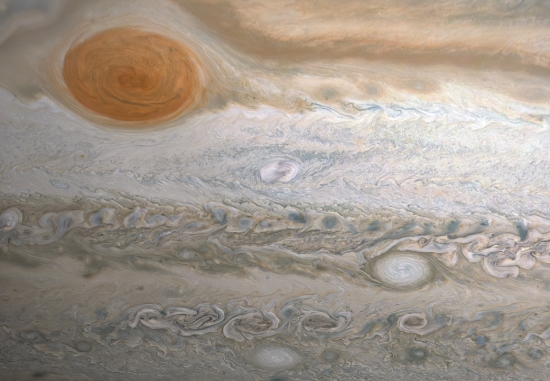
Image: Juno’s view of the swath of Jupiter visible from its recent flyby. Credit: NASA/JPL-Caltech/SwRI/MSSS. Image processing by Kevin M. Gill.
The Juno image, taken on June 2, 2020, is fortuitous, because it was just two days before that South African amateur Clyde Foster (who is director of the Shallow Sky section of the Astronomical Society of Southern Africa) discovered the new spot while working with a filter sensitive to wavelengths where there is strong methane absorption in Jupiter’s atmosphere. Juno happened to be in the midst of its 27th close flyby of the giant planet, and while the craft would not pass directly over the outbreak, the science team realized it was close enough to view the young feature.
Credit goes to another amateur, Kevin M. Gill, for work on the Juno image using data from the spacecraft’s JunoCam. The view is a map projection combining five JunoCam images, taken when the spacecraft was between 45,000 kilometers and 95,000 kilometers from the cloud tops, moving over latitudes between 48 degrees and 67 degrees. For those of you with a yen to manipulate such imagery, the JunoCam raw images can be accessed here.
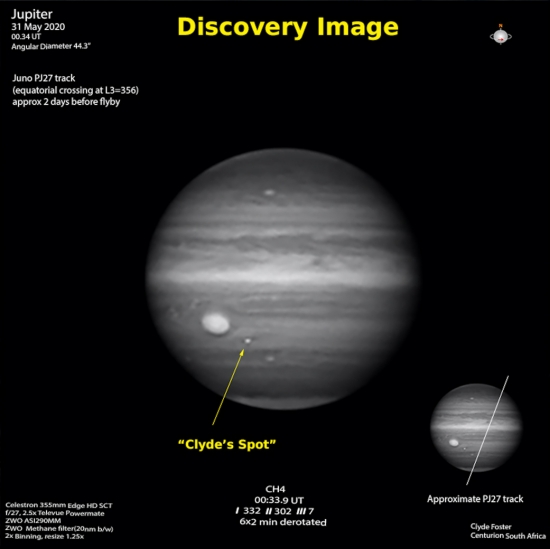
Image: The discovery image, with Juno’s north-to-south trajectory superimposed at bottom right. Nice work with Foster’s Celestron!

“The Juno image, taken on June 2, 2020, is fortuitous, because it was just two days before that Australian amateur Clyde Foster discovered the new spot while working with a filter sensitive to wavelengths where there is strong methane absorption in Jupiter’s atmosphere.”
Not having a Ph.D. in astronomy in no way makes Clyde Foster an amateur. Way to go Clyde! It reminds me of the “space tourist” label. If you are willing to strap yourself in and rocket to space you are an astronaut.
I agree about the quality of Foster’s work, that’s for sure. But it turns out I was wrong to call him an Australian; he’s evidently South African, a mistake I’m about to correct in the text.
Hi, Paul. Clyde Foster is director of the Shallow Sky section of the Astronomical Society of Southern Africa. I can’t find any connection to Australia. http://assa.saao.ac.za/sections/shallow-sky/
Really? How odd. My sources say Australia, but maybe I misread. I’ll make the change, with thanks, John, for calling this to my attention.
There were Aussies(including Anthony Wesley?) doing similar observations just a couple days earlier. But, their Jupiter images didn’t show the new spot. Seems its appearance was quite sudden.
Evidently so. It will be interesting to see how long the new outbreak sticks around.
The famous 1933 white outburst on Saturn, which gradually spread until that whole hemisphere brightened, was discovered by a British comedian and amateur astronomer named Hays (I forget his first name; Patrick Moore pointed out his astronomical contribution, as well as the detailed Jovian observations–including storm cell discoveries–by an English country Parson [whose name escapes me]). It will be interesting to see if this new Jovian outburst spreads and brightens its hemisphere (or at least a belt at its latitude), as did the 1933 Saturnian one.
You got me curious – reading http://www.alpo-astronomy.org/publications/Presentations/Haas%20-%20Saturn%20Outbursts.pdf it sounds like such outbreaks/outbursts occur roughly every 30 years … with the last one in 1990. (The article discusses some numerology regarding the periodicity, but also notes Saturn’s year is 29.4571 Earth years, which seems a straightforward lead for an explanation)
Jupiter has also it share of unusual structures in the historical context, mostly in the beautiful drawings that amateur astronomers have done. In fact several impacts may have been recorded long before Comet Shoemaker-Levy 9. This makes me wonder if Clyde’s Spot might have been a fluffy comet impact.