
Take a look at our missions to Jupiter in context. The image below shows the history back to 1973, with the launch of Pioneer 10, and of course, the Voyager encounters. We also have the flybys by Ulysses, Cassini and New Horizons, each designed for other destinations, for Jupiter offers that highly useful gravitational assist to help us get places fast. JUICE (Jupiter Icy Moons Explorer) joins the orbiter side of the image tomorrow, with launch aboard an Ariane 5 from Kourou (French Guiana) scheduled for 1215 UTC (0815 EDT) on Thursday. You can follow the launch live here or here.
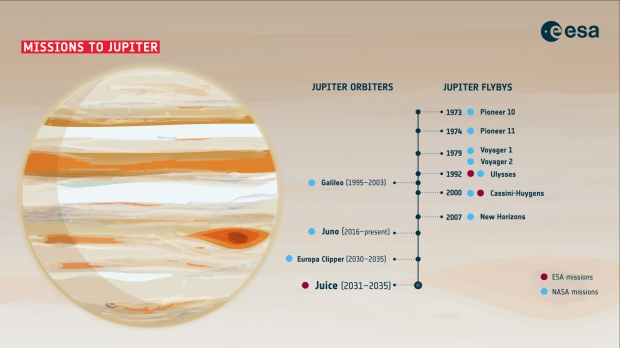
The first gravitational maneuver will be in August of next year with a Lunar-Earth flyby, followed by Venus in 2025 and then two more Earth flybys (2026 and 2029) before arrival at Jupiter in July of 2031. I’ve written a good deal about both Europa Clipper and JUICE in these pages and won’t go back to repeat the details, but we can expect 35 icy moon flybys past Europa, Ganymede and Callisto before insertion into orbit at Ganymede, making JUICE the first mission that will go into orbit around a satellite of another planet. Needless to say, we’ll track JUICE closely in these pages.
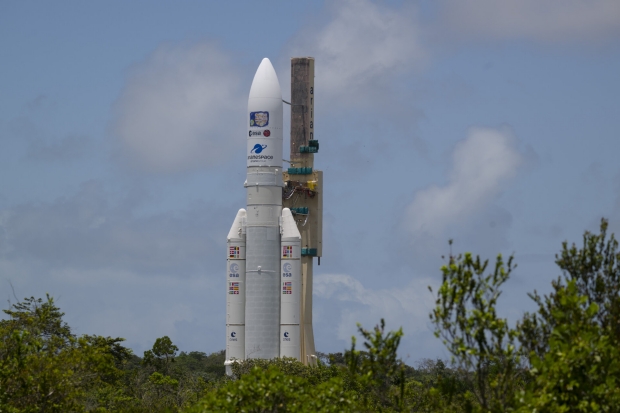
Image: Ariane 5 VA 260 with JUICE, start of rollout on Tuesday 11 April. Credit for this and the above infographic: ESA.


why launch from Kourou (French Guiana) ? not from U.S. territory ?
It’s ESA’s mission, partnering with JAXA primarily. French Guiana is where Ariane launched from.
French Guiana is just north of Brazil and therefore closer to the equator than any US launch site. As a result, the launcher is given a greater starting velocity by the Earth’s rotation for equatorial orbits which applies to solar system targets. How much that is worth, IDK, but clearly enough for ESA to locate there in that French possession rather than, say Spain, and launch eastwards over the Mediterranean. Britain is hoping to build rocket launch sites but using its northerly position to reduce the equatorial velocity making it better suited to high inclination and polar orbits.
As Paul says in his reply, it is not a NASA mission. ESA has generally used its Ariane launchers for its missions, which ensures business for its EU companies.
In the future, as New Space companies like SpaceX promise to reduce launch costs yet maintain high reliability, then it will be interesting to see how the launcher market develops. [I note that Congress is threatening to drastically cut NASA’s civilian budget. I have to think that this would jeopardize the use of SLS for the Artemis missions. Who would gain if that occurs?]
It can be a little surprising to realize that this new triumph was launched from EU soil in South America. But it’s not just the EU going there — NASA built the JWST to fit in an Ariane 5 unit launched from Kourou.
Exactly so. The Ariane ride to space was ESA’s contribution to JWST, and a major one.
I am curious about the flight path. Why so many inner planet flybys? Is there other science happening during this time?
It’s all about the gravitational assist. I’m not aware of any major science projects JUICE will conduct during the cruise phase.
Today’s JU.I.C.E. LAUNCH Was SCRUBBED Because Of LIGHTNING
The launch has been postponed to tomorrow, Friday, due to potential threatening terrestrial weather…
https://www.bbc.com/news/science-environment-65254502
As usual the major space agencies are playing it overly cautious when it comes to the search for alien life- and yes I get that the probe cannot land and so forth.
https://www.space.com/europe-juice-mission-life-jupiter-moons
JUICE is on its long journey to Jupiter!
https://www.space.com/europe-launches-juice-mission-jupiter-ocean-moons
What is involved in the delicate flybys of Jupiter’s moons and the eventual orbit of Ganymede?
The initial timing of the launch?
Exact knowledge of position and velocity at each rendezvous to calculate any necessary corrective RCS burns?
What else?
Whilst the instrumentation and how the data is analyzed most hold my interest, I am intrigued by what is required to make these maneuvers in a gravitational dance that I would assume attempts to minimize propellant use. Is there a computer program doing the predictions, checking simulations against reality, and indicating how best to make corrections to stay on the mission trajectory, or is this done in a very different way?
[Now that it has successfully launched, let’s hope the craft checks out and deploys completely as it heads out toward its first gravity assist. As for me, it would be great if I am still alive to see the mission unfold at Jupiter, as well as Europa Clipper the year earlier.]
“What is involved in the delicate flybys of Jupiter’s moons and the eventual orbit of Ganymede?”
Usually it involves having ENORMOUS unfathomable Brain ! ( but when u need a plumber, electrician, AC tech, and many, many other trades – as a society needs to function – they count too when u need em’!)
“As for me, it would be great if I am still alive to see the mission unfold at Jupiter, as well as Europa Clipper the year earlier.”
you look like a relatively young man from ur pictures; why shouldn’t you be here ?