
We are fortunate enough to be living in the greatest era of discovery in the history of our species. Astronomical observations through ever more sensitive instruments are deepening our view of the cosmos, and just as satisfyingly, forcing questions about its past and uncertain future. I’d much rather live in a universe with puzzling signs of accelerated expansion (still subject to robust debate) and evidence of matter that does not interact with the electromagnetic force (dark matter) than in one I could completely explain.
Thus the sheer enjoyment of mystery, a delight accented this morning as I contemplate the detection of a so-called ‘dark object’ of unusually low mass. Presented in both Nature Astronomy and Monthly Notices of the Royal Astronomical Society, the papers describe an object that could only be detected through gravitational lensing, a familiar exoplanet detection tool that reshapes light passing near it. With proper analysis, the nature of the distortion can produce a solid estimate of the amount of matter involved.
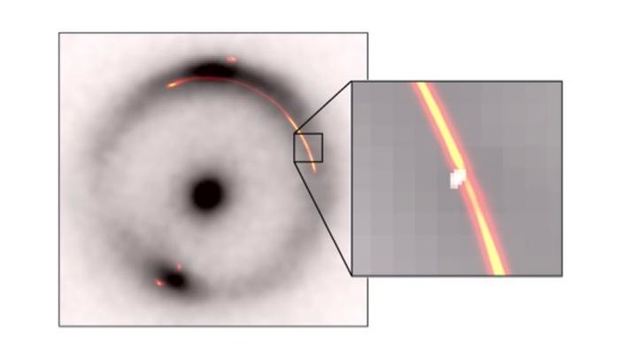
Image: The black ring and central dot show an infrared image of a distant galaxy distorted by a gravitation lens. Orange/red shows radio waves from the same object. The inset shows a pinch caused by another, much smaller, dark gravitational lens (white blob). Credit: Devon Powell, Max Planck Institute for Astrophysics.
We wouldn’t have any notion of dark matter were it not for the fact that while we cannot see it via photons, it does interact with gravity, and was indeed first hypothesized because of the anomalous rotation of distant galaxies. Fritz Zwicky was making conjectures about the Coma Cluster of galaxies way back in the 1930s, while Jan Oort pondered mass and observed motion of the Milky Way’s stars in the same period. It would be Vera Rubin in the 1970s who reawakened the study of dark matter, with her observations of stellar rotation around galactic centers, which proved to be too fast to be explained without additional mass, meaning mass that we currently couldn’t see.
The present work involves the Green Bank Telescope in West Virginia, the Very Long Baseline Array in Hawaii and the European Very Long Baseline Interferometric Network, which creates a virtual telescope the size of Earth. Heavy-hitter instrumentation for sure, and all of it necessary to spot the infinitesimal signals of the gravitational lensing created by this object.
Devon Powell (Max Planck Institute for Astrophysics, Germany is lead author of the paper in Nature Astronomy:
“Given the sensitivity of our data, we were expecting to find at least one dark object, so our discovery is consistent with the so-called ‘cold dark matter theory’ on which much of our understanding of how galaxies form is based. Having found one, the question now is whether we can find more and whether the numbers will still agree with the models.”
An interesting question indeed. It raises the question of whether dark matter can exist in regions without any stars, and offers at least a tentative answer. Or will we subsequently learn that this object is something a bit more prosaic, a compact and inactive dwarf galaxy from the very early universe? The authors point out that this is the lowest mass object ever found through gravitational lensing, which points to the likelihood that future searches will uncover other examples. We’re clearly at the beginning of the study of dark matter and remain ignorant of its makeup, so we can expect this work to continue. New lens-modeling techniques and datasets taken at high angular resolution provide the tools needed to make images more detailed than any before taken of the high-redshift universe and gravitationally lensed objects.
From the Powell et al. paper:
Strong gravitational lensing offers a powerful alternative pathway for studying low-mass objects with little to no EM luminosity. A spatially extended source in a galaxy-scale strong lens system acts as a backlight for the gravitational landscape of its lens galaxy, revealing low-mass perturbers through their gravitational effects alone. Furthermore, lens galaxies typically lie in the redshift range 0.2 ≲ z ≲ 1.5, which means that low-mass, low-luminosity objects can be detected and studied across cosmic time. To date, observations of galaxy-scale lenses with resolved arcs have been used to detect three low-mass perturbers: discovered by Hubble, Keck and ALMA…[E]xpanding the mass range that we can robustly probe necessitates that we use strong lens observations at the highest possible angular resolution.
The first paper is Powell et al., “A million-solar-mass object detected at a cosmological distance using gravitational imaging,” Nature Astronomy 4 March 2025. Full text. The second paper is McKean et al., “An extended and extremely thin gravitational arc from a lensed compact symmetric object at redshift of 2.059.” Monthly Notices of the Royal Astronomical Society Vol. 544, Issue 1 (November, 2025), L24-30. Full text.

If cold dark matter can clump, and if CDM also has a gravity field (space-time distortion), shouldn’t it be, in extreme cases, that CDM should also form black holes? In this particular case, a million solar mass object in one tiny location could be such an object, although it would make itself known by a radiating accretion disk.
In this example, rather than a denser clump of CDM, couldn’t this be like a globular cluster of CDM “stars”, even with retinues of CDM “planets”?
These would be invisible except via gravitational distortion effects. The “star” would not stabilize by the pressure of the radiation from fusion, but would keep collapsing to the size of a dark “neutron star”, depending on how its particles reach the maximum packing density to prevent further collapse. The same would apply to the “planets”, becoming very small, again, the size depending on the particles each was made of.
Could CDM BHs be distinguishable from regular BHs? Both would be dark. Would the difference in composition affect the mass-to-event horizon ratio?
I think this is gravitational lensing caused by ordinary matter. The dark matter idea is invalidated by general relativity which explains the rotation of all galaxies as being normal. Cooperstock and Tieu, 2005
This comment in the Nature paper is interesting: “Although detection of 𝒱 presents no strong tension with CDM or WDM models in terms of halo abundance, its density profile may be problematic.”
I expected to find a comment like this so, yes, I hunted for it. It is no small matter (ha ha) to collect such a large mass of DM (dark matter) into such a small region (80 pc). There really isn’t any mechanism to do that since DM is, effectively, frictionless and without significant EM interaction. I think that all known DM halos or over-dense regions are not nearly as dense as this CSO.
I think it’s more likely to be something else like a large dark nebula of some kind positioned in front of the radio emitting region. But I’m no expert and I didn’t attempt to dive deep into their methods.
Could dark matter be the evidence for advanced ETI we have yet to seriously consider…
https://www.popularmechanics.com/science/a63159523/dyson-spheres-hidden-patterns-alien-civilizations/
https://www.iflscience.com/could-dyson-spheres-be-the-universes-missing-mass-74978
All astronomers know about dark matter and dark energy is that it is there. Does that automatically mean Dyson Shells? No, but the fact that after decades of research science has yet to come up with much of anything beyond “It is there but we can’t see or detect anything” should be an indication that DM and DE are not “standard” objects.
I still think we are an ant colony at a human construction site and we don’t have a clue what is really going on around us. We are vaguely aware at best. And humans still don’t like the idea that they aren’t the focus and best aspects of existence, despite all the physical evidence around us.
@LJK
If DM is really just ordinary baryonic matter, that means that the universe was much more densely packed to account for the gravitational attraction they represent. The matter must have come from somewhere before ETI appeared, so was the universe denser in stars and planets? Either that, or there was much more energy in the universe that could be converted to matter. Or…the matter was imported from another universe in the multiverse, either contemporaneous with our universe, or from the preceding one. None of these speculations seem like good explanations to me, and would open up a raft of new questions.
@LJK
The latest explanation for the Fermi Paradox. Alien technology reaches a plateau not far above our own, ruling out massive structure technosignatures and huge energy demand for running long-term beacons.
Hmm, another “all civilizations act the same way” improbability?
Blink and you’ll miss it — How Technological Acceleration Shrinks SETI’s Narrow Detection Window
I am not saying that ETI can’t follow a similar pattern, especially if they evolved in a situation similar to ours, but I also consider the possibility that life on an alien planet – or an environment very alien to what we came from – could follow very different paths because they are not characters from a typical episode of Star Trek.
They may not build Dyson Shell or other kinds of astroengineering efforts, but they may also go in directions we can hardly imagine, yet still stay within the physical realm we are in.
https://www.xenology.info/
My mistake. I got the wrong end of the stick. The author is saying that as technology changes rapidly (toward a singularity?) that the window of observation of that civilization becomes very short – (between radio and magical technology?) This is different from teh more usual model of civilizations being observable for millions of years with a very advanced, but detectable technology.
Of course, the same effect occurs if most civilizations self-destruct in short order compared to the evolutionary time frame of species survival.
If the civilization becomes transcendant (e.g., invisible, god-like), I am OK with that. This seems preferable to early extinction enabled by technology. If other species become transcendant, then we may too. [Is’t that the scenario of Clarke’s Childhood’s End (albeit nurtured by Karellen’s Overlord species)?]
Yet another explanation for dark matter, not needed according to this new theory.
It describes spacetime as discrete memory cells and potentially solves the black hole information paradox, as well as eliminating the need for dark matter and energy.
https://scitechdaily.com/what-if-the-universe-remembers-everything-new-theory-rewrites-the-rules-of-physics/
I find it interesting and amusing how readily the authors of so many WAGs and conjectures (not theories) ignore the enormous amount of data that have been collected and studied.
I still think this looks like a theory worth considering. It starts with the notion that “spacetime is not smooth, but discrete – made of tiny “cells”, which is what quantum mechanics suggests”.
They then applied it to gravity and found it helped solve the black hole information paradox.
They then investigated their theory further and found “clumps of imprints behave just like dark matter, an unknown substance that makes up most of the matter in the universe. They cluster under gravity and explain the motion of galaxies – which appear to orbit at unexpectedly high speeds”
I understand that there is a lot more data beyond the rotation curves of galaxies indicating that dark matter could exist, the Bullet cluster and gravitational lensing for example, but maybe this clumping of imprints could explain what is happening there as well?
The theory appears to be testable so it may or may not hold up to more intense scrutiny, but at least they are thinking outside the black box we find cosmology in right now.
It is the conclusions that are drawn from observations and also theories which are subject to human error which is whether or not such conjectures and theories are critically examined to see if they are supported by the first principles of physics which stand the test of time.
Cold, clumpy, “matter-like” dark matter, such as mirror matter, is incredibly appealing in sci-fi terms. Imagine there were an invisible star, radiating invisible photons, with a thin flat disc of regular matter – like a flat Earth – spinning at its midline, heated by some rare interaction (neutrinos) to habitable temperatures. To crude approximation, it would spin like a phonograph record, like a galaxy, because gravity would increase linearly with radial distance. That actually is how galaxies spin, so you could argue that this human habited world (how could you resist!) is a planet, and a star, and a galaxy — all at the same time.
Unfortunately, this highlights a problem: dark matter works because it forms a sphere completely surrounding a galaxy. Wouldn’t cold dark fun matter like this tend to end up in the galactic plane, doing nothing to explain the relative invariance of orbital period with distance?
Now to be sure, it’s possible there are two different kinds of dark matter and this is a rare sighting of the fun kind.
In my last comment, I missed major recent activity! I just saw this news report about an article simulating WIMP dark matter in a flattened disk. The article was motivated by exciting preliminary results showing a flattened disk of gamma rays from the plane of the Milky Way, allegedly from dark matter self-annihilation. There’s a plan afoot involving the Cherenkov Telescope Array…
Dear Editors and Authors,
This post on the enigmatic dark object via strong lensing—potentially a compact dark matter clump or gravitational anomaly—is captivating, especially its ties to low-mass voids and JWST’s role in probing unseen structures. It echoes the ongoing debate: are these “shadow masses” particle-based or emergent from modified dynamics?
In that spirit, my brane-world model with Kaluza-Klein dark matter (KK-DM) in a Randall-Sundrum bulk, regulated by a chronon for foliation coherence, emerges modified growth to target the S₈ tension. It predicts oscillatory void-galaxy correlations at ~15 h⁻¹ Mpc, testable with lensing surveys like Euclid, distinguishing from standard CDM clumps.
Thoughts: Could chronon-stabilized KK modes mimic such dark objects in underdense regions, amplifying lensing without new particles? Preprint on Zenodo: https://zenodo.org/records/17430791.
Best regards,
Vitantonio Castronuovo