
How we think intersects with the language we think in. Consider the verb in classical Greek, a linguistic tool so complex that it surely allows shadings of thought that are the stuff of finely tuned philosophy. But are the thoughts in our texts genuinely capable of translation? Every now and then I get a glimpse of something integral that just can’t come across in another tongue.
Back in college (and this was a long time ago), I struggled with Greek from the age of Herodotus and then, in the following semester, moved into Homer, whose language was from maybe 300 years earlier. The Odyssey, our text for that semester, is loaded with repetitive phrases – called Homeric epithets – that are memory anchors for the performance of these epics, which were delivered before large crowds by rhapsōdoi (“song-stitchers”). I was never all that great in Homeric Greek, but I do remember getting so familiar with these ‘anchors’ that I was able now and then to read a sequence of five or six lines without a dictionary. But that was a rare event and I never got much better.
The experience convinced me that translation must always be no more than an approximation. A good translation conveys the thought, but the ineffable qualities of individual languages impose their own patina on the words. ‘Wine-dark sea’ is a lovely phrase in English, but when Homer spins it out in Greek, the phrase conjures different feelings within me, and I realize that the more we learn a language, the more we begin to think like its speakers.
My question then as now is how far can we take this? And moving into SETI realms, how much could we learn if we were actually to encounter alien speakers? Is there a possibility of so capturing their language that we could actually begin to think like them?
Let’s talk about Ted Chiang’s wonderful “Story of Your Life,” which was made (and somewhat changed) into the movie Arrival. Here linguist Louise Banks describes to her daughter her work on aliens called heptapods, seven-limbed creatures who are newly arrived on Earth, motives unknown, although they are communicating. Louise goes to work on Heptapod A and Heptapod B, the spoken and written language of the aliens respectively.
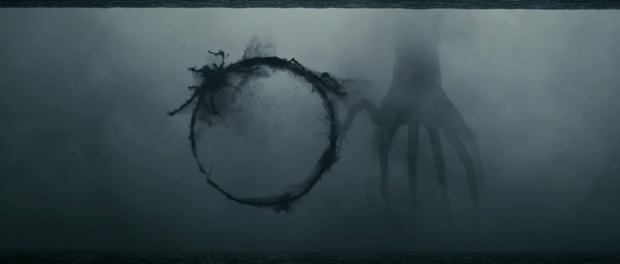
Image: A still from Denis Villeneuve’s 2016 film Arrival captures the mystery of deciphering an alien language.
Heptapod B is graphical, and it begins to become apparent that its symbols (semagrams), are put together into montages that represent complete thoughts or events. The aliens appear to experience time in a non-linear way. How can humans relate to that? Strikingly, immersion in this language has powerful effects on those learning it, as Louise explains in the story:
Before I learned how to think in Heptapod B, my memories grew like a column of cigarette ash, laid down by the infinitesimal sliver of combustion that was my consciousness, marking the sequential present. After I learned Heptapod B, new memories fell into place like gigantic blocks , each one measuring years in duration, and though they didn’t arrive in order or land continuously, they soon composed a period of five decades. It is the period during which I knew Heptapod B well enough to think in it, starting during my interviews with Flapper and Raspberry and ending with my death.
Flapper and Raspberry are the human team’s names for the two heptapods they’re dealing with, and we learn that Louise now has ‘memories’ that extend forward as well as back. Or as she goes on to explain:
Usually, Heptapod B affects just my memory; my consciousness crawls along as it did before, a glowing sliver crawling forward in time, the difference being that the ash of memory lies ahead as well as behind: there is no real combustion. But occasionally I have glimpses when Heptapod B truly reigns, and I experience past and future all at once; my consciousness becomes a half-century long ember burning outside time. I perceive – during those glimpses – that entire epoch as a simultaneity. It’s a period encompassing the rest of my life, and the entirety of yours.
The ‘yours’ refers to Louise’s daughter, and the heartbreak of the story is the vision forward. What would you do if you could indeed glimpse the future and see everything that awaited you, even the death of your only child? How would you behave where your consciousness is now, with that child merely a hoped for future being? How would such knowledge, soaked in the surety of the very language you thought in, affect the things you are going to do tomorrow?
A new paper out of Publications of the National Academy of Sciences has been the trigger for these reflections on Chiang’s tale, which I consider among the finest short stories in science fiction history. The paper, with Christian Bentz (Saarland University) as lead author, looks at 40,000 year old artifacts, all of them bearing sequences of geometric signs that had been engraved by early hunter-gatherers in the Aurignacian culture, the first Homo sapiens in central Europe. It was a time of migrations and shifting populations that would have included encounters with the existing Neanderthals.
These hunter-gatherers have left many traces, among which are these fragments that include several thousand geometric signs. What struck me was that these ancient artifacts demonstrate the same complexity as proto-cuneiform script from roughly 3000 BC. Working with Ewa Dutkiewicz (Museum of Prehistory and Early History of the National Museums, Berlin), Bentz notes objects like the ‘Adorant,’ an ivory plaque showing a creature that is half man, half lion. Found in the “Geißenklösterle,” a cave in the Achtal Valley in southern Germany, it’s marked by notches and rows of dots, in much the same way as a carved mammoth tusk from a cave in the Swabian Alb. The researchers see these markings as an early alternative to writing. Says Bentz:
“Our analyses allow us to demonstrate that the sequences of symbols have nothing in common with our modern writing system, which represents spoken languages and has a high information density. On the archaeological finds, however, we have symbols that repeat very frequently – cross, cross, cross, line, line, line – spoken languages do not exhibit these repetitive structures. But our results also show that the hunter-gatherers of the Paleolithic era developed a symbol system with a statistically comparable information density to the earliest proto-cuneiform tablets from ancient Mesopotamia – a full 40,000 years later. The sequences of symbols in proto-cuneiform are equally repetitive; the individual symbols are repeated with comparable frequency. The sequences are comparable in their complexity.”
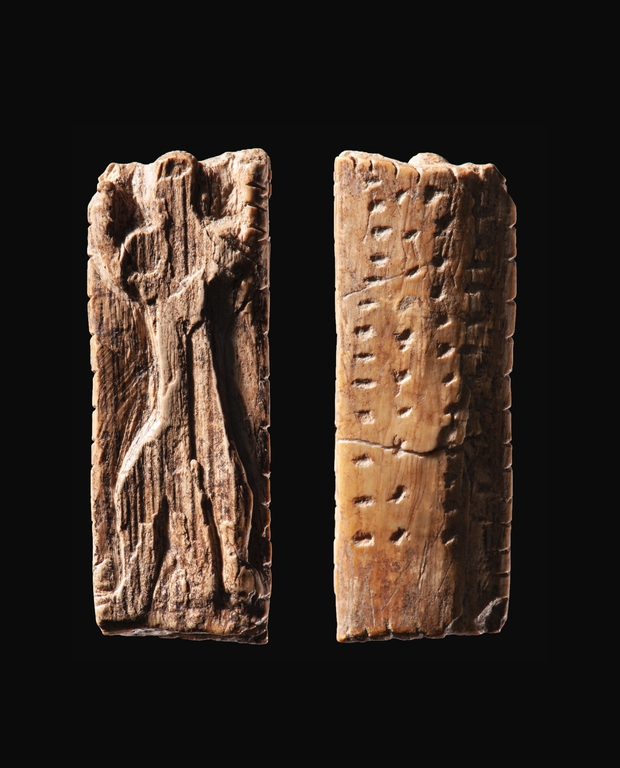
Image: The so-called “Adorant” from the Geißenklösterle Cave is approximately 40,000 years old. It is a small ivory plaque with an anthropomorphic figure and several rows of notches and dots. The arrangement of these markings suggests a notational system, particularly the rows of dots on the back of the plaque. Credit: © Landesmuseum Württemberg / Hendrik Zwietasch, CC BY 4.0.
As the researchers comment, the result is surprising because you would think early cuneiform would be much closer in structure to modern systems of notation, but here we have, over a period of almost 40,000 years, evidence that such writing changed little since the Paleolithic. Says Bentz: “After that, around 5,000 years ago, a new system emerged relatively suddenly, representing spoken language—and there, of course, we find completely different statistical properties,”
The paper digs into the team’s computer analysis of the Paleolithic symbols, weighing the expression of information there against cuneiform and modern writing as well. It’s clear from the results that humans have been able to encode information into signs and symbols for many millennia, with writing as we know it being one growth from many earlier forms of encoding and sign systems.
We have no extraterrestrials to interrogate, but even with our own species, we have to ask what the experience of people who lived in the Stone Age was like. What were they trying to convey with their complex sequences of symbols? The authors assume they were as cognitively capable as modern humans and I see no reason to doubt that, but how we extract their thought from such symbols remains a mystery to be resolved by future work in archaeology and linguistics.
And I wonder whether Ted Chiang’s story doesn’t tell us something about the experience of going beyond translation into total immersion in an unknown text. How does that change us? Acquiring a new language, even a modern one, subtly changes thought, and I’m also reminded of my mother’s Alzheimer’s, which somehow left her able to acquire Spanish phrases even as she lost the ability to speak in English. I always read to her, and when I tried to teach her some basic Spanish, the experiment was startlingly successful. That attempt left me wondering what parts of the human brain may be affected by full immersion in the language of any future extraterrestrial who may become known to us.
Ludwig Wittgenstein argued that words only map a deeper reality, saying “The limits of my language mean the limits of my world.” Beyond this map, how do we proceed? Perhaps one day SETI will succeed and we will explore that terrain.
The paper is Bentz et al., “Humans 40,000 y ago developed a system of conventional signs,” Publications of the National Academy of Sciences 123 (9) e2520385123. 23 February 2026. Full text. For more on this work, see Bentz and Dutkiewicz’ YouTube video: https://www.youtube.com/@StoneAgeSigns. Thanks to my ever reliable friend Antonio Tavani for sending me information about this paper.

I recommend reading the book “The Sucker Punch of Sharing” in order to develop a deeper sense of the structure of “word” as carrier of both knowledge (what we know) and ignorance (what we do not know). So long as we remain incapable of understanding the construction and use of the artifact “word,” the notion of comprehending how aliens construct and use theirs becomes children playing with toys. Lots of movement and little comprehension.
In my early college years, I read about Lincos (https://en.wikipedia.org/wiki/Lincos_language) a language that could be used to communicate with intelligent extraterrestrials.
I was excited to see that the engineering library had a copy on the shelves – I checked it out and was disappointed; I may have dozed off between pages 1 and 5. Lincos seems too complex from the start.
Since SETI will almost certainly be a one-way conversation, I’m sure the sending ETIs will have a better method. Or they’ll just tailor their message to whatever AGIs may be present on the Earth and bypass the messy organics.
Its the the idea that gives words meaning. Words can be used to express nonsense without any ideas or any meaning. Some ideas have universal meaning. Some words had a direct correspondence to symbols and images. Some words have abstracted themselves from their phonetics, a product of modern civilization and language.. Therefore a universal translation device is necessary. It compares the ideas to the words and comes up with the translation. We must communicate with any ET’s the same way we would with any newly discovered foreign country with technology that is communicate the same way with ourselves.
Languages are an evolved mix of things experienced in the environment the speakers live in, and their way of life. Their words and concepts may be almost untranslatable. For example, almost all English speakers know the German word “schadenfreude” and what it means. But put that word into Google Translate and see what you get…a list of possible meanings based on parts of the word. We often get foreign words and their approximate meanings as a result of our global media. Sometimes their concepts don’t translate well into our concepts.
English is perhaps one of the most adaptable languages, absorbing new words, either from elsewhere or created de novo. It has proven very flexible as we develop new concepts as a result of scientific discoveries. German is not so good, and tends to create new words by joining older words together, making the language somewhat unwieldy. The French periodically attempt to purge the usage of foreign words, such as “le weekend”, and try to substitute a more “French” word. {Good luck with that!)
Consider the language of mathematics, which uses symbols. (I still have to use a mathematics dictionary to understand some symbols I am not familiar with). But even with symbol notation, I find I would like a more compact way to express some concepts. Mathematics is almost alien speak for most people. Stephen Hawking once said, “Someone told me that each equation I included in the book would halve the sales. I therefore resolved not to have any equations at all. In the end, however, I did put in one equation, Einstein’s famous equation, E = mc squared. I hope that this will not scare off half of my potential readers.”
Some means of communication are difficult for us to internalize. Consider “Darmok and Jalad at Tanagra”, the metaphoric way of a communicating species that Captain Picard met in an episode of ST: TNG.
We have lost so many spoken languages over time, as cultures have been extinguished. However, with the arrival of computers, computer languages have proliferated, more being created every year, some very successful. There were very few when I was introduced to Fortran in the early 1970s, and when personal computers arrived, BASIC was the default starter language. Today, there are so many computer languages, and which one to learn depends on what you want to do with computers. BASIC is an imperative language, with the program flow moving through the codebase step by step. However, there are other language paradigms, e.g., declarative, logic. Comparison of multi-paradigm programming languages. Some paradigms can be difficult to acquire when one has been trained in another paradigm.
I tend to think that for an ETI species that has evolved in a similar way that we have, communicating in pictures or images is still the easiest to use. We may not be able to read and write Cuneiform or Linear A, but we have at least some connection to the meaning of prehistoric cave paintings, even if their exact meaning is unknown.
If we hadn’t had the Rosetta Stone, could we have deciphered Egyptian Hieroglyphics? An ETI landing in ancient Egypt could at least have interpreted the statues as likely representations of teh dominant intelligent species, and pictures on the walls of palaces could be understood if some of the depictions of activities were clear.
>The French periodically attempt to purge the usage of foreign words, such as “le weekend”, and try to substitute a more “French” word.
It’s the opposite! The richness of the French language, whose origins are Greco-Latin, is being lost. For >twenty years, the official dictionary of French [from France] written by the Academy has been full of English words: live; big-bag, talk-show, show room; backup etc. …I love America but sometimes it tires me ; there are such beautiful subtleties in our languages ;)
They have still replaced ’email’ with ‘courriel’. and we preferred the word ‘computer’ (from the verb ‘order’) rather than ‘computer’. I saw (and appreciated) in Quebec that Quebecers have preserved a more ‘pure’ French with the Acadian, even if some words are old, and are no longer used here which gives much more charm to our language.
The word “week-end” has passed into everyday language with everyone here in France. There is however a reason for this, which is that there is no translation in French to express the idea that we are not going to work on Saturday and Sunday. Word by word ‘weekend’ translates as ‘end of the week’ (fin de semaine) but this only indicates a point in time: on Friday evening; there is therefore no indication of what we are going to do…
conversely I sometimes have trouble explaining English words in French: for example “lift off” (rocket) the verb in French is “décoller” which translates as “take off” that we use here both for a 747 and a rocket. because the idea of mounting vertically does not exist for these machines. Strangely, we nevertheless kept the root of the English verb for the elevator boy who is called a “liftier” (pronouced “leef-tee-hey”)
a translation is always imperfect and fits into a context but also in the translator’s mind. That being said, I admire people who learn French because it is a language that is “logical” only if we know its distant roots and if we plunge with assiduity into our Greek-Latin culture.
BTW : I have a normal vocabulary, but I am still discovering words from my own language.
Back in teh 1980s, a friend who went to do coding in paris that the word for “computer” was “l’ordinateur.” Is that the case, because it seems you used computer as teh preferred French word?
My understanding is that the attempt to purify the French language by removing English words and replacing them with French words is only partially successful, and for teh reasons you state, e.g., the difficulty in replacing “weekend”. This seems to be a good example of how our social environment can create language-specific words that gain common parlance, which are hard to translate well. If a book is translated into French, how would the weekend be translated?
We don’t have a different word for “take off” for aircraft and rockets. Nor for birds. It just means leaving the ground. But we can use acronyms to describe the mode of taking off – “horizontal take off and landing” (HOTOL) and vertical take off and landing (VTOL) (used for both reusable rockets and aircraft like the Harrier, and Vertical take off and horizontal landing (VTOHL) (like the Space Shuttle and the Space Force’s Boeing X-37.
I have read that English is losing words as we have simplified the language to obsolete older words. The total number of words in use has declined. Yet new words are also being added. New words that are invented to convey meaning in the science and technical literature, but may only have niche usage.
The Japanese have the word Ma (間, for the space between things. We don’t for terrestrial things, but at least we have “inter-” e.g., “interstellar” for the concept of the space between stars, although it is often used as a noun, as in “interstellar medium (ISM) rather than a pure gap of nothingness.
@Alex
At the risk of being nit-picky, I should point out that the term “interstellar medium” (ISM) is not used as a means of characterizing a “pure gap of nothingness”. It is a noun which refers to what is actually present in that space between the stars. These things are real measurable physical entities, such as stray matter, waves, fields, radiation, sub-atomic particles, shock fronts and so on. By convention, the term is generally not used to refer to more substantial objects (such as stars, planets or their satellites).
The ISM can vary from place to place and time to time, and it comprises the raw material available for the construction of other more substantial structures and the debris left over from natural processes, and substances which can affect the passage and quality of electromagnetic radiation. Since most of what astronomers do is the collection and analysis of electromagnetic radiation, the ISM must be understood since it can affect that radiation. For example, microscopic dust particles in space are the cause of interstellar reddening, and must be corrected for when studying the intrinsic colors of distant objects. Also, the spectra of distant sources can be altered by matter residing in the line-of-sight of the observer.
But the ISM can also be studied in its own right, as a real and important physical component of the universe itself, one which plays a role in its structure and evolution.
In astronautics, elements of the ISM may present a hazard to spacecraft traveling at high speeds.
@henry
Not nit-picky at all. I thought the last sentence of my comment covered your point, but on re-reading it, I could see the ambiguity. Perhaps I could have used a better example, perhaps “interlude”, the space between events. Yet while we have a concept of the separation of things, we don’t have words for the shape of that space. What is the shape of an interlude other than a length of time?
It is a well-known illusion that Westerners have difficulty ignoring a foreground in favour of the background. Is this a vase or…2 faces? If 2 faces, how would one describe the shape between the faces?
We easily see a pocket in a tertiary protein structure that might be a space for a molecule to be catalyzed, or a pore to allow certain molecules to pass through. But can we see the shape of the pocket without recreating it as a 3D object, without the surrounding protein’s amino acids?
This article brings up several interesting concepts and at least one possible question.
There is a concept that the maker and user of the tool change and form the tool. But the concept also appears to be in reverse, that the tool changes the maker and the user. This, in turn, creates evolutionary pressure: those who can make and use tools better will survive, creating more makers and users of those tools, which will, in turn, make better tools. This concept has been proposed to explain why modern humans have unusually long, dexterous, and strong fingers compared to other primates.
Humans appear to be highly unusual, if not unique, in thinking in linear time. Most animals seem to have a sense of presence and a memory of the past. But that memory of the past is limited to an action and a consequence. In the present, they would remember its actions and their consequences and thus avoid or repeat them. This is not about thinking ahead and planning. Humans seem to be unusual in that they can think about the past and plan in the presence for the future. What changed in humans that led them to acquire the concept of linear time? Possibly dogs?
The concept of writing technology has an inherent linear temporal component. The writer is usually recording something from the past in the present with the intent that this information will be useful in the future. This would appear to drive tool/technology changes toward better tools/technologies with greater utilization, creating an evolutionary change that, in turn, enables better tool/technology creation. Thus, progress in the technology of writing. This process appears to be happening with technology, even today with modern humans.
This begs the question: if we do meet extraterrestrial intelligence and learn to communicate with them, will this, in turn, create changes in humans?
About six years ago I began reading the Odyssey, and even though I had classical Greek at the University (read a bit of the Iliad then), I found it difficult. I did have help from an emeritus professor at Harvard who kept telling me “It will get easier!” And so it did. Because of the repeated epithets, which you talk about Paul,
and ease with the meter – I always read aloud – I found that after several months, I really didn’t have to translate. I pretty well knew what was going on, what was being said or thought. I am not exactly sure how this experience fits with the essay above, but I was surprised – couldn’t believe it.
I’m glad to have your take on this, Barney. It so precisely fits my own experience.
I don’t recall ever not being bilingual–and bicultural. I was born and educated in a North American city with an immigrant community and we were an immigrant family. I am not claiming any special talent on my part, children are wired by evolution to be able to easily learn multiple languages at a very young age, a talent which, unfortunately, rapidly fades with age. As an adult, I have attempted to learn both French and Homeric Greek, with no success whatsoever. Even French, which is grammatically very similar to my native Spanish, defeated me in my college classes.
Spanish developed from Latin during the middle ages, while English is an amalgam of several Germanic and Scandinavian tongues with a vocabulary that borrows liberally from French. But all these languages derive from the ancient Indo-European mother tongue which was widely spoken throughout Europe and Asia in prehistoric times. No doubt my Spanish was also heavily influenced by the Semitic languages introduced to Spain during the Muslim conquest in medieval times.
I have noted a feeling of “otherness” when thinking in my two languages, as if somehow my thought process were molded by the language I was employing to reason or communicate. This feeling is very hard to ignore, but it resists all my attempts to describe it or articulate it. Spanish Henry is very different from American Henry, but I just can’t put my finger on how or why they are different. I cannot prove it to anyone, even to myself, that I have two consciousnesses, but my subjective opinion is convinced of it.
Although both my languages can be traced to a single Indo-European root, I can only speculate on the possibilities of say–an Arabic/Japanese translator, or a person able to speak both Dutch and Bantu. But I know such people exist, and sometimes they speak more than two totally unconnected tongues!
Now when we bring up the topic of extra-terrestrial languages, all bets are off. Alien speakers may not speak at all, they may gesture with their body parts, or modulate their skin coloration like a cuttlefish, or release olfactory gradients into the environment. Even if they use sound like we do, their physiology for producing and interpreting those sounds may be totally incompatible with ours. In fact, I don’t doubt it. The squiggly oscilloscope patterns formed by visually displaying the amplitude and frequency modulations in spoken speech (or even music) can be electronically converted back to the original sounds (there is a one-to-one correspondence), but no human mind is capable of doing so.
If we assume their languages can be codified into symbolic patterns analogous to our alphabet, then perhaps we can communicate with them through some intermediary medium, like written notes or sign language or computer translators. But I haven’t a clue as to how that would work, much less how we would go about teaching each other a common speech. Even a simple statement like “Thank you for inviting us aboard, the temperature range we feel comfortable in is roughly intermediate between the boiling and freezing points of water.”
Developing some form of abstract language which can be communicated by mechanical means, at a distance, with perhaps only one side able to “speak” at all, is beyond me.
—
One simple example from my own, rather limited experience:
A) I watched a TV news anchor speak the following text while commenting on a recent air crash; “The cause of the accident is still under investigation, but terrorism cannot be be ruled out.”
B) On another channel, the talking head remarked; “It is still too soon to determine the cause of the crash, but there is no evidence available to indicate it was anything but an accident.”
Both of these English statements can be translated word-for-word into Spanish, but to my bilingual brain they are both interpreted very differently”.
Both A) and B) admit total ignorance of the cause of the crash, but each attempts to favor a particular (and contradictory) point of view as to why it happened. They are not meant to inform, but to persuade. A) and B) both are phrased to convince the English listener that the speaker is being very precise and thoughtful, but disguise the fact that NOBODY knows why the plane crashed.
The Spanish listener would immediately suspect that neither speaker could be trusted.
Another example: “Education is impossible if the classroom environment is chaotic and undisciplined.”
Contrast and compare: “True education best occurs in a classroom environment that is informal and relaxed”.
Again, both these statements can be translated easily into Spanish, but although both sound perfectly reasonable in English, the Spanish speaker immediately detects an attempt to propagandize in both.
I make no claim Spanish is more “truthful” than English, I’m sure similar examples can be found in any language. But the meanings are interpreted differently, even the bilingual speaker detects subtle differences between the two.
>They are not meant to inform, but to persuade
it is the question of the use of language that is raised in a scene from the film ‘arrivée’ (‘1er contact’ in French, which I reviewed this evening to better appreciate Paul’s article) : at one point the American military understands that China uses a chessboard as a means of communicating with the hectapodes. The attack-defense symbolism of the game can then completely distort the perception of E.T and lead them to a defensive or aggressive posture that would allow China to attack. it’s called propaganda. It’s a shame that the scene goes unnoticed. the subject of the film is interesting – the communication – but once again it is drowned in Hollywood clichés…
Another factor to consider is whether this is a mutual first contact scenario or whether they have done this before
Perhaps this is the type of adventure where prior experience is of little value for the second time around.
What about the 4th or 5th time around?
How many different forms of intelligence does the universe allow?
MY guess would be—an infinite number.
“How many different forms of intelligence does the universe allow?”
This is a poorly formed question. First tell us what a “form of intelligence” is before attempting an enumeration.
When I was in graduate school in Montpellier I didn’t have television in my dorm room. I could have bought one and set up the antenna, as did several of my dorm mates, but in the end the most interesting to watch, if you didn’t have Canal+, was Law & Order SVU dubbed in French. When I visited family friends in Burgundy I watched TV in their home to get my fix, but honestly I was happy. Now I passed my down time reading books and one of them was volume one of Βυζαντινοί ιστορικοί και χρονογράφοι (Byzantine Historians and Chronographers) by Apostolos Karpozilos (ISBN 9789607420312 for anyone interested). The author gives a description of the each historian and his work and in the end gives a segment from the historian, if it has survived, in the original language. I am not particularly good with ancient Greek, otherwise I would have been accepted somewhere harder to get than Agronomy, but after a while, plus the fact that they were writing in Attic or at least an artificial archaic Greek, centuries after it had become a dead form of Greek an thus was missing the idiosyncrasies of a living language but was quite regular, meant that after a while understanding what the historian wrote became easy. Other books I was reading at the time were Herodotus, Thucydides and Xenophon. It was bilingual editions with the original text on the left and translation to modern Greek on the right. I read from the translation, though I did look at the original text if it was a segment that we had done in school.
I am currently reading Project Hail Mary by Andy Weir and it becomes pretty obvious that the author does not speak a foreign language. When I learned foreign languages (I am fluent in Greek, French, English and Portuguese and have had courses in Farsi and German) the most annoying part was not learning the word to word equivalence between each language and avoiding the pitfalls of the same work meaning different thing in another language (e.g. sycophant). It was constructing a grammatically and syntactically correct sentence to hold a conversation. Some languages are extremely strict and formal in their form, such as German, where if you put the wrong proposition accidentally you mess up entirely what you actually want to say. Greek on the other hand is famously flexible, especially when spoken by a politician who wants to say different thing to different people. Also all the languages I have noted above are Indoeuropean, my grandmother’s native language was Turkish which, as an Altaic language, has a completely different syntax. She would speak it with her cousins if she didn’t want me or my cousins to understand. Also when being in the company of that part of the family I do remember several people speaking Turkish in Greek clothes, because while their vocabulary was fine, their syntax simply made no sense in Greek.
The last thing I want to note is that languages are operating systems of societies and that as such they can carry the expectations of each society. EU institution meetings, such as the European Summit every six months, lead to communiques that are translated to all the official languages. It is very interesting how the same text gets interpreted differently in each country because each has its own history expectations. Something made by government is inherently good for Greece and France because these societies have a positive opinion of government. In English though something by government is bad, British (and American) society tends to be hostile to it. This is why official communiques tend to me long and convoluted in order to satisfy all the member states in their language. That in itself also leads to different reception. As my dad put it, when I was working in Crete and we went out for coffee in one of the villages, the less people understand because you speak complicated, the more they respect you. On the other hand in one of the classes I took when doing my dissertation at Virginia Tech we learned to dumb down our science communiques so that John Q Public could understand you, otherwise they would not respect you. In Greek, our philologists actually expect everyone to know what the Paschal Chronicle actually is, even though I doubt it is mentioned specifically in the 5th and 8th grade history book, which is when we do Byzantine History.
A communication can be done through one or more channels that can have different forms: sounds, images, gestures, etc. Language is only a form of communication.
I think that the question of a “contact language” with an ETI will not be done on a single mode of communication but on several simultaneous modes (sounds; images, chemistry etc.) because the gap between the two civilizations will be enormous at least initially. From this point of view, it requires (for humans) the search for a common point, therefore a process, which will then allow to establish a language of exchange. There is even a good chance that we will be forced to invent new languages, at least to modify ours. at random: could we *talk* about mathematics? The presence of an ETI in our world already modifies our perception of things and reflection on the subject. Everything is possible.
On the other hand, I think they will make our work easier if they don’t atomize us before :) indeed, if an ETI comes to us it is very likely that it is ahead of us in technology. So we can assume that she will partially know our means of communication and will take the initiative to facilitate this communication based on who we are.
>could we learn if we were actually meeting alien speakers?
…another side of the universe.
>start thinking like them?
certainly in the sense where man is a mimetic animal. Neuroscience has shown that the human brain is highly plastic and will adapt to the world it perceives. It is therefore a safe bet that our meeting with an ETI speaker will allow us basic communication after a certain learning time and then modify our thinking …but does the ETI think?
We are Beings of communication (the inventors of the Iphone understood it well :) Could humanity have existed if it had only been composed of Helen KELLER ? What would happen if the ETI visiting earth was an H. Keller ?
>we must ask ourselves what the experience of people who lived in the Stone Age was like.
On language and prehistory, we had a great specialist in France who was André Leroy-Gouran. In his famous book “the gesture and the word” he proposes an analysis of the language of the prehistoric Man. From memory he considers that the hand and the tool (therefore the thumb to hold them) form the brain that develops concepts. Thought is externalized through meaningful language, which cannot be before the development of mouth muscles in hominids. Language will then shape needs, exchanges, and therefore sociability to create new tools, etc. (I summarize perhaps with errors because my art history studies are very far away and I don’t have the courage to reread the book;) Alas, Leroy-Gouran has not been translated into English.
The difficulty is that our worlds were totally different: they had a “pure” contact with Nature since technology did not exist; their sensibilities were much more awakened and their visions of the world had nothing to do with ours. (Just as the men of the middle ages lived in a world essentially of beliefs)
The meaning of the prehistoric cave paintings is always a mystery. Did they wish to convey a message? did they simply leave a trace of what they found beautiful in their world? we don’t know.
Some researchers have proposed that it was for them a way to communicate with a ‘magical’ world, a kind of parallel universe somewhat like the aborigines. (the drawing of the hand placed on the walls of the caves could be the idea of touching another world to enter into communication with another universe that it was inaccessible to them
Note that the hand symbolizes the strong idea of communication or signature and that it is exactly the same gesture made by the scientist and the heptapod in the film through the walls!
a fascinating topic. Thank you Paul.
https://ibb.co/Ngnq10By
“The authors assume they were as cognitively capable as modern humans and I see no reason to doubt that, but how we extract their thought from such symbols remains a mystery to be resolved by future work in archaeology and linguistics.”
There is a theory that the prehistoric Homo sapiens actually had more cognitive abilities than modern man, as the environment required them to have excellent spatial awareness and memory, in addition to brutal selection by harsh environment.
“That attempt left me wondering what parts of the human brain may be affected by full immersion in the language of any future extraterrestrial who may become known to us”
A very interesting idea to speculate on. The fact that different languages stimulate different areas of the brain is well-known fact(see link at the end), and some might even claim that this leads to different philosophies of thought and poetry.
Could humans experience the same changes when learning languages of other species, and would others be influenced by our speech?
Of course this assumes this would be audible language, which certainly is not given, in the end we might find ourselves reliant on the universal language of mathematics. And if we follow speculation, one can always recall what learning alien language did to a human mind in Lovecraftian stories.
https://newsroom.northumbria.ac.uk/pressreleases/comment-if-you-speak-mandarin-your-brain-is-different-1194786