
The fortunes of Breakthrough Starshot have been the subject of so much discussion not only in comments in these pages but in backchannel emails that it is with relief that I turn to Jim Benford’s analysis of a project that has done significant work on interstellar travel and is still very much alive. Jim led the sail team for several of his eight years with Breakthrough Starshot and was with the project from the beginning. In this article and a second that will run in a few days, he explains how and why press coverage of the effort has been erroneous, and not always through the fault of writers working the story. Let’s now take a look at what Starshot has accomplished during its intensive Phase I.
by James Benford
“Make no mistake — interstellar travel will always be difficult and expensive, but it can no longer be considered impossible.” – Robert Forward
Breakthrough Starshot has not failed, nor has it been canceled. Phase I of the program achieved its stated objectives: to identify potential show-stoppers in beam-driven interstellar propulsion and determine whether credible solutions exist. That goal was met.
Recent media coverage, including a Scientific American cover article titled “Voyage to Nowhere,” misunderstands both the intent and the outcome of Phase I. The reality is that the project thus far has been successful. It was put “on hold, paused” in 2024 to restructure for the next phase and seek broader support. It has not been canceled, as some in the media are saying.
I contend that Starshot succeeded because the key Phase I objectives were met. Of course, extensive future effort in the later phases is needed to create a fully functional Starshot system, principally the beamer and sailcraft (referred in the project as “photon engine” and “lightsail”). The major issues have been found to have credible solutions. A great many Starshot-related papers have been published. Many address the crucial issues of sail materials and sail ‘beam-riding’, meaning staying on the beam while undergoing inevitable perturbations. There is a final report, but it has not yet been published.
The principal issues for Starshot were 1) Can a phased array of lasers be constructed that is sufficiently coherent and directive as well as being affordable? 2) Can a sail material be made that will have high reflectivity, very low absorption, high emissivity and very low mass so as to be efficiently accelerated and not overheat? 3) Can a sail ride stably on the beam because of inherent restoring forces (without feedback, which is impossible over long ranges)? 4) Can data be sent back to Earth from the probe at sufficient data rates before the sail moves far beyond the target star?
In this first of two reports on the successes of the Starshot project, I discuss the shape of later phases in the effort, and distortions in the reporting on it. In the second report I will describe the major accomplishments of Phase I.
Starshot was not initiated to fully design, build and launch the first interstellar ‘lightsail’ (as they are called, referring to both the low mass and the near-visible frequency of the laser). The program path was divided into phases, as shown below. The first phase was to invest in high-risk, high-reward research that would de-risk the technology. Phase 1 was to find if there were any ‘show-stoppers’ and pave the way forward. It accomplished that.
High levels of research by Starshot retired most of these key issues for beam-driven sail systems, at least at the conceptual level. The results are at the TRL 2 level. Experiments are needed to verify the solutions for these major issues found in Phase 1.
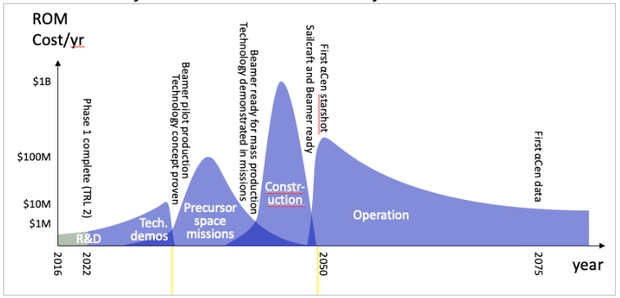
In Phase II, a coalition of Caltech and other institutions would lead experimental technical demonstrations, and the first experiments in orbit. Then, with the technology concepts having been proven, it’s on to near-term missions shaking out various technologies while performing precursor missions, probably to the outer solar system. Much effort would be needed in systems engineering to enable such precursor missions.
The first phases of Starshot, the R&D program, are projected to cost $120M, which includes Phase 1, and concludes with solar system science missions in the medium-term. The large effort would then follow: construction of the Starshot System and finally, operation of the System and the first interstellar probe voyages.
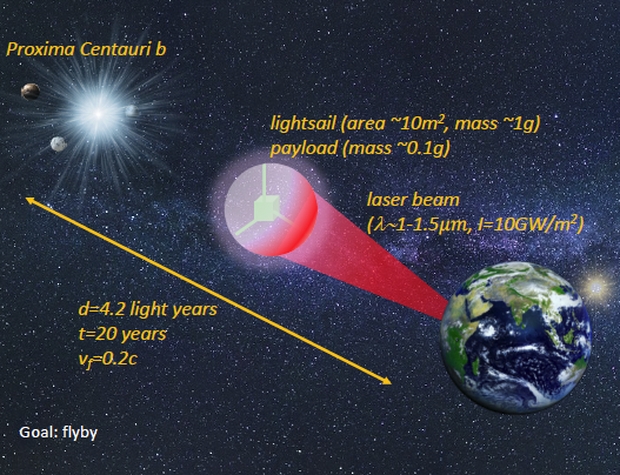
Many requirements of the Starshot mission come together at the sail. Principal technical issues are the design of the beamer, material to be used and whether the beam and sail stay together, meaning stable beam-riding by the sail:
• Stability is influenced by sail shape, beam shape and the distribution of mass, such as payload, on the sail.
• Material properties, are its reflectivity, absorptivity and transmissivity, it’s tensile strength and its areal mass density.
• Deployment of the diaphanous sail, correctly oriented and including any initial spin, is of course a key requirement.
• The beamer interacts with the sail through its power distribution on the sail-causing differential stresses. This depends on duration of the acceleration, the transverse width of the beam, pointing error of the beam as well as its pointing jitter.
• Data return to Earth, interstellar communications, is perhaps the greatest challenge of all.
What Scientific American got wrong
Journalism is only the first draft of history, so flaws occur. Assessing a system as complex as Starshot is a challenge to a journalist with limited time. It would take years to read and absorb all the relevant literature and to mentally organize it into a reconciled and coherent understanding of the system as a whole.
The biased title – “Voyage To Nowhere” – of the piece in Scientific American, (which was chosen by the editors, not the author Sarah Scoles), may have been chosen to refer to the famous Bridge to Nowhere in Alaska and the Train to Nowhere in California. The Scientific American reporting is already being mistaken for a primary source by others, who are stating that Starshot has been “canceled”. This is an example of how media myths, once manufactured, propagate through journalistic copying.
The article fails to understand the Starshot project for a basic reason: The key people who did extensive work on the program were not available or not even known to the writer.
Because the principal workers from the Breakthrough Foundation and the leaders of Breakthrough Starshot, Pete Worden and Avi Loeb, were not interviewed, it seems the author did not know who the main contributors actually were. She relied instead on people she could easily reach. Few of them are major contributors to the program and most left the project early on or never actually participated in the project. A key participant who is not mentioned is Kevin Parkin [1, 2], who spent 8 years under contract, as did most of us who were in at the beginning or even before that. Others are Mason Peck (who is mentioned in the piece), Paul Mauskopf and Dave Messerschmitt. Unfortunately, the final report, which went through many iterations, has never been published publicly [3].
The recent policy of Breakthrough Starshot has been to have little contact with the media, so not to engage with Sarah Scoles at all didn’t help things: it left the door open for detractors to influence the narrative in her piece. Communication was a priority, with public outreach from and within Starshot during Phase 1. In research, communication enables cross-fertilization and prevents work duplication. The big gap now is a comprehensive publication that ties it all together. It could motivate researchers to continue or take up the project later if Phase II occurs.
The article also truncates the long history that led up to Starshot. Beam-driven propulsion concepts didn’t start in 2016! This was documented in my Photon Beam Propulsion Timeline, which appeared here at the start of Starshot in 2016. Media are not aware of how much has been done by the propulsion community over the last decades. Several areas of photon beam-driven sail system development, to include experiments demonstrating sail beam-driven flight [4, 5] and sail stability and dynamics, such as beam-driven spin of sails for stability [6, 7], have been reserched. The major innovation which caused the beginning of Starshot was the realization that going to much smaller sails and much higher accelerations reduces the cost of the overall system substantially.
The budget estimate given in the Scientific American article is clearly wrong. That only 4.5 million dollars could fund 8 years of steady work by many people is absurd. Thirty contracts were executed over 8 years. There were years of invitational meetings, a standing staff of advisors, subcommittees for specific topics; all of them further expenditures. And I count about 50 Starshot-related papers, some of which have been published since it was put on hold. I estimate that Breakthrough Starshot Phase 1 had a cost of 25 million dollars.
The way Forward
Phase II would lead to a firm experimental basis for the later phases in Figure 1. If Breakthrough decides to move on to Phase II, it must deal with the costs of interruption: institutional knowledge about the previous work, which is never fully captured in documentation, will need to be relearned, as the people who worked on Phase 1 have dispersed to other programs.
My second piece on Breakthrough Starshot, scheduled to run here next week, will describe the present state of the concept and the many advances achieved by Starshot in Phase I
Breakthrough Starshot was the most significant event in the history of beam propulsion, which clearly is the only way that probes can be sent to the stars in this century. And now the work goes on, the hope still lives, and the dream of beam-driven interstellar travel could be realized.
References
[1] “The Breakthrough Starshot Systems Model”, Kevin Parkin, Acta Astronautica 152, pp 370–384 (2018).
[2] “Starshot System Model” Kevin Parkin, Ch 3, in Claude Phipps, Editor, Laser Propulsion in Space: Fundamentals, Technology, and Future Missions, Elsevier (2024).
[3] Breakthrough Starshot Summary Report, September 2023, not published.
[4] “Microwave Beam-Driven Sail Flight Experiments”, James Benford, Gregory Benford, Keith Goodfellow, Raul Perez, Henry Harris, and Timothy Knowles, Proc. Space Technology and Applications International Forum, Space Exploration Technology Conf, AIP Conf. Proceedings 552, ISBN 1-56396-980-7STAIF, pg. 540, (2001).
[5] “Laser-Boosted Light Sail Experiments with the 150 kW LHMEL II CO2 Laser,” Leik Myrabo, Timothy Knowles, John Bagford and H. Harris, “High-Power Laser Ablation IV,” edited by Claude Phipps, Editor, Proc. Space Exploration Technology Conf., 4760 pp. 774-798 (2002).
[6] “Spin of Microwave Propelled Sails” Gregory Benford, Olga Goronostavea and James Benford, Beamed Energy Propulsion, AIP Conf. Proc. 664, pg. 313, A. Pakhomov, ed., (2003).
[7] “Experimental Tests of Beam-Riding Sail Dynamics”, James Benford, Gregory Benford, Olga Gornostaeva, Eusebio Garate, Michael Anderson, Alan Prichard, and Henry Harris, Proc. Space Technology and Applications International Forum (STAIF-2002), Space Exploration Technology Conf, AIP Conf. Proc. 608, ISBN 0-7354-0052-0, pg. 457, (2002).
Returning to the moon IMO is the game changer. The laser program if adopted would share power so there would be some synergises and massive cost reductions. The laser power could also be used to move craft around the solar system and even accelerating the development of a journey to mars.
That’s right, Michael. When the Beamer is under construction, many missions and applications become possible that are at lower speeds. The laser driver can beam power to locations in space, such as Earth satellites and space stations. It can de-orbit orbital debris. It can drive fast sail missions to the Moon, Mars and the outer planets. And it can beam power to high-performance ion engines.
It can also be used for direct thermal heating of a hydrogen gas for propulsion and deep space communications. There is quite a list.
Suggest looking into Photonic Laser Propulsion (PLP), lot more efficient as far as laser beam propulsion goes:
https://www.linkedin.com/pulse/advanced-propulsion-resources-22-paul-titze-su26c/
I Far be it from me to question Bae’s proof that PLP works for real applications, but I see a number of issues that I cannot afford paying $200 for an unreviewed book on Amazon to see if they are fully addressed.
Lab demos show it works if the 2 mirrors are perfectly aligned and the separation distance is not affected by the laser light dispersion.
1. Laser light still disperses over long distances so there are reduced times the beam can be recycled. If it didn’t, we could propel a sail towards c.
2. The phased laser arrays proposed for BS still have teh dispersion issue. IIRC, the distance until they become ineffective is not very distant. Hence the need for a very powerful beam operating over a short time on a low mass craft.
3. The alignment of the 2 mirrors is critical to recyclying. Any change will end the recycling. The only obvious way to overcome this is to use mirrors that return the light regardless of mirror alignment, using the cibic arrangement see in reflectors. Whether physical or holographic (if this works), the incident beam will become less coherent with reflection unless the full beam path length exactly equal across the beam’s diameter. Any change in the course of the vehicle e.g., expiencing a gravity well, will result in the beam losing track of the vehicle as the time delay for beam direction will prevent accurate tracking.
4. As the vehicle’s velocity increases, the beam’s wavelength is Doppler shifted, reducing its energy on each reflection. A minor point, given the other issues.
Perhaps Bae’s analysis tackles all these issues and more I haven’t immediately thought of, but I would like to see some proof of this in the math. [The editorial review suggests these problems are solved, including the use of an active optical cavity for reflection.]
I was disappointed that the list of references did not include Scoles’ article, but did reference an unpublished paper. I found (what I believe is) the mentioned Scoles’ article at the following URL, which some may find helpful. I have not yet read it.
https://www.scientificamerican.com/article/the-quiet-demise-of-breakthrough-starshot-a-billionaires-interstellar/
Looks like they’ve re-titled it from “Voyage to Nowhere” to “How a Billionaire’s Plan to Reach Another Star Fell Apart.” Or maybe they just used “Voyage to Nowhere” on the cover. I don’t have that issue, but I see it’s still listed as “Voyage to Nowhere” on the NASA ADS system.
Paul, my recollection is that the Scientific American picked the title of the article not Scoles.
The Scientific American is not the only publication that does ‘tabloid-ization’ of news articles, lord many news ‘outlets’ on the Web (of which there seem to an uncountable number now) just do it blatantly, sometime deliberately posting false information as click bait.
I have to say that I find none of this in the Full regular articles in the Scientific American, I find them to be straight forward science for the intelligent layman.
I do miss Martin Gardner’s column, Phillip Morrison’s book reviews, the Amateur Scientist, Michael Shermer … seems to me these were budget circumscribed … well both Martin Gardner and Phillip Morrison passed away.
Yes, Morrison was a gem as a contributor to the magazine. What a lineup it once had.
Both the cover page and title if the article in the October Scientific American was ‘Voyage to Nowhere’. They probably changed it when I rebutted the title and theme on The Space Show interview with Sarah Scoles a few weeks ago. (You can listen to it online.)
Alex is right about many multiple reflections. Geoff Landis and I independently looked into this concept some years ago. We both came to the same conclusion: only a few, maybe 3-4, reflections will actually occur at best. And later simulations of sails in flight on a beam show several types of perturbations and oscillations of the sail, which allow beam-riding, but would defeat multiple reflections.
Multiple reflections work best on rapid accelerations on small sails and have a direct impact on capital costs. Work by the late Jordin Kare indicates just how fast you can push these sails with material limits of 32 million g’s !
https://www.niac.usra.edu/files/library/meetings/fellows/oct01/597Kare.pdf
You could in principle use the main laser to be concentrated into a channel that accelerates these small discs out from the back of a much larger craft for thrust.
There was also good progress on light sail materials as well.
https://www.nextbigfuture.com/2025/06/optical-lithography-breakthrough-makes-laser-sails-9000-times-lower-cost.html
Space Show link:
https://thespaceshow.com/show/30-jan-2026/broadcast-4496-zoom-sarah-scoles
1:31 length and 10.4 MB download
Thanks, James Benford, for sharing your updates with this wonderful site.
The Scientific American article strikes me more as a polemic against private science in general rather than Starshot itself. If Starshot had been a government funded program, Scientific American would have thought it just wonderful, even if it didn’t work. I am not surprised by this attitude as Scientific American has been politically compromised for over 40 years, starting with the infamous Carl Sagan “nuclear winter” thing in the early 1980’s.
Something I’ve noticed in the last few years is a hostility from the left towards any kind of private endeavors in general. Unfortunately, this mind virus appears to have infected many of our scientific journals.
American politics looks absurd from a distance, no matter the “side”. I see this as entirely irrelevant to the matter at hand. Science and engineering proposals, and critique of them, isn’t political. The points raised in Scoles’ article are correct or incorrect. I would appreciate that commenters, including Jim, speak to that.
Can you be more specific about what private space endeavors the left has demonstrated hostility towards? Hard not to read this as anything other than spacex, which “the left” seemed pretty supportive of until Elon started sieg heiling, programmed an AI to praise Hitler, was revealed to have begged to go to pedo island, and proved a willingness to use his companies to intervene in political affairs based on his own whim. None of that is an objection to private endeavors in general.
Musk’s behavior also took the halo off his Tesla autos business. His destruction of Twitter, his outlandish Tesla pay deal forced on the board by threats, his recent Starship failures, and his nonsensical desire to merge his companies have hardly endeared him to any political or mainstream business POV. It wouldn’t surprise me if his business approach blows up in his face.
I found Twitter is much more for free speech than BlueSky or Redit. You are much more likely to get mobbed or banned for writing something they don’t like with the former two, But each to there own. His tesla deal is linked to him I think increasing the share price by around 8 times which would be a monumental achievement. Starlink is a fantastic business model and I believe funds Starship not like the money grabbing government business model. As for the salute there are plenty of examples of the left doing it.
I haven’t noticed the political bias in the few SciAm articles I have read recently. My main beef with SciAm was that it was a more serious magazine in my youth, with the articles written by scientists doing the work, not journalists writing dumbed-down articles for a wider audience, more in the style of PopSci. That was an editorial/business decision, which ended my regular reading of the magazine.
Same here, Alex. Alas. I used to love that magazine and it was a constant source of information some decades back. No more.
@Paul
Back in the 1970s in teh UK, we had very little choice for science reporting. SciAm was one. The New Scientist was another (a mixture of science articles and news, mostly UK), and of course, the science journals, like Nature. This was before the huge proliferation of journals started by the publisher Rupert Maxwell (father of Ghislaine). When questioned about what to pick as the only source to read, SciAm was THE ONE back then.
A few years ago, I tried a subscription to New Scientist again for nostalgia reasons. It too is a pale shadow of its former serious self. I believe the 2006 breathless (and gullible) article on the Shawyer Drive ended their reputation for serious science articles (it was a short-lived scandal). Their very good science writers had left for better opportunities or retired.
Today, in the US, we are flooded with options from the very dumb to serious science magazines before resorting to Journals (also polluted with “vanity publishing” journals, with a lack of serious, or any, peer review. Poor work can still get through even the top-tier journals, like the arsenic bacteria article in Science that was only just retracted after 15 years. The number of falsified papers are excaping the peer review filter, and AI-created papers are starting to flood some journals, especially about AI. The blogs are often better for accessibility, including CD, IMO.
@Jim Benford
I don’t know why you equate opposition to geoengineering with a political issue. There are very good reasons to be cautious about experiments. Any approach to diminish sunlight heating with increasing cloud cover or with sun shades fails to address the ocean acidification problem, especially as they are often used as a way to reduce the need to end net CO2 emissions. It is this last that has become political.
You reflect my own thoughts on New Scientist, Alex. I’ve subscribed off and on over the years but finally let it go for good last year. If only the old Scientific American — or its true successor — could re-emeerge.
@Abelard
AFAIK, “nuclear winter” is an accepted hypothesis on the effect of a nuclear war. It isn’t a political opinion. What position did SciAm take on this?
Abelard: You’re quite right in pointing out that Scientific American diverged from objectivity several decades ago. They have shifted to the left. They are clearly opposed to geoengineering, strategic missile defense, and almost anything related to national defense and weapons. They are hostile to the private sector, the market economy especially, although it is the source of our prosperity.Their drifting away from an objective stance is probably hurting them with the right in the political spectrum. I think it’s an unwise policy for them. There is plenty enough political media, but two little scientific media.
New discovery
https://phys.org/news/2026-03-laser-driven-photonic-crystals.html
@Jeff,
I am unclear why the design needs to be transparent to other wavelengths than the power beam’s. I would have thought that any natural emissions would be of very low power in comparison, so what is the value of letting them pass by? Is it to do with the sail being mainly non-reflective to other wavelengths and therefore prone to heating?
I don’t know, but I can speculate. Possibly, light from other sources (such as the sun) will generate rotational forces on the lightsail, making it more difficult to keep the sail pointed correctly. Light from a source like the sun would be a dominant problem until the lightsail was heading directly away from it.
Might a transparent sail double as optics?
@Jeff
I don’t see how. I visualize this sail material as being like a plate-glass window. Letting visible light through, but reflecting IR light (greenhouse effect). I see this with a security camera that looks out through a window. During the day, it sees outside. At night, it switches to IR mode, using LEDs to illuminate the scene. If it were outdoors, I would get a monochrome scene. But indoors, the window reflects back the IR and the camera sees nothing other than the reflected LEDs.
The sail just has a very narrow wavelength that it reflects.
Whether the sail material is like clear glass or frosted, IDK.
For it to have useful optics properties, such as a lens, it would need the requisite material to recreate the effect of the lens. Could it do this using stacked layers to create the effect of refraction to differentially bend the light, IDK? [A Fresnel lens seems like the best way to keep the mass down, but this only works if the layers can mimic the prisms, which would depend on how the light passes through the sail.
My thought is that it might be better used as a way to filter light to allow just a very tight wavelength to be separated out for use, discarding the rest of the wavelengths. Think of colored filters, but with very limited wavelengths being separated out via reflection to be used for some instrumentation. The amount of material needed could be very small, with different ones tuned for known wavelengths. Whether this makes sense rather than using a prism to split the light with a slit to let through the desired wavelength, IDK. My imagination for its use fails me.
Do you have some thoughts on how it could be used in optics?
The late 60’s/early 70’s hippies were cool. If they didn’t like the world around them, they went out and did things on their own (e.g. started communes and the like). This is where Stuart Brand and his “access to tools” came from. This DIY mentality carried over into the tech and life extension scene in the 1990’s. It was totally cool too (BTW, I’m one of these people doing DIY life extension stuff).
Today’s leftists, in contrast, are total losers. They do not go out and do their own thing. Instead, they join political movements to stop other people from doing their own thing. Note their hostility toward private space development activities, even though these do not consume tax payer’s money nor do they detract from the social programs they favor. Same for life extension. There is a DIY guy with lots of money who is doing DIY stuff (Bryan Johnson). Admittedly what he is doing is way too expensive for guys like me. But he is doing such on his own. Rather than treating him as a Guiana Pig to be followed (to come up with cheaper methods that most of us CAN do), they criticize him as though he is bring on the End Of The World. Its like these today’s woke leftist simply can’t stand people doing things on their own, without their approval. This is a very infantile mentality. Today’s leftists are totally uncool (in comparison to hippies of 1970).
Although there is a weakness in the phased array with the side lode issue they could be potentially used to power much smaller and slower probe placements around the solar system.
Jim asked me to comment on sidelobes:
The question implies that any sidelobes produced by the Starshot phased array are regarded by some as a weakness/issue. I will take ‘sidelobe’ to mean the radiated power in a direction other than the main lobe. I will also assume that it is the fluence deposited on other craft that is the source of concern?
A similar situation was discussed and not found to be a ‘showstopper’. For the Centauri lightsail, the beam focuses near the lightsail’s starting location at 60,000 km and then this focus is accelerated out with the lightsail. If one were to not wait for an orbital slot in which to lase (from the Laser Clearing House or equivalent on the basis of laser conjunction analysis), and to place one’s satellite beyond GEO, at -60 degrees declination, and sit within a limited volumetric region surrounding the beacon in which the power from individual lasers coherently combines, and stay within a few dozen beamwidths of the main lobe (the beamwidth being less than the lightsail width at that distance), and if the photon engine were not tapering its beam, then it should be possible for the satellite to receive a concerning fluence. For this reason, the beacon satellite (which is separate from the lightsail and must sit fairly near it for the ~10 minute beam duration) will likely include ways to mitigate the residual laser illumination.
A LEO satellite that were to deliberately transit the beam (given permission for the beam to remain on while it does so) would experience the unfocussed beam at close to its transmitted profile. It would receive up to 40 suns equivalent illumination for the time it takes to transit the beam, which for a 2.7 km diameter photon engine transited by satellite at 7.9 km/s (corresponding to ~600 km altitude) would last for up to 1/3 of a second with the best aim.
For a solar system mission the beaming profile is different than for the Centauri system mission. The photon engine is smaller so its beamwidth wider, and it is less powerful than the Centauri system photon engine, and its beam would be on for hours instead of minutes and it would point in a different direction and the lightsail would start closer. But it would still be subject to the same beam conjunction constraints for orbital slots in which to lase, and given the duration it would very likely be able to dim (or turn completely off) when transited by a sensitive object and then resume (or reacquire) afterwards. On the timescale of acceleration, having no beam for a second or two would be a miniscule interruption with no effect on the ultimate trajectory because the remaining acceleration trajectory would be adjusted to compensate.
Is disliking life extension a leftist thing? Or do you just call everyone who doesn’t like the same stuff as you a leftist? I don’t remember Kamala or Gavin talking about it.
That said, a gentle reminder that we’re straying increasingly into politics, which invariably turns the discussion off the topic at hand. So let’s talk Starshot.
I think we are all dreaming if a laser of this power would be allowed to be built on Earth, someone somewhere will object. Best place I would think is the far side of the moon where there should be plenty of energy.
Kevin’s detailed response deals with the issue of whether other spacecraft would be vulnerable to the beam through the sidelobes of the beam of the radiating aperture below. Sidelobes exist at greatly reduced levels at small angles to the main beam. For Starshot the first sidelobe is at about 2% of the fluence of the main beam. Considering that the launch point is in Chile pointed southward toward Centauri, there are very few spacecraft likely to be in that region. Most earth satellites are equatorial or close to the equator. Polar satellites could be vulnerable, but Kevin gives a pretty strong argument that the radiation intensity would be low, perhaps 50 kW per square meter. And the duration of the radiation would be very short as the spacecraft passes through the beam.