
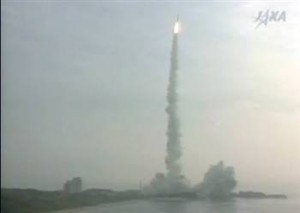
Congratulations to JAXA, the Japan Aerospace Exploration Agency, for the successful launch of the IKAROS space sail, launched from the Tanegashima Space Center along with the Venus Climate Orbiter yesterday evening US time. The launch was a beautiful sight via JAXA’s Internet feed and we now have the opportunity to shake down solar sail technologies in space, from deployment to navigation and maneuvering. The mission sequence ahead is shown in the diagram below, but as we wait for further news, a special nod of appreciation for IKAROS project leader Osamu Mori and the fine team that has made this solar sail a reality.

Image: After separation from H-IIA, IKAROS will spin at up to 20 rpm, deploying the sail membrane and generating solar power by means of thin film solar cells (minimum success level) within several weeks. Acceleration and navigation using the solar sail will then be demonstrated (full success level) within half a year. Credit: JAXA.
The AKATSUKI climate orbiter is a fascinating mission in its own right, but we focus on IKAROS because our brief in these pages is the technologies that may one day be adapted for deep space, and solar sails have a bright future in helping us travel without carrying propellant. Future sails will experiment with microwave and laser beaming as we learn how sails can operate far from the momentum-inducing photons of the Sun. Also fascinating in terms of IKAROS is JAXA’s hybrid design, which will generate solar power aboard the craft and, in coming iterations, test the capabilities of an integrated ion engine. Japan’s ultimate sail target is Jupiter.
The video below shows how IKAROS will deploy its sail, a maneuver that is the most crucial of the mission. Meanwhile, Louis Friedman reported to Planetary Society members yesterday that the LightSail program is on track for the launch of LightSail-1, the first in a series of three sail attempts that will dovetail nicely with IKAROS’ investigations of solar sail capabilities. LightSail-1 is to be ready for launch by the end of this year, with the actual launch date dependent upon the choice of launch vehicle. Like IKAROS, LightSail-1 will piggyback aboard another mission.
[youtube 7Mb47w0vB04 500 375]
Local space news is complemented by news from the heliopause as we learn that the recent problems of Voyager 2 were caused by ‘one flip of a bit in the memory of an onboard computer,’ according to NASA. Scientists at the Jet Propulsion Laboratory were able to recreate the effect on a computer at their site and, on May 19, were able to reset the computer bit, with engineering data confirming success on Thursday. If all continues to go well, the receipt of science data will resume on May 23. Thus would end the furthest repair operation yet attempted, but only a precursor to what will be needed as we push into the Kuiper Belt and destinations beyond.

A beautiful deployment!
With my brother Jim I worked out various sail deployment schemes for JPL, and did lab experiments showing how they worked in scaled-down vacuum chambers. The oscillation of the Japanese sail in the film here is exactly what experiment showed. Dissipation should eventually leave the sail fully open.
An added excellence is the solar paneling in the sail. They’re going to learn a lot about maneuvering in the next year. Measurement of accelerations should tell us a lot about the dynamics and stability during Venus rendezvous. Congratulations!
If the Japanese solar sail is successful then this could be the first major step towards someday deploying titanically large (kilometers in diameter) solar sails that could be utilized for capturing small asteroids (hundreds or thousands of tonnes in mass) for their natural resources and perhaps for transporting humans and other heavy payload through interplanetary space.
This also shows the importance of other nations having their own space programs and their own space priorities. NASA should have attempted to deploy solar sails into space– decades ago!
IKAROS can be “christened” en route with a targeted laser.
When exactly does deployment of the sail start?
A gossamer sail with circuits printed on to it for payload could conceivably reach ~0.012-0.015 c by a solar “fry-by” to 0.01 AU for deployment. That’s 350-300 years to Alpha Centauri – a long trip time, but cool because it needs no super-rocket power, just enough to get to Jupiter to lower the perihelion via a “reverse gravity-assist”.
The task would be potentially much easier in a system with red-giant Sun and would give a higher final velocity, making me wonder if civilizations don’t evacuate their star systems en masse via such an energy-lite means. So many opaque occulters would surely produce an observable signal of some kind, fitting in with the previous discussion here about SETI-as-archaeology.
Uncle Dan writes:
I don’t have the timing on that yet. The IKAROS site is still talking about deployment within the first few weeks. The latest I have from JAXA is this update:
How big is a mass of the Ikaros?
All I can suggest is going to the IKAROS page at JAXA:
http://www.jaxa.jp/projects/sat/ikaros/index_e.html
As to the sail itself, JAXA says this:
Thank you for answering my question, Administrator! Great site!
How can you sail towards something that’s closer to the sun than the earth is (Venus). Am I missing something here?
What happens then if solar sail is prove to be useful than using a propellant?like how we explore space, colonise and etc.
Answers to two questions, first the one from Parmanello:
To see how a solar sail can ‘tack’ to move closer to the Sun, see this link, which lays out the idea with a diagram:
http://wiki.solarsails.info/index.php?title=Tacking_Solar_Sails
And for Jeremy, the answer is that we have to learn just how useful a solar sail may be. If sails work as per expectation, then we have a means of getting around the inner Solar System and out to Mars without burning propellant aboard the vehicle, and that means we’re much more nimble because we don’t have to carry all the excess weight. Some people have envisioned sails being used to move cargo between bases on the Moon and Mars, etc. But we won’t really know until we’ve run through early experiments like IKAROS and LightSail, which will show us how well the idea matches the reality.
Thanks for answering my question. :D
Likewise!
My (I hope correct) understanding is that by traveling very close to the sun and/or making multiple orbits (sundiver) a solar sail could acquire enough speed to reach near-interstellar space in a few years as opposed to the 30+ year mission times required with current ion propulsion technology. We’re finally starting to test these ideas.
NS: multiple orbits won’t do it. Once you have escape velocity, there is no turning back. And solar escape velocity is pitiful, in interstellar terms.
I’m pretty sure I saw a proposal where a solar sail would gain speed during several orbits relatively close to the sun, which would also permit the sail area to be smaller. I’ll try and find a link.
I was speaking of near interstellar space, past the heliopause/bow shock to ‘pristine’ space no longer influenced by the solar system. Flight to another star is a whole different kettle of fish.