
You knew as soon as you opened Carl Sagan’s 1973 title The Cosmic Connection that you were leaving an Earth-centric view of the cosmos behind. The title page showed, spread across both it and the facing page, a spiral galaxy. The work of Sagan friend and collaborator Jon Lomberg, the illustration included reference to Type I, II and III civilizations, the Kardashev ranking that few laymen had heard about in those days, but which Sagan’s work would illuminate for an increasingly interested public.
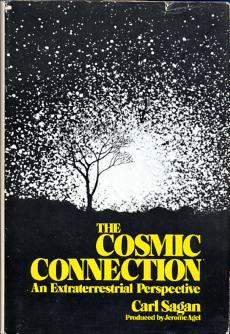
The public would have been drawn first, though, to the cover of that first edition of The Cosmic Connection. A night landscape in black and white, a solitary tree outlined against the sky. But what a sky, filled with what looked like a galaxy — billions and billions of stars — rising. That image encapsulated so much of the book’s message. It juxtaposed our familiar terrain against something so vast, so filled with the potential other stars suggest, that you were forced to speculate on our place in the universe, and ponder all over again how unlikely it was that we might be alone.
Image: A bit dog-eared but still a prize possession, my copy of The Cosmic Connection.
I remember feeling these things when I bought the book in 1973, and find them reawakened as I look at that same copy on my desk this morning. The subtitle of the book is ‘An Extraterrestrial Perspective,’ and Sagan wasted no time in providing it, speculating in an early chapter on using a computer to view the sky as seen from Alpha Centauri:
We now ask the computer to draw us the sky from the nearest star to our own, Alpha Centauri, a triple-star system, about 4.3 light years from Earth. In terms of the scale of our Milky Way Galaxy, this is such a short distance that our perspectives remain almost exactly the same. From α Cen the Big Dipper appears just as it does from Earth. Almost all the other constellations are similarly unchanged. There is one striking exception, however, and that is the constellation Cassiopeia. Cassiopeia, the queen of an ancient kingdom, mother of Andromeda and mother-in-law of Perseus, is mainly a set of five stars arranged as a W or an M, depending on which way the sky has turned. From Alpha Centauri, however, there is one extra jog in the M; a sixth star appears in Cassiopeia, one significantly brighter than the other five. That star is the Sun. From the vantage point of the nearest star, our Sun is a relatively bright but unprepossessing point in the night sky. There is no way to tell by looking at Cassiopeia from the sky of a hypothetical planet of Alpha Centauri that there are planets going around the Sun, that on the third of these planets there are life forms, and that one of these life forms considers itself to be of quite considerable intelligence. If this is the case for the sixth star in Cassiopeia, might it not also be the case for innumerable millions of other stars in the night sky?
Indeed. Back then, speculations about the ‘Great Silence’ weren’t quite so hard-edged as they’ve become, and the belief that if a large-scale SETI search were mounted, it would produce results in short order seemed more than reasonable. It’s certainly what I believed at the time.
Reading Sagan’s book made the prospect of extraterrestrial intelligence not just accessible but thrillingly real. I was a graduate student in 1973, studying arcane medieval languages like Old Icelandic, Gothic and Anglo-Saxon, absolutely in love with the idea of re-creating a vanished past through words. I identified with Sagan not only because of my own long-standing interest in our place in the universe but also because he brought that same kind of passion to the study of space.
Passion was the ticket, and The Cosmic Connection was loaded with it. I can’t say it changed my life, because even as a kid I was obsessed with the questions it considers. But I know people whose life it and the later COSMOS series did change, people who went on to careers in various of the sciences because of the enthusiasm they gathered from Sagan’s work. On a broader scale, I know people who continued at their own careers in entirely other fields, but who retained a sense of the grandeur and awe of the universe that they first acquired by watching COSMOS or reading other Sagan books, particularly the absorbing Contact.
Back in 1973, I took my well-read copy of The Cosmic Connection around to my friends. We were, most of us, laboring in subjects far removed from the celestial, but the book got passed around, read, discussed at our innumerable coffee sessions in UNC-Chapel Hill’s Pine Room. It’s not as if we didn’t have other things to do, all of them on tight deadline. Now that’s skillful — to take subjects as vast as exobiology and astrophysics and render them with such transparent, supple style that amateurs like we all were then found ourselves excitedly weighing the prospects for other life in the cosmos, for missions to other stars. All of this while we were supposed to be parsing scribal errors in the Beowulf manuscript!
Making the technical accessible is one of the most difficult writing jobs there is. Sagan had the gift, but he coupled it with art (the exquisite designs of Lomberg), music, special effects, and photography from our space missions to create the classic COSMOS series. In a sense, his gift was more that of film director than writer, for a director works with a team, and not only with a script but with values of cinematography that transform written words into visual experience. His later books drew on the same values. No one in the cosmology game has equaled what Carl Sagan did with these tools, and it’s both humbling and empowering to remember how he used them on this eleventh anniversary of his death.
Not the point of this post but I think the whole “Great Silence” paradox is way overblown. Humanity has been transmitting on radio only for an infinitesimal amount of the total history of the universe.
Let’s presume we develop an alternate/ more advanced form of communication even within the next 500-1000 years (which certainly seems plausible). If a million civilizations throughout all time did the same thing we are still talking lottery odds that we’d be in the right place, at the right time, with the proper technology to detect one of them.
Am I the only one to find this a perfectly plausible (and more likely) scenario?
At 71, MIT Physicist is a Web star
New York Times, Dec. 19, 2007
Walter H. G. Lewin, 71, a physics professor who has long had a cult following at MIT, has now emerged as an international Internet guru with his videotaped physics lectures, free online on MIT’s OpenCourseWare.
MIT recently expanded its online classes by opening a site aimed at high school students and teachers.
Full article here:
http://www.nytimes.com/2007/12/19/education/19physics.html?_r=1&oref=slogin
Rob, the situation you suggest is plausible. We’re already going silent in radio frequencies as we put more and more of our communications into cable and other technologies. That leaves other types of SETI via, for example, optical searches and who knows what else. Some of us, myself included, think intelligent life is extremely rare in the galaxy, but that’s little more than a guess at this point. I’d prefer to think you’re right, though it often seems to me that a Type III civilization should be detectable with the tools we currently have. And if there are no Type IIIs, the question becomes, why not?
Larry, I’m a great admirer of MIT’s move in open courseware, and I’m glad to know about Dr. Lewin’s lectures. I plan to take full advantage of these!
Carl Sagan’s ability to make an analytic subject so interesting is amazing. I think he had a rare mix of being a scientist plus an artist/philosopher. I still remember viewing Cosmos in the mid 1980’s when I was in high school; later, I got the Cosmos DVD’s and they are just amazing. Same with his “latest” book edited by Ann Druyan, “The Varieties of Scientific Experience, a personal view of the search for god”. It is worth a read, chapter 4 and 5 are devoted to (the search and implications) of Extraterrestrial Intelligence.
I’ve read quite a bunch of books from Paul Davies, David Grinspoon, Giancarlo Genta, and of course, Carl Sagan. I believe some day we will find evidence that life and ET Intelligence is widespread in the universe. I believe we are not unique, otherwise and quoting a famous movie: “it would be be a terrible waste of space”
Antonio, I assume from your message that the Giancarlo Genta book you’re referring to is his wonderful Lonely Minds in the Universe. I’m also a great admirer of David Grinspoon. Which of the Paul Davies books do you particularly recommend? I’ve read several, but he seems quite prolific!
Hello Paul,
Yes, P. Davies is quite prolific. I would recommend 3 books: “The 5th Miracle”, “Are We Alone?” And “The Mind of God”, in that order. What I like about Davies’ books is that he is clean, ideologically speaking.
As for Giancarlo Genta’s book, yes, I refer to Lonely Minds in the Universe. The book is OK to me, I would probably give it 3 starts in the Amazon scale. I found some sections too long and unfocused some times.
And for D. Grinspoon, yes, he is great. Even his family and Carl Sagan (as well as Isaac Asimov) were family friends, David disagrees on a couple of things with Carl, especially on the possible existence/presence of ET Intelligence in the Solar System, or even on earth.
As far as the Fermi Paradox… I suspect that we already have picked up very faint and non-repeatable signals, not beacons and not aimed at us, but due to scintillation. Perhaps we should abandodn the search for beacons and focus on a different radio frequency than the “watering hole” and it’s multiples. The most powerful signals that our K type 0.6 civilization sends out are the radar pulses to detect asteroids and map moons and planets surfaces. I do not know what frequencies our pulses are sent out at; to avoid the Earth’s atmosphere’s distortion we may have to put a radio telescope in orbit (or better yet the moon’s far side).
One thing to consider about the possibility of Type III civilizations in the Universe is our own history- it hasn’t been a steady, upward climb. Early man was nearly annihilated in the now-famous “bottleneck” genetic study that revealed there were only about 10,000 homo sapiens left after a supervolcano eruption in Indonesia some 75,000 years ago, and there have been a number of other natural as well as man-made dark ages that have periodically impeded human progress. Extrapolating the same unfortunate circumstances to alien civilization, it’s possible that Type III civilizations are *extremely* rare or even nonexistent. The high level of scientific knowledge, technical ability and long-term sociological “steady state” required to achieve and maintain a Type III might be such an odd occurrence in the Universe that for most civilizations, it remains forever out of reach- a tantalizing, elusive goal constantly thwarted by circumstances, either beyond their control or of their own making. There’s also the possibility that if we do find a Type III, what we’re observing is its remnants, with either nobody home due to some catastrophe, or its remaining occupants de-evolved to a point that they no longer fully comprehend the astonishing achievements of their ancient ancestors, alien squatters whose knowledge has descended into myths and legends shared around alien campfires.
Just something to consider.
stargazerdude
seti claims the ATA-350 array will be able to detect signals like that out to 1000 light years.
According to this Web page piece written by Ann Druyan:
http://anndruyan.typepad.com/the_observatory/2007/12/20-december-200.html
“One such effort, his 1980 “Cosmos” television series, has
now been seen by a billion people worldwide. Parts of it will
be broadcast in North America at 8 pm EST on Christmas Day
on the Discovery Science Channel. On Tuesday evenings at 9
pm EST, starting January 8, 2008 the whole series will begin to
run again. “Cosmos'” enduring world-wide appeal is another
testament to his prophetic vision.”
I loved that book. I recently re-read it and posted a review here:
http://texasbestgrok.mu.nu/archives/227924.php
A sequel to Cosmos is in the works:
http://cosmiclog.msnbc.msn.com/archive/2007/12/20/528690.aspx
fred ljk – i have read cosmos twice also and own the dvd’s which i have watched quite afew times!! a sequel!!!??? like to know more kinda doubt it could be as good ESPECIALLY without carl sagan!!!!!!!! thank you your friend george
Proposed Carl Sagan commemorative stamps unveiled
at Ithaca Sciencenter
By Anne Ju
A movement to immortalize famed Cornell astronomer
Carl Sagan with a U.S. postage stamp was launched
Feb. 11 for local media at the Ithaca Sciencenter.
Patrick Fish, founder of the Utica-based grassroots Sagan
Appreciation Society, and Charles Trautmann, executive
director of the Sciencenter, unveiled four renderings by
three artists or artist teams of proposed Sagan memorial
stamps that the society plans to submit to the U.S. Postal
Service for commissioning.
“As Carl was America’s science popularizer, it seems fitting
that he be bestowed with a populist kind of honor,” Fish said.
“Carl wasn’t just an astronomer, physicist and the world’s
pre-eminent science teacher. He was arguably the first
exobiologist, one of the fathers of global-warming awareness,
a peacemaker and a brilliant author who could make science
sound like poetry.”
Trautmann read a statement by Sagan’s widow, author Ann
Druyan, at the media launch. She described how Sagan had
been an avid stamp collector as a boy and how that interest
was perhaps early evidence of his “passion for the diversity
of Earth’s cultures.”
Full article here:
http://www.news.cornell.edu/stories/Feb08/sagan.stamps.aj.html
ljk,a stamp for carl sagan? great idea!! you know who reminds me of dr sagan today? neil degrasse tyson the black gentleman who runs the hyden planetarium.he also appears with great regularity on the new series universe. i have had the honor of exchanging e mails with him twice,he is a great guy! if they need somebody to be the voice of the new cosmos series i think he would be the logical choice.thank you,your friend george
Hi ljk;
This is an interesting article. My Dad was an avid Postage Stamp collector and a stamp dealer as his second retirement career right up until the time of his death. He always liked artistic commemorative type stamps and would no doubt find these Carl Sagan stamps beautiful. As a result of his postage stamp activities, I had found an appreciation for fine commemorative modern postage stamps and although so many were produced so that they are not worth much, they are none-the-less often beautiful works of art.
Thanks;
Your Friend Jim
In the Orion’s Arm realm around one Dyson Shell is a
Jupiter Brain named after Carl Sagan:
http://www.orionsarm.com/downloads/sagan.jpg
The Lewin physics lectures
Walter Lewin has been teaching physics at MIT since 1972.
He employs large doses of fun with large-scale demonstrations
in his classes. These include charging himself using a Vandergraph
generator, and swinging from the end of a giant pendulum. He also
employs practical jokes and puzzles. As well as mention in The New
York Times 100 of Walter Lewin’s lectures can be found online.
Full transcript here:
http://www.abc.net.au/rn/scienceshow/stories/2008/2234064.htm
Carl Sagan’s companion book to Cosmos is online here:
http://www.scribd.com/doc/3573701/Carl-Sagan-Cosmos
In 1977, John Denver guest hosted NBC’s The Tonight Show.
One of his guests was Carl Sagan:
http://www.youtube.com/watch?v=qho15vV3Lz8
The science of talking so people want to listen
June 19, 2009 | 8:45 am
If you study high-energy particle physics, the importance and excitement of neutrinos is obvious. But how do you convey that to an auditorium of students, a member of Congress, or your neighbor?
If you’re Michael Turner, a University of Chicago astrophysicist, you borrow a plot line from the classic Christmas movie, It’s a Wonderful Life. “What if neutrinos had never existed?” Turner asked in a recent public outreach lecture. Then he showed the audience a world without the subatomic particles, just as the movie showed life minus the main character George Bailey.
“No neutrinos,” Turner said. “That means no atoms, no Earth, and no us.”
Connecting science to everyday experiences in jargon free terms is key to science outreach, something Turner excels at doing. He shared his insights and tips from more than a decade worth of talks with scientists at Fermilab’s annual Users’ Meeting this month.
The meeting featured a special Outreach Workshop with talks to help scientists adjust to a changing climate that requires every scientist be able to explain the value of research in language a banker with no science background would understand.
Full article here:
http://www.symmetrymagazine.org/breaking/2009/06/19/the-science-of-talking-so-people-want-to-listen/
To quote:
“What we do is intrinsically interesting and important,” Turner said. “You have to work hard to make it boring.”
Heaven’s Touch
From Killer Stars to the Seeds of Life, How We Are Connected to the Universe
James B. Kaler
To read the entire book description or a sample chapter, please visit:
http://press.princeton.edu/titles/8991.html
Did you know that as you read these words showers of high-speed particles from exploding stars are raining down on you? As you gaze into the starry sky, you might feel isolated from the Universe around you–but you’re not. This book reveals the startling ways life on Earth is touched by our cosmic environment, and demonstrates why without such contact, life itself wouldn’t be possible.
Carl Sagan excerpts from Cosmos episodes set to music:
http://blogs.discovermagazine.com/cosmicvariance/2009/10/14/autotuned-sagan/
Oddly enough, it works.
At Home in the Cosmos with Annie Druyan
In more entertainment news, CSI fellow, SKEPTICAL INQUIRER contributor, and Carl Sagan’s last wife Ann Druyan has a new video podcast available, detailing intimate accounts of her life with Carl Sagan.
At Home in the Cosmos with Annie Druyan includes reflections on Druyan’s and Sagan’s childhoods, the story of an unmade version of the film Contact, a show and tell of important personal objects from the couple’s home, a never-before-seen video tour of Sagan’s archives, and graveside footage of Druyan discussing her own philosophy on life and death.
http://www.podjockey.com/members/cosmos/
Video: The Frontier Is Everywhere
Jan. 12, 2011 | 15:09 PST | 23:09 UTC
Weblog Archive by Charlene Anderson
No one ever said it like Carl Sagan. No one else could capture in a few words the power and glory of humankind’s efforts to reach other worlds. A young and enthusiastic NASA supporter has married Carl’s writing with images to create a YouTube video in the hope of helping NASA engage the public in its mission of exploration. It reminds me of how much I miss Carl, and how we all need to listen to the words he left us
http://planetary.org/blog/article/00002876/
Lynn Margulis, Carl Sagan’s first wife:
http://paleblueblog.org/post/13224508962/farewell-to-a-brilliant-earth-mother
Carl Sagan, A Cosmic Celebrity (full documentary)
by Socrates on December 14, 2011
Carl Sagan was perhaps the best known science-celebrity of the 20th century.
His 13-part television series called Cosmos: A Personal Voyage, was the first time that I – not even 7 years old and growing up behind the Iron Curtain in communist Bulgaria, had a glimpse of our amazing universe.
The story of our Cosmos, as told brilliantly by Carl Sagan, had a profound impact not only on me but also on hundreds of millions of people across the world who also saw the film.
Yesterday I happened to discover Carl Sagan, A Cosmic Celebrity, a film about the man behind Cosmos. This 45 minute documentary follows Sagan’s personal story from his birth in a struggling Jewish family during the Great Depression to his eventual tragic death from cancer. The movie also documents his important scientific contribution to NASA, his campaign against nuclear weapons, his embrace of the scientific method as a tool to skeptically examine the world, his atheism and his very human flaws and struggles.
Full article and videos here:
http://www.singularityweblog.com/carl-sagan-a-cosmic-celebrity-full-documentary/
Life’s Most Amazing Invisible Secrets
By Andy Mannie, Carbon-Base Life Form
Posted: 1/11/12 06:31 PM ET
One of my heroes, evolutionary microbiologist Lynn Margulis, died this past Thanksgiving. She was an amazing lady who was married to Carl Sagan for many years, and partnered with James Lovelock in discovering that the earth is an interconnected living global ecosystem run largely by microbes. She pioneered the theory of symbiogenesis — that new species are created through symbiotic partnerships.
Her book What is Life? offers stunning insight into the nature and evolution of living systems.
Here are some of her most surprising, and fascinating revelations:
http://www.huffingtonpost.com/andy-mannle/lifes-ten-most-amazing-se_b_1152771.html
The Holy Cosmos: The New Religion of Space Exploration
By Ross Andersen
Mar 29 2012, 7:05 AM ET 22
Carl Sagan and Neil deGrasse Tyson are high priests, astronauts are like saints that ascend into heaven, and extraterrestrials are as gods — benevolent, wise, and capable of manipulating space and time.
Full article here:
http://www.theatlantic.com/technology/archive/2012/03/the-holy-cosmos-the-new-religion-of-space-exploration/255136/
To quote:
In what ways does Cosmism resemble a religion?
Harrison: Well, the roots of this extend back to antiquity in early notions of sky gods and that sort of thing; it’s telling, for instance, that the polytheistic gods of yesteryear lent their names to planets. In the modern era, Cosmism is generally thought to have originated with early twentieth century Russians. There are a couple different ways that you see the religious aspects of Cosmism. One place you see it is in the tremendous faith that both Russians and Americans have in technology; specifically, the idea that technology can solve the problems of humanity, and that we need to leave Earth to create a better society, to find, in some sense, perfection in space. You see this idea over and over when space exploration is discussed, the idea that we can leave behind the problems that plague society here on Earth and we create these wonderful new societies in space. There’s a general resemblance in this thinking to religious views of heaven, and in particular notions of salvation.
Russian Cosmism actually preceded the Bolshevik Revolution, which meant that the first instances of it were culturally intermingled with the Russian Orthodox Church, which may have lent it some of these religious overtones. You see this kind of messianic approach to space flight, with people touting this deliverance that awaits man in the cosmos. In the twenties, Russian Cosmists talked a great deal about redeeming deceased individuals in space by reassembling the atoms of their bodies, bringing them back to life and letting them enjoy the “ideal society” of the Bolsheviks.
Now if you skip forward to SETI, which I conceive of as a part of space exploration, though it’s certainly exploration at a distance, you find that it’s premised on this view that any alien civilization capable of persisting long enough to make themselves evident to other civilizations will have passed through a bottleneck of technological adolescence, and as a result they’re going to be very old and wise and almost godlike. There’s a guy named Ted Peters who has done some great work on religious symbolism in SETI. He argues that it’s pure mythology, this idea that these beings exist, that they’re out there and they’re smarter than us, and that they’re good-natured and they’re going to help us. From his point of view, it has all the markings of a religious myth. This religious, godlike aspect of extraterrestrials is particularly evident in the culture surrounding UFOs, especially in the 1950’s and 60’s.
AMC story notes on Contact, many of which I did not know about the 1997 film before:
http://blogs.amctv.com/movie-blog/2012/04/story-notes-contact.php
http://citizenofthegalaxy.com/wordpress/?p=417
ENCYCLOPEDIA GALACTICA: Civilization: Man
Posted on January 31, 2012 by Jon Lomberg
ENCYCLOPEDIA GALACTICA, mixed media on Masonite, 1972
Forty years have passed since Carl Sagan and I met.
He was the truest Citizen of the Galaxy that ever was.
In early 1972 I wrote him a fan letter motivated by the launch of NASA’s Pioneer missions, the first to reach Jupiter and Saturn. They were the first spacecraft to leave the solar system, containing the now iconic plaque of interstellar greeting devised by Carl and Frank Drake, featuring humans beautifully drawn by Linda Salzman Sagan, then Carl’s wife.
Nobody knows whether the message will ever reach extraterrestrials, but it certainly reached me. I was thrilled and inspired by the idea that real astronomers, not UFO loonies, were attempting interstellar communication, attempting to log onto the Encyclopedia Galactica (that’s what Carl called it then; today I guess we’d speak of the Galactic Internet.)
One of the first paintings I did in homage to Sagan’s vision was titled Encyclopedia Galactica. It shows the user interface of a search engine to find galactic civilizations—and how our own entry might read in English translation. Thia was the first painting of the Milky Way Galaxy that I ever did.
In 1972, shortly after I had moved to Toronto, I wrote Carl a letter of appreciation for his words and deeds, trying to express how powerfully I had been affected by his ideas and by their manifestation in the Pioneer plaque. He wrote back an enthusiastic letter in which he said some nice things about my paintings. And he invited me to meet him in the Toronto airport, where he was making a flight connection on his way back from Nova Scotia. He had been there to observe the solar eclipse on July 10, as a guest of the Canadian industrialist and philanthropist Cyrus Eaton.
Carl had told me the day and approximate time he would arrive, but neglected to mention the airline, flight number, or which city he was flying in from. It was actually remarkably similar to the central problem of interstellar communication: How do you find someone you are looking for when you haven’t pre-arranged a meeting place? The problem is the same whether you are searching the vastness of New York City or the electromagnetic spectrum. You could search at random, with little chance of success. Or you might concentrate your search on landmarks known to you both, such as the Empire State Building (in the case of New York) or the natural emission frequency of interstellar hydrogen (in the case of the radio spectrum).
The airport was a simpler case. I could position myself so that most of the disembarking passengers from domestic Canadian flights would have to walk past me. But neither Carl nor I knew the other’s appearance. What landmark would both of us recognize? The solution I came up with was the Drake Equation, written N=R*FpFlFiFc x L. Carl had discussed this formula at great length in Intelligent Life In The Universe, a groundbreaking book he co-authored with the Russian astrophysicist Iosep Shklovskii.
I reasoned that on that particular day in the Toronto International airport he, and only he, would be able to recognize and understand it. [Frank Drake invented the equation that bears his name as a way of calculating the number of civilizations in the galaxy as a function of various factors such as the fraction of stars that have planets, the fraction of planets that have life, and so forth. It was one of the most well known equations among scientists interested in extraterrestrial life.]
I wrote the equation in black magic marker on a big piece of paper, taped it to the outside of my portfolio, and went to the airport. I wandered around the gates as planes arrived. Many people eyed me suspiciously, wondering what cult I was hawking, until a tall, dark-haired man came towards me with a big grin and outstretched hand saying, “Hi, I’m Carl. That was a great method for finding me. I thought you’d have me paged, but this is far more elegant.”
We talked for two hours in the airport about astronomy, science fiction, art, and the Encyclopedia Galactica. Then he had to catch another plane back to Ithaca. “Look”, he said” I’ve just signed a contract with Doubleday to write a book for a popular audience. Would you like to illustrate it? Yes? Good! Can you come down to Ithaca within the next few weeks and we’ll talk about it?”
Shortly afterward I drove down to Ithaca, New York, home of Cornell University and Sagan’s Laboratory for Planetary Studies The back of my car was filled with artwork I wanted to show him.
When he saw the Encyclopedia Galactica painting, Carl’s reaction was “I’ve been waiting to see this painting my whole life!” He asked to use it as the cover for his book Communication with Extraterrestrial Intelligence [MIT Press, 1972 the proceedings of a now-classic international conference held in 1972 in Byurakan, Soviet Armenia.]
Carl bought the painting and he paid me in something far more precious than money—he gave me a back-up Pioneer plaque, one of the spares they had left over. He, Frank, and Linda all signed the back of it. It was like receiving a signed home run baseball from the World Series. It hung in my home for years, then spent 15 years on display at the National Air and Space Museum, part of the gallery Where Next Columbus?, for which I was commissioned to paint my Portrait of the Milky Way.
In the years that followed I did several more paintings in this series, most of them after discussions with him or Frank Drake. The concept of the Encyclopedia Galactica eventually found its way into the COSMOS series as title of Episode12. I’ll post others in the series on this blog from time to time. Would that be of interest to you, reader?
It has been 40 years since my journey with Carl began, and I like to think of it continuing still, beyond even our deaths, as our Voyager Record cruises towards the stars.
http://www.washingtonpost.com/national/health-science/library-of-congress-obtains-astronomer-carl-sagans-personal-papers/2012/06/26/gJQABdFN5V_story.html
Library of Congress obtains astronomer Carl Sagan’s personal papers
By Joel Achenbach, Published: June 26
The life of Carl Sagan now fills the tabletops of two vast rooms in the Madison Building of the Library of Congress. The life arrived in recent weeks at the building’s loading dock on 41 pallets containing 798 boxes.
Sagan famously talked about billions of stars and billions of galaxies, and it appears that he saved roughly that many pieces of paper.
The material documents Sagan’s energetic career as an astronomer, author, unrivaled popularizer of science and TV star, and it ranges from childhood report cards to college term papers to eloquent letters written just before his untimely death in 1996 at age 62. Also in the mix are files labeled F/C, for “fissured ceramics,” Sagan’s code name for letters from crackpots.
And there’s this, from Johnny Carson, after Sagan declared that he’d never actually used the much-satirized phrase “billions and billions” on “The Tonight Show”: “Even if you didn’t say ‘billions and billions’ you should have. — Johnny.”
Until recently, all this stuff had been stacked in filing cabinet drawers in the Sphinx Head, a tomblike secret-society building that became Sagan’s home in Ithaca, N.Y. For years, Sagan’s widow, Ann Druyan, had carefully preserved her husband’s archive, hoping to find an appropriate repository. The Library of Congress had long been interested; the library owns the papers of such innovators and scientific luminaries as Alexander Graham Bell, the Wright brothers, J. Robert Oppenheimer, E.O. Wilson and Margaret Mead.
Along came Seth MacFarlane, creator of TV’s “Family Guy” (and director of the new movie “Ted”). Astrophysicist Neil deGrasse Tyson introduced MacFarlane to Druyan when Tyson and Druyan were developing a remake of the enormously popular 1980 PBS series “Cosmos” that made Sagan famous. In the process of backing the new “Cosmos,” MacFarlane provided an undisclosed sum of money to the Library of Congress to buy the archive from Druyan. The library will officially announce the acquisition Wednesday.
Now comes the arduous task of sorting through it. The boxes fill two sprawling rooms. The organization of the archive is expected to be completed by November 2013, at which point the material will be open to researchers.
“He was practically the face of science in this country for a long, long time,” said Leonard Bruno, a historian specializing in science, who recommended that the library obtain the material and who is retiring later this week. “He made science cool.”
Druyan said of her late husband, “He wasn’t a pack rat at all. But I think he had a sense of his place in cultural history. I think he knew he was corresponding with the great and the near-great both inside and outside of science.”
Library officials let a Washington Post reporter spend a couple of hours going through a few select boxes.
Sagan was, one quickly discovers, a phenom.
“If you wish to gain information concerning anything, go to Carl Sagan. He is Noah Webster, Einstein, and a walking encyclopedia all rolled into one. (There is a streak of John Barrymore in his nature, also.),” wrote the student newspaper at Rahway (N.J.) High School in 1950.
The archive includes documents related to Sagan’s controversial hypothesis that an all-out nuclear war would result in a “nuclear winter.” It also includes letters to and from Sagan during a painful episode when the National Academy of Sciences declined to extend him membership (some scientists had sniffed that Sagan was a popularizer whose scientific work wasn’t of the highest merit, but other colleagues defended him, noting, for example, that he did early, significant work showing that a greenhouse effect broiled the surface of Venus and that dust storms on Mars explained changing features seen through telescopes.
There’s fascinating correspondence between ordinary people and the famous scientist. Sagan was both a promoter of science and its gatekeeper, remaining skeptical of paranormal claims and UFO reports. The trick was to be a defender of science without being a scold. To one correspondent, Sagan gently asked “only that you be open to the possibility that you are wrong, and not confuse what feels good with what’s true.”
A sampling of the “fissured ceramics” letters that he received after he became famous with “Cosmos”:
?“I have discovered a planet between Venus and the earth. .?.?. I am in Attica Correctional Facility and am unable to check out this discovery further without your assistance.”
?“I feel we have much to give to each other — you in the scientific field and me as one who is working with those beautiful, highly evolved Beings living on the planets, stars, orbs in our many universes. .?.?. ”
?“Behind Jupiter hidden from earth, is a small planet and for the want of a name, let us call it, JUPITENOUS. It is on this planet that these UFO’s come from. .?.?. ”
One woman wrote him in the fall of 1996 to discuss people who communicated from beyond the grave. Sagan wrote back:
“The only thing that would convince me, coming over from ‘the other side’, is information that we do not yet have but that once enunciated would be verifiable. Let’s have Sophocles, Democritus, and Aristarchus dictate their lost works. Let’s ask Fermat to reproduce his short proof of Fermat’s Last Theorem. Have Alexander the Great tell us where his tomb is so we can go dig and verify.”
In the papers, we see Sagan imagining life not only on Venus and Mars but even beneath the surface of the moon. That’s the young Sagan, fresh out of the University of Chicago.
We also see the mature Sagan pondering the tendentious issues of God and the relationship of science and religion.
In a 1989 letter to famed Harvard scientist Stephen Jay Gould, he refers to a Cincinnati Post editorial:
“Do you understand how — assuming either of us ever did say ‘The universe can be explained without postulating God’ — this could be understood as dogmatic? I often talk about the ‘God hypothesis’ as something I’d be fully willing to accept if there were compelling evidence; unfortunately, there is nothing approaching compelling evidence. That attitude, it seems to me, is undogmatic.”
In October 1996, Sagan wrote to Robert Pope of Windsor, Ontario:
“I am not an atheist. An atheist is someone who has compelling evidence that there is no Judeo-Christian-Islamic God. I am not that wise, but neither do I consider there to be anything approaching adequate evidence for such a god. Why are you in such a hurry to make up your mind? Why not simply wait until there is compelling evidence?”
He died two months later. Soon after, Gould wrote to Sagan’s widow:
“He taught the whole world. What a wonderful life!”
Read Carl Sagan’s letter (politely) telling Warner Bros. their Contact script sucked
Michael Ann Dobbs
You may have recently encountered Carl Sagan’s 1954 reading list out in the internet. But the Library of Congress has posted some much more interesting papers from the scientist, novelist and all around fascinating guy: A draft of the 1995 letter he sent to Warner Brothers about the adaptation of Contact.
The first two pages of what seems to be an even longer letter give a glimpse into just how complicated the production of a science fiction film can be.
Sagan and his wife Ann Druyan wrote an earlier screenplay adaptation of the novel and (unlike virtually every screenwriter ever) had the opportunity to comment on seems to be at least a third draft of the script by Michael Goldenberg. Goldenberg and James V. Hart would both be credited by the WGA for the final screenplay, suggesting even more drafts would follow this letter.
Sagan and Druyan have concerns about the problems that plague every screenplay, as well scientific accuracy.
Full article here:
http://io9.com/5931333/read-carl-sagans-letter-politely-telling-warner-bros-their-script-sucked
Forget trying to find ETI: Getting Hollywood to produce an intelligent and scientifically accurate science fiction film remains a much harder tasks.
http://www.dailygalaxy.com/my_weblog/2012/08/image-of-the-day-carl-sagans-childhood-drawing-of-his-vision-of-outer-space.html
Image of the Day: Carl Sagan’s Childhood Drawing of His Vision of Outer Space
Carl Sagan’s passion for exploring worlds beyond our own began as a child growing up in Brooklyn, when a the age of five he began frequenting the New York Public Library to browse books that could give him a better understanding of the stars. He later reflected on the what he discovered: “There was a magnificence to it, a grandeur, a scale which has never left me. Never ever left me.”
Sagan’s fixation continued and as a pre-teen he sketched his vision for the future of interstellar space exploration, currently housed in the The Library of Congress. The drawing featured newspaper headlines he predicted would happen in the future.
Our favorite: “Epsilon Altair seen fit for human habitation.”
Sagan pursued hispassion into adulthood writing later: “All my life, I’ve wondered about life beyond the earth. On those countless other planets that we think circle other suns, is there also life? Might the beings of other worlds resemble us, or would they be astonishingly different? What would they be made of? In the vast Milky Way galaxy, how common is what we call life? The nature of life on earth and the quest for life elsewhere are the two sides of the same question: the search for who we are.”
The Daily Galaxy via Library of Congress
Carl Sagan and Timothy Leary corresponded about life, the Universe, and everything back in the early 1970s – with Leary expressing many of the desires and concerns most space advocates have when it comes to space and human expansion:
http://www.timothylearyarchives.org/carl-sagans-letters-to-timothy-leary-1974/
To quote:
“There’s little doubt Leary was inspired by Sagan’s extra-terrestrial messaging, when he composed his own message in binary code and reproduced it on the cover of the book Terra II, as a transmission from “Higher Intelligence,” an imagined response from a distant galaxy to Sagan’s Pioneer 10 message. (Terra II is also a complex prison escape plan, arguably one of the most bizarre ever conceived, but that’s another story.)”
and…
“Soon after Timothy was released from prison, he and his archivist, Michael Horowitz, brainstormed the idea of creating a television show modeled on Cosmos, with the subject being Inner Space rather than Outer Space. The theme was the discovery of psychedelic plants and drugs, and resultant brain change in the species, with Leary taking Sagan’s role as host. But it never got past the planning stage.”
This has been known since it was revealed in Sagan’s 1999 bios. What the news items failed to mention is that Sagan was involved to see if the nuclear blast might release any organisms from beneath the lunar surface for study.
http://news.nationalpost.com/2012/11/26/how-the-u-s-and-carl-sagan-planned-to-nuke-the-moon/
Much better information here:
http://en.wikipedia.org/wiki/Project_A119
Details on the Soviet plan to do the same. Ah, the Cold War.
http://www.svengrahn.pp.se/histind/E3/E3orig.htm
http://www.artdaily.org/index.asp?int_sec=11&int_new=59173
Leo Villareal installation is tribute to the late Cornell astronomy professor Carl Sagan
Leo Villareal, Cosmos, 2012. White LEDs, custom software, and electrical hardware; approx.. 45 x 68 ft. Acquired through the generosity of Lisa and Richard Baker, Class of 1988. Photo: James Ewing.
ITHACA, NY.- The Herbert F. Johnson Museum of Art at Cornell University presents Leo Villareal: Cosmos. An homage to the late Cornell astronomy professor Carl Sagan, Cosmos is the most recent site-specific installation by New York–based artist Leo Villareal (born 1967), a pioneer in the use of light-emitting diodes (LEDs) and computer-driven imagery. His signature pieces explore complex movement and dazzling patterns created by points of light using his own computer software.
Planning for Cosmos began in November 2010, when Villareal—along with the project architect, Walter Smith AIA LEED AP, and donors Lisa and Richard Baker—worked with Johnson Museum staff to determine the optimal location for the installation. The 45 x 68 foot ceiling of the Sherry and Joel Mallin Sculpture Court was chosen for its high visibility not only on campus but also from the city of Ithaca. Cosmos is made up of twelve thousand energy-efficient LEDs attached to a gridded framework. A zero gravity bench, 25 feet long, was especially designed by the artist for viewers to fully immerse themselves in the viewing experience and to foster a more communal involvement with his installation.
While Villareal developed many of the light patterns on the computer in his studio, final imagery also came from direct observation on site, such as cloud movement and flocks of geese flying over Ithaca in early fall. “It’s almost like a musical instrument that you have to tune and get just right,” said the artist. “It’s a process of discovery, because I don’t know in advance what it’s going to be.”
Villareal spent a week in residence at Cornell, adjusting his programming from a variety of vantage points on the Museum grounds. “It is especially exciting to view the installation at nighttime, when the patterns of light make the ceiling disappear and turn it into a void—light trumping matter,” said Andrea Inselmann, curator of modern and contemporary art at the Johnson Museum.
Commenting on this interaction between the existing architecture and his installation, Villareal has noted, “The challenge for me is to find a way to do it that respects what’s here but that adds another layer that can really invigorate the building and make people look at it in a new way.”
Searching out Sagan in Ithaca
by Elizabeth Howell on November 28, 2012
I never knew of Carl Sagan as a living human being, as I missed him by mere months. I read Pale Blue Dot sometime in 1997, if my memory serves, sometime after the movie Contact (based on his book) came out in theaters and I asked my parents what the “FOR CARL” dedication was at the end of the movie.
At a time when I was all awkward teenagerhood, Sagan’s writing showed me a Universe of beauty. Not organized beauty, to be sure, but a destination worth exploring. Worth learning more about, even from a humble perch on Earth.
Sagan had a bit of everything in him: a knowledge of philosophy and history, an influence on early NASA missions, an ability to take the Universe and make it homey enough to show on television screens and in books.
His formative research years were at Cornell University in Ithaca, New York. More than 15 years after his death, he’s actually pretty easy to find in that town.
http://www.universetoday.com/98681/searching-out-sagan-in-ithaca/
What Exactly Was Carl Sagan Working on with the U.S. Military?
Keith Veronese
News of Carl Sagan’s involvement with a plan to “nuke” the moon, Project A119, has become relevant again. In fact, Sagan was involved in a number of military causes during his all-too-short lifetime. But later, he cut all ties with the military. Here’s what happened.
Full article here:
http://io9.com/5968239/what-exactly-was-carl-sagan-working-on-with-the-us-military#13558392819752
Nice graphic depiction of Carl Sagan describing the Pale Blue Dot:
http://zenpencils.com/comic/100-carl-sagan-pale-blue-dot/
The Art of Our Pale Blue Dot
By Phil Plait
Posted Sunday, Jan. 27, 2013, at 8:00 AM ET
It is a wonderful thing that words written many years ago can inspire people today. When Carl Sagan wrote his essay “Reflections on a Mote of Dust” (commonly called “Pale Blue Dot”), he must have known how special it was. His words were inspired by a picture taken from a spacecraft 6 billion kilometers away, a probe commanded to turn around and look at our solar system from this great distance. It was so terribly remote at the time that our entire planet appears as a simple pale blue dot, a single pixel of color in a vast patch of darkness.
His essay is, in my opinion, one of the finest examples of writing in the English language. It’s no surprise that people find new ways to honor his words. My friend Gavin Aung Than draws Zen Pencils, where he takes words by scientists and other figures and draws an inspirational web comic based on them. He took my own essay “Welcome to Science” and made a phenomenal series of panels for it, and he recently did the same using Sagan’s words. It’s wonderful, and you may discover your room is very dusty as you read it.
Sagan has inspired artists in other ways too, of course. An animation was recently brought to my attention that uses Sagan’s own voice to breathe new life into this phenomenal tract:
Full article plus animation here:
http://www.slate.com/blogs/bad_astronomy/2013/01/27/carl_sagan_s_pale_blue_dot_amazing_art_based_on_sagan_s_essay.html
Sagan & Swan’s Voyager Mars Landing Sites (1965)
BY DAVID S. F. PORTREE02.10.13
12:34 AM
Until the 1980s, most U.S. automated space explorers bore names connoting ventures into unknown parts – Explorer, Pioneer, Ranger, Surveyor, Mariner, and Voyager. Most people today identify the last of these names with the spectacularly successful pair of outer Solar System flyby spacecraft launched in the late 1970s.
There was, however, an earlier Voyager program. First proposed in 1960 as a follow-on to the planned Mariner planetary flyby program, the original Voyager aimed to explore Venus and (especially) Mars using orbiters and landing capsules.
Carl Sagan, an assistant professor of astronomy at Harvard, and Paul Swan, Senior Project Scientist at Avco Corporation, published results of a study of possible Voyager Mars landing sites in the January-February 1965 issue of Journal of Spacecraft and Rockets.
For their study, they invoked a Voyager design Avco had developed in 1963 on contract to NASA Headquarters.
The “split-payload” design comprised an orbiter “bus” based on the Jet Propulsion Laboratory’s Mariner (or proposed advanced Mariner-B) design and a landing capsule shaped like the Apollo Command Module (that is, conical, with a bowl-shaped heat shield). Bus and capsule would leave Earth together on a Saturn IB rocket with an “S-VI” upper stage (a modified Centaur stage).
Full article here:
http://www.wired.com/wiredscience/2013/02/sagan-swans-voyager-mars-landing-sites-1965/
Cosmic Pastoral: Diane Ackerman’s Poems for the Planets, Which Carl Sagan Sent Timothy Leary in Prison
by Maria Popova
“I’m stricken by the ricochet wonder of it all: the plain everythingness of everything, in cahoots with the everythingness of everything else.”
On this day in 1974, shortly before visiting Timothy Leary in prison, Carl Sagan sent the psychedelic pioneer a letter discussing evolution, the possibility of extraterrestrial life, and the details of the upcoming visit.
The postscript read:
P.S. The enclosed poem, ‘The Other Night’ by Dianne Ackermann [sic] of Cornell, is something I think we both resonate to. It’s unfinished so it shouldn’t yet be quoted publically.
But the poem was eventually finished and along, with fourteen others, included in Diane Ackerman’s 1976 poetry anthology The Planets: A Cosmic Pastoral (public library) — a whimsical and wonderful ode to the universe, celebrating its phenomena and featuring a poem for each planet in the Solar System, along with one specifically dedicated to Carl Sagan.
Full article here with some poems:
http://www.brainpickings.org/index.php/2013/02/19/diane-ackerman-the-planets-a-cosmic-pastoral/
Carl Sagan accepts the AHA’s Humanist of the Year award at the 1981 AHA conference:
http://americanhumanist.tumblr.com/post/49188107415/carl-sagan-accepts-the-ahas-humanist-of-the-year-award