
One way to advance interesting science is to give it multiple uses. If you can make one aspect of what you’re doing broadly accessible to the public, you can use that lever to promote understanding (and funding) for the rest of it. All of which comes to mind as I look at Joe Davis (Massachusetts Institute of Technology), who has the engaging notion of building a tower to throw some of nature’s energy back into the sky. He would do this on an island off the US Gulf coast, one idea being to memorialize the victims of hurricane Katrina.
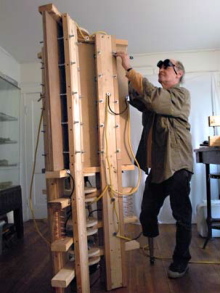
Stay with me on this, because the connection with interstellar travel is interesting. Imagine a hundred-foot tower something like a lightning rod, but with three vertical masts made of aluminum. When lightning strikes the tower, a resonant cavity is formed that breaks down nitrogen in the air and triggers an ultraviolet laser discharge, sending the beams back into the sky. Davis expects secondary laser discharges triggered by the first will be produced. And that may well remind you of interstellar sail ideas, a vast reflective sail being pushed by laser beam to the outer edges of the Solar System and beyond.
Image: MIT biology research affiliate Joe Davis works in his apartment in Cambridge on the prototype for a Hurricane Katrina memorial–a 109-foot tower that will send laser beams into the sky. He recently won a Rockefeller fellowship for the project. Credit: Donna Coveney.
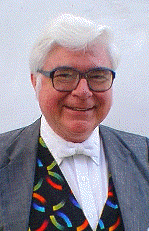
Call it a lightsail rather than a solar sail, driven by those intense laser beams in ways that interstellar theorist Robert Forward so brilliantly detailed both in his scientific papers and his fiction. Forward, of course, took the idea well beyond the outer limits of our engineering, envisioning an enormous Fresnel lens between the orbits of Saturn and Uranus that would tune laser light from an installation close to the Sun, keeping the beam collimated so that it would remain narrow enough to continue pushing a reflective sail to another star.
Image: Scientist and author Robert Forward. Note the vest, one of many made for Forward by his wife Martha, and a trademark in his many public appearances. Credit: Salmon Library/University of Alabama at Huntsville.
Davis’ plan, of course, only suggests such concepts, and it’s hardly utilitarian for a specific space mission. But I like its multi-purpose design, and the fact that Davis is getting technical and financial support from private donors as well as the Rockefeller New Media Fellowship. The Mississippi coast is an ideal place to study the electrodynamics of natural storms, producing information that may be helpful down the line in future Katrina situations. So the ‘Call Me Ishmael’ project is a research effort as well as a monument like no other, which is why the Mississippi Arts Commission may get into the act, as local arts groups already have done.
Davis, a biologist who spent most of his childhood in Mississippi, crosses the line between science and art with evident ease. Again I think of Forward, whose energies were such that when he wasn’t developing breakthrough ideas for propulsion, he was to be found penning novel after novel in which those ideas took shape and were eased into the public consciousness. Never the most literary of novelists (as he would have been quick to tell you), he could nonetheless make a tale come alive with the power and originality of his concepts. Dragon’s Egg (Ballantine, 1980) is a good place to start, but you’ll want to read Rocheworld (Baen, 1990) for his ultimate take on lightsails to the stars.
Addendum: Larry Klaes forwards this interesting article in Scientific American on Joe Davis and his work. Note this snippet, which suggests the eclectic nature of Davis’ interest in deep space:
Davis set about creating what he calls “an infogene, a gene to be translated by the machinery of human beings into meaning, and not by the machinery of cells into protein.” His idea was to send a message in a bottle to extraterrestrials: to genetically engineer a sign of human intelligence into the genome of bacteria, grow them up by the trillions and fling them out across the heavens, to land where they may. …[T]he real message was of course aimed not at aliens, but at a public that has yet to digest the fact that DNA can encode any information, not just genetic sequences.


Hi Folks;
I think the concept of the light sail has enormous implication for high gamma factor interstellar/intragalactic manned space travel. With the Sun putting out 4 x 10 EXP 26 Watts, if we could capture 1/4,000,000 of this output or 10 EXP 20 Watts and direct this energy to a light sail craft with overall 1 percent efficiency at converting the beam energy to ship based kinetic energy, this would provide us with 10 EXP 18 watts of propulsion power or the equivalent of about 300,000 metric tons of matter turned into energy in one year. This is enough energy to power a 3,000 metric tons space craft to a gamma factor of 100 in just one year. The G forces would be a little high, but perhaps the crew could remain within pressure suits immersed in hydrostatic sealed containers to negate the force effects on their bodies due to such acceleration.
Capturing 1/40,000 of the solar output or 10 EXP 22 Watts and using such for an overall 0.1% beam energy to ship kinetic energy conversion efficiency would allow the 3,000 metric ton space craft to reach a gamma factor 1,000 in one year putting the craft in route to any part of the stellariferous Milky Way Galaxy in one human lifetime, ship’s reference frame.
A really interesting form of beam propulsion would entail harnessing the zpf for its latent energy content which some calculations suggest is as high as 120 orders of magnitude greater in energy density than that for the real mattergy content within the observable universe. A ship based photon rocket/drive propulsion unit that would somehow convert the zpf energy into a real mattergy photon beam would allow the 30,000,000 seconds Isp of the photon beam to be utilized much more efficiently that that of a light sail beam due to relativistic Doppler red shift losses wherein the light sail beam would originate from a solar orbiting station.
Thanks;
Jim
In additional to the good words we can say about the Tou Zero Foundation and its purpose I would like to suggest the interested parties the invited paper “Free (Reaction Less) Torque Generation – Fiction or Reality” presented in the WSEAS Conference in Corfu Greece
http://www.wseas.org/conferences/2008/corfu/control/
And page 139 of the contents of http://www.worldses.org/books/2008/corfu/control_systems.pdf
Thanks
Bojidar
Fearless wizardry. brilliant. Surely time to make Davis a professor @ MIT
Inflatable tower may offer easier access to space
At 9-miles tall, it could also enable creation of new wireless data network
By Eric Bland
updated 2:03 p.m. ET, Thurs., July 2, 2009
An inflatable tower nine miles tall and tethered to a mountain top could cut the cost to launch spacecraft, reduce the need for geostationary communications satellites and improve cell phone signals.
“This structure could be made of commercially available materials,” said Brendan Quine, who, along with Raj Seth and George Zhu at York University in Toronto wrote an article detailing their tower in the journal Acta Astronautica.
The tower itself would be 15 kilometers (9.3 miles) tall, 230 meters (754 feet) across, and weigh approximately 800,000 tons, or about twice the weight of the world’s largest supertanker when fully inflated with a variety of gases, including helium.
Full article here:
http://www.msnbc.msn.com/id/31710845/ns/technology_and_science-science/
Review: Scientist-artist Joe Davis’ mind-bending works at UW gallery
See an exhibition of works — including some in glass, a skill he picked up at the Pilchuck School — by scientist-artist Joe Davis at Jacob Lawrence Gallery on the UW campus through Feb. 19.
By Gayle Clemans
Special to The Seattle Times
Artist and scientist Joe Davis has an exhibit of his works at the UW’s Jacob Lawrence Gallery.
EXHIBITION REVIEW
‘Resonance: Nature, Glass, and Standing Waves in the Art of Joe Davis’
Photographs, installations, and sculptures, noon-4 p.m. Wednesdays-Saturdays through Feb. 19, Jacob Lawrence Gallery, Room 132 in the School of Art, University of Washington campus (206-685-1805 or http://art.washington.edu/63_Jacob-Lawrence-Gallery).
Spending some time with Joe Davis, or his art, just might blow your mind. He began our interview by saying, “At the farthest ends of the cosmos, at the edge of the universe, you’ll find your own cerebral cortex imprinted there, but when you look inside you only find ‘the other.’ ”
Davis, 60, an artist-researcher at MIT and Harvard, has been called a free spirit and a mad scientist, and, according to Marek Wieczorek, professor of art history at the University of Washington, Davis is “a likely candidate to save the world” (more on that later).
Davis uses the most advanced, and the most rudimentary, scientific equipment, processes and principles to explore ideas about existence (human and extraterrestrial) and the quest for knowledge — what we think we know, and how we know what we know.
Full article here:
http://seattletimes.nwsource.com/html/thearts/2014185076_joedavis11.html
The True Story of the Hurricane Katrina Lightning-Laser Memorial and the Peg-Leg Biologist
By Jack Loftus
July 30, 2008, 12:00 PM
Joe Davis is telling me about his design for a 110-foot lightning-laser tower that will literally seize a hurricane’s force, bottle it up and hurl it angrily back into the sky. It’s intended as a memorial for the victims of Hurricane Katrina. Davis—whose official role at MIT is research affiliate associate in the biology department—plans to name the tower “Call Me Ishmael.” I ask him why, but before I finish the question, he smashes his steel peg leg down onto the table. Good answer.
Full article here:
http://gizmodo.com/5030927/the-true-story-of-the-hurricane-katrina-lightning+laser-memorial-and-the-peg+leg-biologist
To quote:
Some of this stuff sounds admittedly absurd. What’s the point of a frog-powered ornithopter? Why are human vaginal contractions speeding though space toward the unassuming denizens of Epsilon Eridani? Crazy as the projects are, the nature of these experiments goes a long way toward explaining Davis himself. He isn’t necessarily a straight-up scientist, but he isn’t totally an artist, either.
As the Washington Post’s Pamela Ferdinand once wrote, “Davis eschews the art-versus-science argument, insisting that he speaks both languages and could not possibly tear the two disciplines apart in his own mind.”
AND:
Sadly the laser emission is ultraviolet, and therefore invisible to the naked eye. However, if the laser grew enough in intensity, it could be used to push solar sails beyond the inner solar system.
“The sun on its own just isn’t strong enough,” Davis said, proposing that the solar sail concept be renamed “light sails.”
Davis doesn’t stop there: “It might even be able to help deflect asteroids. And because it is using coherent radiation, and is more powerful than the solar output at that same frequency, it is also ideal for optical SETI as a beacon.” It could be used for communicating with extraterrestrials. “For that I would have to get FAA permits, of course.”
Joe Davis: The mad scientist of MIT?
16:30 23 March 2012
Phil McKenna, contributor
Thirty years ago Joe Davis, a peg-legged artist and motorcycle mechanic from Mississippi, walked into MIT’s Center for Advanced Visual Studies demanding to speak with the director. Forty-five minutes later – after trashing a receptionist’s desk and fending off the police – Davis left with a six-month academic appointment. It ultimately lasted more than a decade.
In Heaven + Earth + Joe Davis director Peter Sasowsky takes viewers on an exhilarating, entertaining, and thought provoking ride deep into the complicated mind of the artist and “mad scientist”.
Before seeing the film, I had the unforgettable and fascinating experience of meeting Davis in person at a bar in Cambridge, Massachusetts. Much to the benefit of the film, Sasowsky had a similar encounter. So intrigued was he by Davis, that he spent a decade filming the enigmatic man on travels throughout North America and Europe. The end result is a biopic enriched with archival footage of Davis’s early years as well as interviews with family, friends, and the scientists and artists who come closest to being counted among his peers.
So who is Joe Davis? Early in the documentary we hear from a former molecular anthropologist at Harvard University who posits that he is either a genius or the most brilliant con artist that ever lived. Sasowsky lets us draw our own conclusions – and mine is that limiting him to one or the other would do Davis a disservice.
Full article here:
http://www.newscientist.com/blogs/culturelab/2012/03/the-mad-scientist-of-mit.html
To quote:
“In another sexually charged example of performance art Davis sets out to correct what he feels is a case of censorship in scientists’ efforts to communicate with extraterrestrials. He explains that researchers have sent images of an anatomically correct man into outer space but the image they sent of a woman lacked genitalia. To right this wrong, Davis transmitted the sound of vaginal contractions of ballet dancers to several nearby stars. The audio recording was beamed from MIT’s Millstone Hill radar for several minutes before the United States Air Force shut him down.”
Scientific Art Goes Rogue
Artist, tinkerer and mad scientist Joe Davis stands with his iconic sculpture Galaxy: Earth Sphere at Kendall Square in Cambridge, Massachusetts. Davis’s non-traditional work has not always been welcomed as public art.
His zany artistic interpretations have gotten him kicked out of countless schools and cited for a municipal trash-dumping violation. Such opposition has not deterred the scientific artist, however, whose expressions range from minuscule DNA encoding to broadcasting sounds in space.
“Artists have to open up a window on the world, because art must describe everything,” Davis says. “Since all of our dreams will come true, somebody had better have some good ones.”
Full article and slide show here:
http://discovermagazine.com/galleries/2013/april/joe-davis#.USpmlaLF-uJ