
Finding planets around other stars is hampered by a key fact: the light from the primary star effectively masks the far dimmer reflected light from any planets. But NASA engineers at the Keck Observatory (Mauna Kea, HI) have used the Keck Interferometer in conjunction with a light-blocking device to suppress the starlight around three stars, one of which is Vega. The procedure may be used to detect dust disks of planetary systems in formation.
“We have proven that the Keck Interferometer can block light from nearby stars, which will allow us to survey the amount of dust around them,” said Dr. James Fanson, project manager for the Keck Interferometer at NASA’s Jet Propulsion Laboratory.
 Keck’s interferometer links its two 10-meter telescopes to provide the resolving power of a much larger instrument (in Keck’s case, one the size of a football field). Examining dust disks in greater and greater detail is crucial, because NASA needs to select targets for its Terrestrial Planet Finder mission, which will use both visible light and infrared to look for Earth-like worlds. Acquiring the right ‘signature’ for likely systems means studying their dust disks to determine which might have spawned such planets.
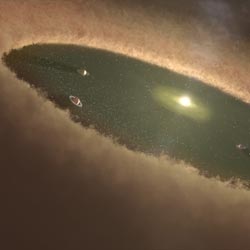
Image: Astronomers know that dust disks may breed planets. This artist’s conception is based on data from the Spitzer Space Telescope that reveals a gap in a protoplanetary, or planet-forming, disk surrounding a young star. The new work with the Keck Interferometer may provide parameters for judging which stars are the most likely candidates for terrestrial planets, based on much better imagery and analysis of such disks. Image credit: NASA/JPL-Caltech.
To put the search for terrestrial worlds in context, the discovery of six new worlds was announced in August, ranging from 20 to 289 light years from Earth. But the largest of these is 1.6 times as massive as Jupiter; the smallest is roughly the size of Uranus, some 14 times the mass of Earth. All six of the new planets orbit their stars much closer than the distance between Mercury and our Sun. It is clear that a new generation of instruments like those aboard the Terrestrial Planet Finder missions will be needed to uncover the kind of small, rocky world that could be the home to life.
Source: Jet Propulsion Laboratory news release.


Spectroscopic metallicities of Vega-like stars
Authors: C. Saffe, M. Gomez, O. Pintado, E. Gonzalez
(Submitted on 26 May 2008)
Abstract: Aims: To determine the metallicities of 113 Southern Hemisphere Vega-like candidate stars in relation to the Exoplanet host group and field stars.
Methods: We applied two spectroscopic methods of abundance determinations: equivalent width measurements together with the ATLAS9 (Kurucz 1993) model atmospheres and the WIDTH9 program, and a comparison of observed spectra with the grid of synthetic spectra of Munari et al. (2005).
Results: For the Vega-like group, the metallicities are indistinguishable from those of field stars not known to be associated with planets or disks. This result is quite different from the metallicities of Exoplanet host stars which are metal-rich in comparison to field stars.
Comments: 25 pages, 4 figures
Subjects: Astrophysics (astro-ph)
Cite as: arXiv:0805.3936v1 [astro-ph]
Submission history
From: Carlos Saffe [view email]
[v1] Mon, 26 May 2008 11:50:52 GMT (44kb)
http://arxiv.org/abs/0805.3936