
Because Europa Clipper has been on my mind, what with the confirmation of its next mission phase (see Europa Clipper Moves to Next Stage), we need to continue to keep the mission in context. What is playing out is a deepening of our initial reconnaissance of the Jovian system, and the JUICE mission (Jupiter Icy Moons Explorer) is a significant part of that overall effort. The European Space Agency has the spacecraft under development, with Airbus Defence and Space as the primary contractor.
We saw last week that while Europa Clipper will use flybys of Ganymede and Callisto for gravity maneuvers intended to refine its orbit, the latter two moons are not science priorities. JUICE, on the other hand, focuses on all three, each thought to house liquid water beneath the surface. JUICE is slated for a June, 2022 launch, reaching Jupiter in 2029 with the help of five gravity assists along the way, so its operations will overlap with Europa Clipper, the NASA craft launching in 2023. The coming decade will be busy indeed as we journey to and explore these compelling icy targets.
The orbital maneuvers chosen for JUICE are intriguing, for after its first flyby of Europa in 2030, the spacecraft is to enter a high-inclination orbit to study Jupiter’s polar regions and magnetosphere. Repeated flybys of Europa, Ganymede and Callisto are planned, and following a Callisto flyby in 2031, the spacecraft will actually enter orbit around Ganymede, making it the first spacecraft to orbit a moon other than our own. I’m simplifying these complicated orbital maneuvers for the sake of brevity, but the point is that JUICE will greatly expand our datasets on all three moons.
In June of 2019, engineers at Airbus Defence and Space’s site in Toulouse tested the navigation camera that will be essential for radio tracking and position and velocity information of the spacecraft relative to the moon it is currently studying. Given the powerful radiation found near Jupiter, the spacecraft will, like Europa Clipper, be radiation-hardened, allowing it to operate between 200 and 400 kilometers from its targets at closest points of rendezvous. The pointing accuracy demanded of NavCam during fast and close approaches like these is critical to the mission’s success.
The June tests looked at the NavCam engineering model in real sky conditions, the point being to stress the hardware and software interfaces to validate their design, as well as to prepare the image processing and onboard navigation software that JUICE will use to acquire its images. The engineers observed Earth’s own moon and a variety of sky objects included Jupiter itself as part of these tests, running NavCam in ‘imaging mode’ and ‘sky centroiding mode’ as part of fine tuning attitude control software.
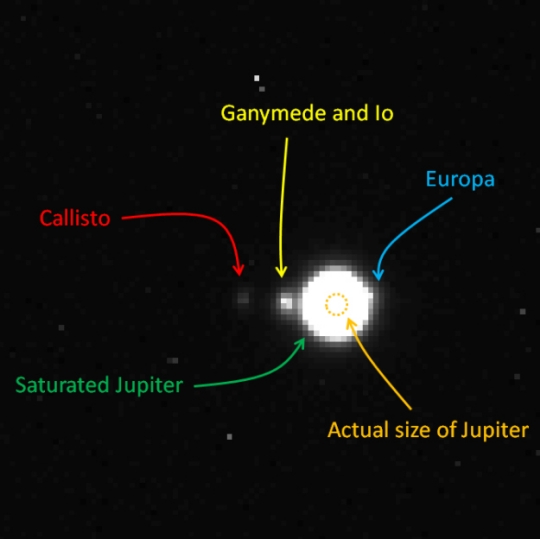
Image: The Navigation Camera (NavCam) of the Jupiter Icy Moons Explorer (JUICE) has been given its first glimpse of the mission’s destination while still on Earth. The camera was mounted to an equatorial mount and pointed towards different targets, including bright stars, Jupiter and its moons in order to exercise its ‘Imaging Mode’ and ‘Stars Centroiding Mode’. The integration time was optimized for capturing the stars and moons acquisition, so Jupiter appears saturated. In this annotated image the size of Jupiter is indicated. Credit & Copyright: Airbus Defence and Space.
“Unsurprisingly, some 640 million kilometres away, the moons of Jupiter are seen only as a mere pixel or two, and Jupiter itself appears saturated in the long exposure images needed to capture both the moons and background stars, but these images are useful to fine-tune our image processing software that will run autonomously onboard the spacecraft,” says Gregory Jonniaux, Vision-Based Navigation expert at Airbus Defence and Space. “It felt particularly meaningful to conduct our tests already on our destination!”
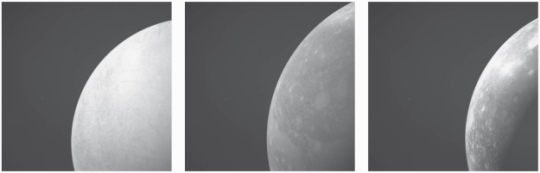
Image: Impressions of how the Jupiter Icy Moons Explorer will see moons Europa (left), Ganymede (middle) and Callisto (right) with its Navigation Camera (NavCam). To generate these images, the NavCam was fed simulated views – based on existing images of the moons – to process realistic views of what can be expected once in the Jupiter system. Credit & copyright: Airbus Defence and Space.
The actual flybys will provide close inspection of surface features on Europa, Ganymede and Callisto. In the suite of tests, NavCam also received simulated views of the three moons in order to process the kind of imagery it will acquire in Jupiter space. NavCam will capture imagery that will be greatly augmented by the high-resolution camera suite that will give us our best views of the icy surfaces below.
By the end of 2019, the test NavCam will be augmented with a full flight representative performance optics assembly that will support onboard tests of the complete spacecraft. Meanwhile, a test version of the spacecraft’s 10.5-m long magnetometer boom developed by SENER in Spain has undergone testing at ESA’s Test Centre in the Netherlands, as part of what ESA is describing as “… the most powerful remote sensing, geophysical, and in situ payload complement ever flown to the outer Solar System.”
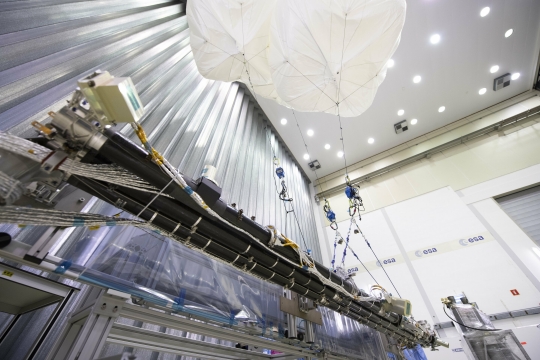
Image: Magnetometer boom built for ESA’s mission to Jupiter by European Space Agency. Credit: ESA-G. Porter, CC BY-SA 3.0 IGO.
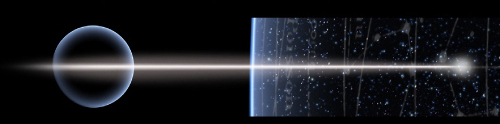


I see that the science objectives include looking at the organics on the 3 moons, as well as the gases in Jupiter’s atmosphere. The instruments can even analyze isotopic ratios of carbon and oxygen, which might provide hints of biological activity in any of the organics compared to the primordial gas ratios.
Science objectives of the JUICE mission:
http://sci.esa.int/juice/50320-juice-science-requirement-matrix/#
Extraordinary! I haven’t read the complete article, including Friday’s (too much competition by others on the Internet. I guess), but it seems that this is a remarkable set of complicated maneuvers and it certainly is in its own right, a triumph of human intellect that we can accomplish such things…
Now onto two issues; the Juno spacecraft around Jupiter suffered a valve malfunction in its fuel line that dealt with getting the engine to function, and as a result from that point on mission planners were stuck in permanently in orbit, which had not been foreseen. Here we have a very complicated set of maneuvers to achieve a certain goal – any planning in the event that a similar misfortune should befall these relatively complicated machines?
Second question is, is this craft NOT planning to have a Lander on one of these relatively submerged ocean worlds? In other words, they are going to miss the chance to actually attempt to look for water-based life under the ice crust of these moons? I thought that was the biggest question that we had here in the annals of science: extraterrestrial life.
On the second question: ESA has no money for that and also they think that a detailed map of the surface is needed before sending any lander.
There’s a presentation with a graphical flybys schedule here on pg. 10:
https://www.lpi.usra.edu/opag/jan2014/presentations/18_titov_JUICE.pdf
A much more comprehensive ESA document is here:
http://sci.esa.int/juice/54994-juice-definition-study-report/
There are only two Europa flybys. I believe for radiation reasons. Their dates, reported in the docs above, don’t quite match the dates reported on Wikipedia though, but not by much.
Paul Gilster: Speaking of moons: WASP 49b 1?!?!?! ArXiv: 1908.10732, Sodium and Potassium Signatures of Volcanic Satellites Orbiting Close-in Gas Giant Planets.” by Apurva Oza et al. My take: This is probably going to be even HARDER to PROVE than Kepler 1625b 1 is, but I would love to have David Kipping’s take on this!
Yes, I’m watching this one as well.
You may also want to check in with Rene Heller and Michael Hippke to see: ONE – how many(if any)transits of WASP 49b were observed by TESS, and; TWO – whether they can apply EITHER of their “stacking” or “Transit Least Squares” methods to tease the exomoon out of any TESS data.