
One result of the Breakthrough Starshot effort has been an intense examination of sail stability under a laser beam. The issue is critical, for a small sail under a powerful beam for only a few minutes must not only survive the acceleration but follow a precise trajectory. As Greg Matloff explains in the essay below, holography used in conjunction with a diffractive sail (one that diffracts light waves through optical structures like microscopic gratings or metamaterials) can allow a flat sail to operate like a curved or even round one. I’ll have more on this in terms of the numerous sail papers that Starshot has spawned soon. For today, Greg explains how what had begun as an attempt to harness holography for messaging on a deep space probe can also become a key to flight operations. The Alpha Cubesat now in orbit is an early test of these concepts. The author of The Starflight Handbook among many other books (volumes whose pages have often been graced by the artwork of the gifted C Bangs), Greg has been inspiring this writer since 1989.
by Greg Matloff

The study of diffractive photon sails likely begins in 1999 during the first year of my tenure as a NASA Summer Faculty Fellow. I was attending an IAA symposium in Aosta, Italy where my wife C Bangs curated a concurrent art show. The title of the show , which included work by about thirty artists, was “Messages from Earth”. At the show’s opening, C was approached by visionary physicist Robert Forward who informed her that the best technology to affix a message plaque to an interstellar photon sail was holography. A few weeks later, back in Huntsville AL, Bob suggested to NASA manager Les Johnson that he fund her to create a prototype holographic interstellar message plaque.
It is likely that Bob encouraged this art project as an engineering demonstration. He was aware that photon sails do not last long in Low Earth Orbit because the optimum sail aspect angle to increase orbital energy is also the worst angle to increase atmospheric drag. He had experimented with the concept of a two-sail photon sail and correctly assumed that from a dynamic point of view such a sail would fail. A thin-film hologram of an appropriate optical device could redirect solar radiation pressure accurately without increasing drag.
Our efforts resulted in the creation of a prototype holographic interstellar message plaque that is currently at NASA Marshall Space Flight Center. It was displayed to NASA staff during the summer of 2001 and has been described in a NASA report and elsewhere [1].
I thought little about holography until 2016, when I was asked by Harvard’s Avi Loeb to participate in Breakthrough Starshot as a member of the Scientific Advisory Committee. This technology development project examined the possibility of inserting nano-spacecraft into the beam of a high energy laser array located on a terrestrial mountain top. The highly reflective photon sail affixed to the tiny payload could in theory be accelerated to 20% of the speed of light.
One of the major issues was sail stability during the 5-6 minutes in a laser beam moving with Earth’s rotation. Work by Greg and Jim Benford, Avi Loeb and Zac Manchester (Carnegie Mellon University) indicated that a curved sail was necessary. to compensate for beam motion. But a curved thin sail would collapse immediately during the enormous acceleration load.
Some researchers realized that a diffractive sail that could simulate a curved surface might be necessary. Grover Swartzlander of Rochester Institute of Technology published on the topic [2].
Martina Mongrovius, then Creative Director of the NYC HoloCenter, suggested to C that one approach to incorporating an image of an appropriate diffractive optical device in the physically flat sail was holography; this was later confirmed by Swartzlander. Avi Loeb arranged for C to attend the 2017 Breakthrough meeting and demonstrate our version of the prototype holographic message plaque.
A Breakthrough Advisor present at the demonstration was Cornell professor and former NASA chief technologist Mason Peck. Mason invited C to create, with Martina’s aid, five holograms to be affixed to Cornell’s Alpha CubeSat, a student-coordinated project to serve as a test bed for several Starshot technologies.
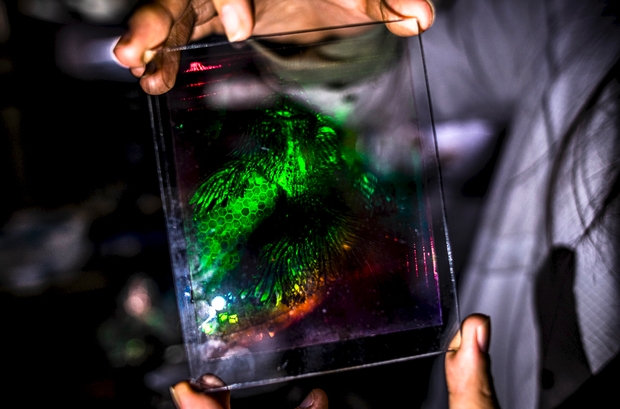
Image: Fish Hologram (Sculpture by C Bangs, exposure by Martina Mrongovius). A holographic plaque could carry an interstellar message. But could holography also be used to simulate the optimal sail surface on a flat sail?
During the next eight years, about 100 Cornell aerospace engineering students participated in the project. Doctoral student Joshua Umansky-Castro, who has now earned his Ph.D. was the major coordinator.
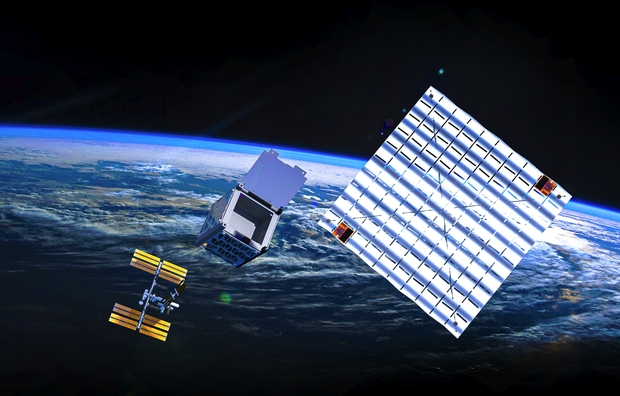
In 2023, there was an exhibition aboard the NYC museum ship Intrepid (a World War II era aircraft carrier) presenting the scientific and artistic work of the Alpha CubeSat team. Alpha was launched in September of 2025 as part of a ferry mission to the ISS. The cubesat was deployed in Dec. 2025.
All goals of the effort have been successfully achieved. The tiny chipsats continue to communicate with Earth. The demonstration sail deployed as planned from the CubeSat. A post-deployment glint photographed from the ISS indicates that the holograms perform in space as expected, increasing the Technological Readiness of in-space holograms and diffraction sailing.
In May 2026 a workshop on Lagrange Sunshades to alleviate global warning is scheduled to take place in Nottingham. The best sunshade concepts suggested to date are reflective sails. Two issues with reflective sail sunshades are apparent. One is the meta-stability of L1, which requires active control to maintain the sunshade on station. A related issue is that the solar radiation momentum flux moves the effective Lagrange point farther from the Earth, requiring a larger sunshade. At the Nottingham Workshop. C and I will collaborate with Grover Swartzlander to demonstrate how a holographic/diffractive sunshade surface alleviates these issues.
References
1.G. L. Matloff, G. Vulpetti, C. Bangs and R. Haggerty, “The Interstellar Probe (ISP): Pre-Perihelion Trajectories and Application of Holography”, NASA/CR-2002-211730, NASA Marshal Spaceflight Center, Huntsville, AL (June, 2002). Also see G. L. Matloff, Deep-Space Probes: To the Outer Solar System and Beyond, 2nd. ed., Springer/Praxis, Chichester, UK (2005).
2.G. A. Swartzlander, Jr., “Radiation Pressure on a Diffractive Sailcraft”, arXiv: 1703.02940.
IIRC, there was another post about the concept of holography to create images on a flat surface to mimic optical devices such as curved mirrors, lenses, and in this case, a diffractive surface.
However, I watched the Alpha CubeSat video, and there is no indication that holography is to be tested in this way. The diffractive element of the sail is impressed in the sail’s surface conventionally.
So I am still unaware that holography has been demonstrated to create optical devices that work to replace the physical optical device.
Regarding holography.
I recall that when holography was first demonstrated, it required laser light to generate the image. (The green fish hologram seemed to suggest to me that this hologram was illuminated with green laser light.) White light holograms are now available, and are used in various applications, including hard-to-forge surface elements on banknotes and bank cards. This was demonstrated in the Alpha CubeSat video. However, the resolution of the images seemed rather poor and would not seem likely adequate to mimic optical devices of the same scale.
Is this going to be a demonstration that a holographic diffraction surface works to effectively mimic a physical diffraction surface? If so, I would be most interested to read a report on this demo with an associated paper on the limitations of laser and white light holography to achieve this effect.
[I am aware that holography preserves an image even when only a part of the film is used, but with a lower resolution than with the whole folm. This would be a very effective way to compensate for meteoroid and particle damage to the film during flight. For laser propulsion, the laser provides the monochromatic illumination. For the proposed sunshade, it would be a white light hologram.]
In a wider sense, holograms have been proposed for all sorts of applications, yet they don’t seem to ever get real devices made. Over 40 years ago, when 2010: The Year We Make Contact (1984) was produced, it was stated that the Discovery’s HAL 9000 computer used holographic memory. And yet, here we are with no holographic memory devices for our computers, and AFAIK, no long-term data storage of our prodigious data exhaust is proposing to use holography to improve storage density. (The Alpha CubeSat video alludes to the potential storage density of holograms for messages to ETI on our interstellar probes, replacing the electronic images stored on conventional media. Has anyone ever considered that an ultrashort wavelength, transient emission, is the information to create a holographic image/video when correctly used? Isn’t this a way to maintain output fidelity without needing error correction for noise? Just as we need to know how bits have to be interpreted and arranged to extract images from streaming data, the same needs to be known for holographic images and video.)
On holograms
https://phys.org/news/2026-02-hologram-method-boosts-3d-image.html
Dear Alex,
The testing of the hologram in space is not on the Alpha website. Mason told C and Martina to include a retroreflective surface as the backdrop to the art in the holograms. As the cubesat drifted off from the ISS a glint was received by the camera aboard the ISS. This indicated that the holographic retroreflector performs in the same manner as a “real” retroreflector. Joshua is soliciting various groups to use a laser to further demonstrate retroreflection and offer additional verification of holography in space.
@Greg
Thank you for this clarification. This explanation was not clear to me from the website. So this is proof that the hologram version works like the physical version. That is good news. I hope to read more about this in due course. Please keep us posted.
using holographs sounds like a good idea that is making a simulated curve inside straight, rectangular block which might be stronger than a curved sail? I like the sunshade idea to reduce solar radiation. We might need a lot of those for it to cool down our climate. I like the ultra high frequency idea too, Alex, but one might have to change the material since the shorter wavelengths are much higher energy. One would need an ultra violet, x ray and gamma rays lasers. Things get hot fast with high energy. According to Google AI we do actually have working 3D holographic laser computer memory, but they are too energy costly to be mass produced. Maybe that will happen in the future.
WE will discuss climate applications in Nottingham.
A very long time ago, I played around a little bit with holograms in school. From what I remember, the hologram is a duplicate of the object’s wavefront. If you take a hologram of a mirror or a lens, the laser light that reconstructs the hologram, which has to be at the exact same frequency used to create the hologram, will behave the same on the wavefront as it would to the original object. So, in this case, if the hologram were created from multiple mirrors, the laser light would be reflected off of them in the same way. All of this has to be at the exact same frequency as the laser that created the hologram. I’m not sure how this would redirect solar radiation pressure beyond the single frequency that matches the laser.
A “white light hologram” is not really white light is merely a hologram made up of 3 different colors of laser light that, when created, looks white to our eyes. So this whole concept would only work with laser light, not really with sunlight.
There are 2 components that allow a solar sail concept work. The 1st is sunlight, but the 2nd is the solar wind, which will also affect a solar sail. Does all of this have something to do with the difference between the solar light and solar wind, and the difference caused by this, and the launch laser light? I’m not sure I understand the need for the holographic mirror.
Microsoft’s Project HSD is actively developing it for cloud storage, aiming for high density and durability by storing data within a medium’s volume rather than its surface. Primarily aimed at archival and data center use rather than consumer desktops. There are some other projects in the works. Then there is the arc mission’s solar library. It uses 5D optical data storage, which embeds data in quartz glass using lasers, rather than traditional, less durable, or purely holographic methods. Not a traditional hologram, but is instead designed to survive for millions of years.
If there are military applications for this technology, then it may have limited access, especially regarding the NSA. I can imagine where a radar satellite using a combination of holographic imaging of the surface of the Earth, making highly detailed images, and subsurface analysis, combination of technologies could make this a very powerful way to look at your adversaries. On the side of extraterrestrial civilizations, this may be one of the ways they analyze a planet in detail. Because the information would be stored in holograms and transferred, possibly via some holographic transmission system in the Terahertz
range.
https://share.google/aimode/pLCYC00WRTEjGlzrN
https://www.frontiersin.org/journals/physics/articles/10.3389/fphy.2021.818130/full
https://www.researching.cn/articles/OJ9696bb30337f5a4c
https://onlinelibrary.wiley.com/doi/10.1002/lpor.202502169
Thank you, Paul – this is a great report. I’ve been noodling on an interstellar mission for a while and this is valuable input. It’s been a long road from staggered-lifetimes Kugelblitzer, but I’m now settling on the basic Starshot approach.
Examples of white light holograms that are viewed in ordinary light, not laser light. I was mistaken about the illumination of C Bang’s fish hologram that was green. I thought it meant it was illuminated with laser light, but it was a white light hologram.
gallery of Reflection Holograms
If holograms of optical surfaces are to be used for managing sunshades, almost by definition, they will be illuminated by sunlight, not laser light. The Alpha CubeSat experimental sail is a printed sail whose surface returns the incident light from the direction it arrives. This is like the cube reflectors we use on vehicles and those Apollo era reflectors to return laser light to measure the distance to the lunar surface. As Greg Matloff stated, the hologram version has the same effect, showing that the hologram achieves the same or similar optical properties as the physical surface.
The reason for using such a reflective surface is that the orientation of the surface does not affect the direction of thrust. For a laser-accelerated sail, keeping the sail correctly oriented to the laser beam is important to maintain acceleration in the correct direction. A sail that can change orientation to the beam, but still maintain the correct direction of thrust, is advantageous and avoids the need to design the sail’s configuration to do this with conventional reflection. How a sunshade will be kept oriented to prevent tumbling, idk, but I am guessing other approaches will also be used to retain the shade’s surface in a normal orientation to the sun.
I would be interested in understanding the tradeoffs between a physical and holographic optical surface. For example, are they of equivalent efficiency? Are all the incident wavelengths similarly affected, or not? Can the 2 methods scale well for large surfaces? Are there cost and/or performance advantages?
I wonder if you can get a two-fer–see here:
https://advanced.onlinelibrary.wiley.com/doi/10.1002/adom.202502880
“To use solar energy effectively, environmentally benign solid-state hydrogen storage materials are sought that are capable of releasing hydrogen under visible light irradiation. The gravimetric hydrogen capacity of layered hydrogen silicane (L-HSi) is quite high (3.44 wt.%). The optical bandgap of L-HSi is 2.13 eV, which corresponds to a wavelength of ≈600 nm (green-to-yellow region). Here, visible-light-driven hydrogen release from L-HSi is reported. The action spectrum of L-HSi for hydrogen release is consistent with its absorption spectrum, indicating that hydrogen release is driven by bandgap excitation rather than the photothermal effect. The quantum efficiency of hydrogen release is 7.3% at 550 nm. Hydrogen release from L-HSi can occur under both inert gas conditions and in the dispersed liquid form. The light intensity dependence indicates that hydrogen release is driven by low-intensity light such as sunlight or a light-emitting diode. L-HSi is expected to be used as a safe, solid-state, and lightweight hydrogen carrier with low energy consumption for hydrogen release.”
Similar?
https://phys.org/news/2026-01-hydrogen-energy-flattening-granular-catalysts.html
The idea is that the surface of the sail itself can be a rocket–staging hydrogen off with the bare remaining sail used as normal–just photon pressure.
An additional “stage” can be the reflective sail material spalling off fission fragment time—and whatever remains eaten for an auto-phage rocket—the coasting spacecfraft bus being all that is left behind.
Several theoretical papers show that a flat sail with sophisticated surfaces can ride stably on the beam. One reason to prefer flat is that flat sails are easier to build in large sizes. But I’d like to see an experimental demonstration before I would agree that a shaped sail, such as a parabolic sail, not be preferred. Note that a spherical sail is very inefficient, because most of the beam is outside the sail, so it bounces back and forth within the hollow beam.
>A holographic plaque could carry an interstellar message.
Could a holographic message be subject to loss of information ? By radio comparison, what would be the signal-noise ratio ?
@Fred
If the hologram surface is slowly destroyed, e.g., by micrometeoroids, the image will get blurrier. Text with small fonts will start to become unreadable first. Images will lose their sharpness. Eventually, the information will be lost. The advantage of holograms is that the whole image just gets blurrier overall, unlike an image made by “painting” it on a surface. If you tear a photograph in half and discard one half, you lose half the image. A hologram treated the same way retains all the image because the information for each point is spread across the surface, but with lower resolution. Unlike an image on a flat surface, where depth is rendered by perspective and shading, a hologram maintains a true 3D representation. Theoretically, this should allow for denser information storage.
There is a concept that describes our universe as a hologram where the information is stored on a distant surface. How that supports an evolving universe is well beyond my understanding.
Once we get to the farside of the moon we should be allowed to use lasers or particle beams without serious legal or political resistance. Only then can I see us developing interstellar craft.
The location would be good, but the costs of building laser infrastructure and power sources may be extremely cost-prohibitive without orders of magnitude cost reductions in space construction. On the plus side, the Moon makes an excellent stable platform, although any point on the surface takes a lunar month to traverse 360 degrees for laser propulsion or energy beaming in any specific direction.
It also makes a great location for radio telescopes to avoid RFI from Earth, and increasingly satellite swarms in LEO for optical Radio telescopes slung across lunar craters could make extraordinarily large receivers without exposure to weather, far larger than Arecibo and even the Chinese Five-hundred-meter Aperture Spherical radio Telescope (FAST).
There is also the power that would be available from the sun. I see the cost coming down with starship greatly. I just can’t see them allowing lasers on earth of that power needed.
What about geosynchronous solar power satellites to power Earth-based lasers? However low the cost of space transport, it cannot compete with terrestrial transport costs. The solar power arrays can probably be mostly manufactured on the Moon, once the manufacturing facilities have been created with equipment transported from Earth. The lasers will probably have to be transported from Earth. The cost will certainly be orders of magnitude higher than a terrestrial laser array; however, it will be powered. A century or two from today, the tradeoffs may be very different. A facility on or near Mercury might be the optimum placement given a growing solar system-wide economy. If we have nuclear fusion on tap, maybe the best place will be at the solar focus, so that the laser array can be used for interstellar communication. Or perhaps in a location where the lasers can be used for planetary defence from asteroid impacts. Maybe some or all of the above. Of course, this assumes that lasers will still be the best means of powering small starprobes. This may not be true in the future.
Alex, its the geopolitical environment that’s is the biggest issue, someone somewhere will be offended by such a powerful laser. Its powerful enough to destroy all satellites in orbit !
It would be less effective than nukes that are already being readied to do that. A terrestrial surface-based laser has limited targets depending on its position at any given moment. How many satellites it can destroy at any moment may also be limited. Nuclear weapons can destroy many satellites for each use, and many can be launched for simultaneous strikes.
The laser array is a very vulnerable target. Its location is known, and it cannot be moved. Any use as a weapon, and it can be quickly destroyed. Missiles do not have this disadvantage.
While I agree it has theoretical use as a weapon as has been raised as an issue before, it is far less-powerful, mobile lasers that are a better type of laser weapon to attack satellites. These lasers can even be in orbit, as the Reagan SDI (“Star Wars”) ideas for X-ray laser killer satellites suggested.
A few dozen satellites destroyed and you would have a kessler syndrome effect from missles or lasers.
@Michael
I agree. So does that make a terrestrial laser attack on vehicles in orbit a weapon that cannot be used, rather like nuclear weapon strikes on terrestrial targets, that potentially cause global climatic effects that affect all nations? A Kessler syndrome could seal off space, ending all use of satellites until some massive cleanup could be accomplished. Any major disruption of space assets that results in debris rather than a clean removal should be outlawed. However, given that we cannot control other human impacts on our biosphere, I don’t hold out much hope of restraint, especially if it is used as a bluff, called, and then used, resulting in catastrophe.
A laser could be used to deorbit debris if the laser could be fired at a certain point in its rotation. OT Elon is now concentrating on the moon which I think is a good thing to do now. Then we can build power lasers and particle beams.