
Theories that explain Earthly cataclysms through astronomy are always fascinating. The notion that a dwarf star dubbed ‘Nemesis’ orbits the Sun and occasionally stirs up cometary debris in the Oort Cloud emerged in the 1980s, published by two independent teams, one of which included Richard Muller. A UC-Berkeley physicist, Muller has since given up on Nemesis, but he’s still looking for the cause of what he sees as a 62-million year cycle (plus or minus 3 million years) in mass extinction events.
Berkeley’s James Kirchner, quoted in this 2005 story on Muller’s work, thinks the evidence Muller and graduate student Robert Rohde have assembled on such extinction cycles “simply jumps out of the data.” Says Kirchner:
“Their discovery is exciting, it’s unexpected and it’s unexplained. Everyone and his brother will be proposing an explanation — and eventually, at least one or two will turn out to be right while all the others will be wrong.”
Muller and Rohde used a huge fossil database of marine organisms developed by the late John Sepkoski Jr. (University of Chicago), one whose data extend back to the time of the ‘Cambrian Explosion,’ the period when so many forms of multicellular life emerged. But while Muller and Rohde pondered alternative explanations for the cycle, two University of Kansas professors have come up with a theory involving the Sun’s position in the Milky Way, one that has gone on to win Muller’s approval.
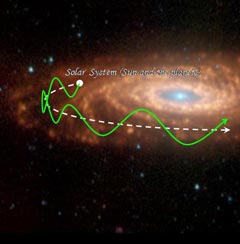
The Solar System moves up and down as it orbits the galactic core (see image at left). Mikhail Medvedev and Adrian Melott, taking that motion into account, factor in the motion of the Milky Way itself, hypothesizing that its leading, north side generates a shock wave that exposes the Earth to high-energy radiation every 64 million years or so. Here’s Melott on the matter:
“I did notice that not only did these time scales appear to be almost the same, but the drops in biodiversity coincide with the times when the sun is on the north side of the galactic disc. I already knew the north side of the galactic disc was the direction toward which the galaxy is falling.”
Image: Our solar system, represented by the white dot, moves around the center of the galaxy (like planets around the sun). It also moves up and down around the mid-plane of the galaxy. The mid-plane is shown by the dashed white line. The solid green line represents the up-and-down motion of the solar system as it circumnavigates the galaxy.
With a 3-million year uncertainty in the calculations, that 64 million year cycle matches well enough with the 62 million year cycle of extinctions. The match resonates with Richard Muller, who says of the KU team: “They succeeded where I failed in coming up with a possible explanation for the effect that we observed.” And if they’re right, we have time to prepare for the next major event, since the Solar System has just passed the mid-plane of the galaxy. The next peak occurs in ten to twelve million years, assuming the KU theorists are onto something.
The extinction event that cries out for explanation here is the most recent, the Cretaceous/Tertiary dinosaur extinction that dates back some 65 million years. It’s exceptional in this context because it occurred within two million years of the Solar System’s mid-plane galactic crossing. Here’s how the authors deal with that issue in their paper:
[Rohde and Muller] noted that the 62 My signal in the fossil record emerges from integration over almost 9 periods, and while highly signi?cant does not coincide exactly with the onset of major extinction events, dated to within uncertainties in geological dating methods. These may be caused by a combination of stresses including for example CR ?ux variation, bolide impacts, volcanism, methane release, anoxia in the oceans, ionizing radiation bursts from other sources, etc. (It is an interesting aspect of this that the onset of the K/T (“dinosaur”) extinction, generally thought to be due to a bolide impact, coincides within 2 My of mid-plane crossing. Nevertheless, the 62 My cycle is strong and robust against alternate methods of Fourier decomposition and alternate approaches to computing its statistical signi?cance.
The Berkeley work on the 62-million year cycle appears in Rohde and Muller, “Cycles in fossil diversity,” Nature 434 (10 March 2005), pp. 208-210 (abstract). The KU work is found in Medvedev and Melott, “Do extragalactic cosmic rays induce cycles in fossil diversity?” accepted by the Astrophysical Journal and available online.



Nice post. Thank you.
Is that graphic really representative of the sun’s orbital path around the center of the galaxy? Or is it that the sun completes one sin curve every complete orbit, as in its orbit is not quite on the plane of the ecliptic of the galaxy?
Ted: to bear in mind here: the galaxy cannot be approximated as a point source when working out the Sun’s orbit – you have to treat it as an extended object, so the orbit won’t be an ellipse. The complete orbit takes about 250 million years to go once round the galaxy, so an oscillation of 60 million years up and down would look similar to the diagram.
“The complete orbit takes about 250 million years to go once round the galaxy, so an oscillation of 60 million years up and down would look similar to the diagram.”
OK, but what causes this oscillation? Are it simply two superimposed motions : the 250 my rotation cancels out the attraction of the galaxy core, and then we have the sun oscillating through the galactic plane, where the most mass is concentrated?
Yes, the sun bobs up and down through the mass concentration in the galactic plane. The rotation is a schematic – remember the spiral arms in the galactic disc are a wave-type feature and are not permanent in this time scale.
If the extinctions might be due to increased radiation rather than bolide impacts, then how might this radiation compare in intensity with what might occur during magnetic reversals? Should there be an expected ecological signature?
The 60MY ‘signal’ in all such mass extinction data analysis is old news and has always been controversial. Is the statistical analysis by the authors now verified by others’ papers? Is the regular periodicity now accepted as likely so?
This is weird.. a while back I was reading on a Mayan prophecy for the end of the world. According to the Mayan’s it happens in 2012 when the solar system moves up to the galactic equator.
http://www.levity.com/eschaton/Why2012.html
Not that I believe it…
Scientific American has a blog item on this, including some commentary (and some nonsense here and there), including some reported Q & A with the author, Medvedev. Here’s the link (hope it get through ok since it’s long).
http://blog.sciam.com/index.php?title=in_12_million_years_we_re_dead&more=1&c=1&tb=1&pb=1&more=1#comments
My own worthless opinion is that this 65 megayear cycle isn’t too enlightening in the face of other, more plausible explanations for extinction events. The statistical fit looks iffy and the causal mechanism overly speculative.
WHOW- there are some contradictory remarks in this article (quoted):
“With a 3-million year uncertainty in the calculations, that 64 million year cycle matches well enough with the 62 million year cycle of extinctions….And if they’re right, we have time to prepare for the next major event, since the Solar System has just passed the mid-plane of the galaxy. The next peak occurs in ten to twelve million years, assuming the KU theorists are onto something.
The extinction event that cries out for explanation here is the most recent, the Cretaceous/Tertiary dinosaur extinction that dates back some 65 million years.”
Does anyone see the problem here??
…
If the last major extinction (that nearly coincided with our cyclic galactic position) took place 65 My ago, then we have been due for another such event for 1 Mys, and will definitely have one at least within the next 2 Mys (not in the next “ten to twelve”)!!!
…am I wrong?
ohh sh*t… if it’s 62 Mys for the extinctions (and it’s been 65 since the last) and we take into account the 3 My uncertainty, then we are due for another one soon. (!)
…all I wanna know is: How did they Mayans know this stuff?
Said: …all I wanna know is: How did they Mayans know this stuff?
They didn’t develop the knowledge. It was given to them. Why would a civilization mostly agrarian need such an accurate system to measure time on a scale that extends way beyond their own existence both ways: toward the future and toward the past. The most logical explanation for such a calendar is to be developed and own by a star-faring civilization that has to deal with relativistic time dilatation as it travels vast distances of space. Of course, some times the most logical explanation for something is a little difficult to digest.
K/T event.
Although the scientific community’s current view is that the K/T boundary was created by a meteorite impact, it is still under debate. The K/T layer has very high amounts of iridium, which is hard to explain by other means than an extraterrestrial origin. This gives us at least two possibilities, namely an isolated major impact or a large meteor shower which would affect the climate in the same way as a single large asteroid. There are a number of anthropomorphic ideas trying to explain dinosaur extinction: Epidemic disease, Acid rains, Giant tsunami, Other proposed causes are climatic change (especially cooling and drying), change in sea levels, chemical poisoning of ocean waters, changes in atmospheric chemistry, rocks falling out of the sky, cosmic radiation, and global volcanic activity. All versions are true. They were together reason dinosaurs’ extinction and additional factors too: Only Modern Cosmogeological Theory can explain everything. http://www.cosmogeology.ge
-http://www.cosmogeology.ge/chapter-16.htm … -The huge geocatastrophe 65 mya.
Billions of years ago in the Solar system were collapsed 5-th planet (Ceres’ Titanic mother body), one of the Saturn’s and Neptune’s moon. 65 million years ago one of the remains of this catastrophes, one of the destroyed geosphere huge chunk (10 km in diameter) was crushed to the Earth on the north-west part ancient Africa-south American (without west Andes) continent. There were created giant cracks on the ancient Tethys Ocean bad and on the inner and outer margins of ancient Africa-south American continent. There were destroyed everything and everybody around centre of explosion. There were submerged almost all north-west part of ancient continent by this time. Only high mountains were not submerged and now they are as the islands and parts of American continents around Caribbean sea. Giant meteorite’s explosion caused not only shock-shaking all over the Earth, impact destroyed balance of huge geoforces between inner geospheres… Started EB geotransfer (huge geocatastrophe)…… C and D geosphere of mantle are under influence huge geoforces. Into outer nucleus is huge pressure. Reason is defect of volume into E geosphere. C and D geosphere are under huge pressure of asthenosphere and crust too.
I don’t have any doubt of many scientists investigations about Chicxulub Crater . Caribbean sea’s floor proves that, impact was huge… but it can not explain how did the reptiles and fishes die into all seas and all oceans…. how could create Caucasus, west part of northern Cordilleras and Andes, all same age mountain chains very far from impact. This crater was not center of huge K/T geocatastrophe, it was only DETONATOR of huge K/T geocatastrophe. Impact theory could not explain destroy huge Tethys ocean, formation of Atlantic Ocean, etc. Clue is into EB geotransfer… (Rapid movement outer nucleus masses into asthenosphere). Inner balance of Earth inner geological forces between mantle and outer nucleus was destroyed by this giant impact, and was began EB geotransfer… It has another name, HUGE GEOCATASTROPHE….. (K/T event) now we can explain everything …
Fact is that: One of the scientists gropes found K/T event evidences to the Everest. Second grope found huge crater under Caribbean Sea. Third grope found evidences of giant kilometer high tsunami in the Andes. Fourth grope found evidences Acid rains. Fifth grope found change in sea levels. Sixth grope found chemical poisoning of ocean waters evidences. Seventh grope found That K/T layer has very high amounts of iridium…etc. Usually members of these gropes are best scientists of different scientific fields. Usually members of these gropes are working separately and they are discussing evidences during own separately meetings.
No one theory could connect these evidences still. Only cosmogeological theory can explain everything. (www.cosmogeology.ge) I’m very sorry but K/T event was part of our planets’ geological evolution and it was particle of universe evolution. I have already proved everything with my theory.
I’ll try explain everything. 200 years of research and a wealth of data are not contradict of my arguments. Slowly displacement (drift during peaceful period reason of oceans appear, expand and contract on a geologic timescale) is supported by cosmogeologycal theory as well as all main scientific versions about K/T event.
Important news for scientists is EB geotransfer (rapid movement of outer nocleus masses into asthenosphere) with huge destruction results for lithosphere platforms. (During huge geocatastrophes only)
1. EB geotransfer means rapid movement of huge thick continental plateforms.
2. EB geotransfer means destruction almost all thin lithosphere plateforms of oceans.
3. EB geotransfer means chemical poisoning of ocean waters
4. EB geotransfer means Giant tsunamis
5. EB geotransfer means a lot of acid rains
6. EB geotransfer means change in sea levels
7. EB geotransfer means changes in atmospheric chemistry (chemical poisoning of whole atmosphere by poisoning and suffocating gaseous streams)
8. EB geotransfer means global volcanic activity.
9. EB geotransfer means alive boiling almost all species of seas and oceans.
10. EB geotransfer means poisoning and suffocating almost all species on the continents.
11. EB geotransfer means huge putrefaction all over the Earth and into all seas and oceans. (Epidemic disease)
12. EB geotransfer means overridden movements thin lithosphere platforms on the each other and on the thick continental platforms too.
13. EB geotransfer means fossils of ammonites to the Everest.
14. EB geotransfer means huge folded geolayers of the crust.
15. EB geotransfer means red-hot atmosfere of the Earth with temporary drying rivers.
16. EB geotransfer means temporary huge thick clouds all over the Earth.
17. EB geotransfer means formation new continental folded structures from destroyed floor tiles of oceans.
18. Asteroid impact means rocks falling out of the sky on the surrounded hemisphere.
Did The Solar System Bounce And Kill Off The Dinosaurs?
by Staff Writers
Cardiff, Scotland (SPX) May 05, 2008
The sun’s movement through the Milky Way regularly sends comets hurtling into the inner solar system – coinciding with mass life extinctions on earth, a new study claims. Scientists at the Cardiff Centre for Astrobiology built a computer model of our solar system’s movement and found that it “bounces” up and down through the plane of the galaxy.
As we pass through the densest part of the plane, gravitational forces from the surrounding giant gas and dust clouds dislodge comets from their paths. The comets plunge into the solar system, some of them colliding with the Earth.
The Cardiff team found that we pass through the galactic plane every 35 to 40 million years, increasing the chances of a comet collision tenfold. Evidence from craters on Earth also suggests we suffer more collisions approximately 36 million years. Professor William Napier, of the Cardiff Centre for Astrobiology, said: “It’s a beautiful match between what we see on the ground and what is expected from the galactic record.”
The periods of comet bombardment also coincide with mass extinctions, such as that of the dinosaurs 65 million years ago. Our present position in the galaxy suggests we are now very close to another such period.
While the “bounce” effect may have been bad news for dinosaurs, it may also have helped life to spread. The scientists suggest the impact may have thrown debris containing micro-organisms out into space and across the universe.
Centre director Professor Chandra Wickramasinghe said: “This is a seminal paper which places the comet-life interaction on a firm basis, and shows a mechanism by which life can be dispersed on a galactic scale.”
http://www.terradaily.com/reports/Did_The_Solar_System_Bounce_And_Kill_Off_The_Dinosaurs_999.html
Animal Interaction Behind Cambrian Explosion? ‘Missing’ Ancestors Of Today’s Animals May Not Be Missing After All
ScienceDaily (May 8, 2008) — An event as simple as the world’s first bite may have sparked an ancient “explosion” of life 500 million years ago that led to the rise of the broad groups of animals that are still alive today.
The cause of what is known as the “Cambrian Explosion” — which occurred during the Cambrian Period 542 million to 490 million years ago — has puzzled scientists for years. Theories about the event’s cause include an increase in the amount of atmospheric oxygen, a recovery from a global glaciation, and key genetic changes in precursor animals that allowed the development of bilateral symmetry, hard shells and bones, and rapid locomotion.
Harvard Professor of Biology and of Geology Charles Marshall presented his alternate theory Tuesday (April 29), suggesting that it was an increase in interactions between species, such as predation, that drove an escalating evolutionary process that led to the development of teeth and claws and the wide variety of characteristics that we see among Earth’s animals today.
Full article here:
http://www.sciencedaily.com/releases/2008/05/080506195605.htm
People who are reading this are making the assumption that the K/T extinction is supposed to be a part of the 64 My cycle. It isn’t.
Does the Milky Way Influence Earth’s Biodiversity Cycles? Research Says “Yes”
Full article here:
http://www.dailygalaxy.com/my_weblog/2008/08/is-there-a-milk.html
To quote:
Once the researchers independently confirmed the biodiversity cycle, they then proposed a novel mechanism whereby which the Sun’s galactic travels is causing it.
It’s no secret that the Milky Way is being gravitationally pulled toward a massive cluster of galaxies, called the Virgo Cluster, which is located about 50 million light years away. Adrian Melott and his colleague Mikhail Medvedev, speculate that as the Milky Way rushes towards the Virgo Cluster, it generates a so-called bow shock in front of it that is similar to the shock wave created by a supersonic jet.
“Our solar system has a shock wave around it, and it produces a good quantity of the cosmic rays that hit the Earth. Why shouldn’t the galaxy have a shock wave, too?” Melott asks.
The galactic bow shock is only present on the north side of the Milky Way’s galactic plane, because that is the side facing the Virgo Cluster as it moves through space, and it would cause superheated gas and cosmic rays to stream behind it, the researchers say. Normally, our galaxy’s magnetic field shields our solar system from this “galactic wind.” But every 64 million years, the solar system’s cyclical travels take it above the galactic plane.
“When we emerge out of the disk, we have less protection, so we become exposed to many more cosmic rays,” Melott has said.
The boost in cosmic-ray exposure may have a direct effect on Earth’s organisms, according to paleontologist Bruce Lieberman. The radiation would lead to higher rates of genetic mutations in organisms or interfere with their ability to repair DNA damage. In this way, the process could lead to new species while killing off others.
Constraints on Planet X and Nemesis from Solar System’s inner dynamics
Authors: Lorenzo Iorio
(Submitted on 9 Apr 2009)
Abstract: The gravitational acceleration imparted on the solar system’s rocky planets by a putative large body like a planet or a star located at hundreds/thousands AU from the Sun can be considered as a small constant and uniform perturbation A over the characteristic temporal and spatial scales of the inner planetary regions (P_b <= 1 yr, r <= 1.5 AU).
We computed the variation of the longitude of the perihelion \varpi averaged over one orbital revolution due to A by finding a long-period harmonic signal which can be approximated by a secular precession over the typical timescales of the inner planets. We compared such predicted effects with the corrections \Delta\dot\varpi to the standard Newtonian/Einsteinian perihelion precessions of Venus, Earth and Mars recently estimated by E.V. Pitjeva by fitting almost one century of observations with the dynamical force models of the EPM ephemerides which did not include the force imparted by the aforementioned body.
We obtained A_x =(-0.3 +/- 1) X 10^-15 m s^-2, A_y = (2 +/- 5) X 10^-16 m s^-2 and A_z = (-0.6 +/- 3) X 10^-14 m s^-2 for the Cartesian components of the perturbing acceleration, so that A= (0.6 +/- 3) X 10^-14 m s^-2. Such a constrain is three orders of magnitude better than that recently obtained from the analysis of the timing data concerning the time derivative of the periods of a set of pulsars.
As a result, the minimum distances at which putative bodies with the mass of the Earth, Mars, Jupiter and the Sun can be located are 250 AU, 750 AU, 13.5 kAU = 0.21 ly, 500 kAU = 7.9 ly, respectively. A brown dwarf with m\approx 75-80 m_Jup cannot orbit at a distance smaller than about 1.8-1.9 ly from the Sun, while the minimum distance for a red dwarf (0.075 M_\odot <= m <= 0.5$ M\odot) ranges from 2.1 ly to 5.6 ly.
Comments: LaTex, 11 pages, no figures, 4 tables
Subjects: General Relativity and Quantum Cosmology (gr-qc); Earth and Planetary Astrophysics (astro-ph.EP); Space Physics (physics.space-ph)
Cite as: arXiv:0904.1562v1 [gr-qc]
Submission history
From: Lorenzo Iorio [view email]
[v1] Thu, 9 Apr 2009 17:02:58 GMT (9kb)
http://arxiv.org/abs/0904.1562
Lunar Palaeoregolith Deposits as Recorders of the Galactic Environment of the Solar System and Implications for Astrobiology
Authors: Ian A. Crawford, Sarah A. Fagents, Katherine H. Joy, M. Elise Rumpf
(Submitted on 24 Aug 2010)
Abstract: One of the principal scientific reasons for wanting to resume in situ exploration of the lunar surface is to gain access to the record it contains of early Solar System history. Part of this record will pertain to the galactic environment of the Solar System, including variations in the cosmic ray flux, energetic galactic events (e.g, supernovae and/or gamma-ray bursts), and passages of the Solar System through dense interstellar clouds. Much of this record is of astrobiological interest as these processes may have affected the evolution of life on Earth, and perhaps other Solar System bodies.
We argue that this galactic record, as for that of more local Solar System processes also of astrobiological interest, will be best preserved in ancient, buried regolith (‘palaeoregolith’) deposits in the lunar near sub-surface. Locating and sampling such deposits will be an important objective of future lunar exploration activities.
Comments: 23 pages, 1 figure. Accepted for publication in ‘Earth Moon and Planets’ as part of Special Issue on Lunar Astrobiology
Subjects: Earth and Planetary Astrophysics (astro-ph.EP)
Cite as: arXiv:1008.4027v1 [astro-ph.EP]
Submission history
From: Ian Crawford [view email]
[v1] Tue, 24 Aug 2010 12:26:21 GMT (422kb)
http://arxiv.org/abs/1008.4027
Greetings and Salutations,
I am an amateur student with only masters degrees in business and project management but my hobby is astrophysics.
I have known about the bobble for several years and and though about it a great deal and I think I figured out the mechanics of the cycle. I will not waste the time on the math not because I unable but the numbers really don’t matter without additional evidence.
Based on what little I know, the Galactic orbital pattern is a binary orbit with an equidistant dead star or dwarf black whole now dormant as celestial residue from the star that exploded giving birth to our accretion nebula that developed into our solar system.
I believe that if we look to the stellar position that is the calculated gravitational pivot, we should find a mass comparable to the mass of our sun but more ancient than our sun.
I hope you consider the this observation as a potential opportunity.
Kirk John Larson
a1kjl@Hotmail.com
Would it be possible to provide an edit feature to this site? My typing has never been great.
Kirk
Kirk, I’ll keep in mind the possibility of ‘edit’ features beyond what’s now present, but I’m afraid I don’t have time to explore this at the moment. We’ll see what’s possible down the road, though.
Thank you, I appreciate that Mr. Gilster. I hope the previous thought will encourage some insight by observers. I have not had a telescope since I was a kid.
Now I can only pursue my hobby through the net.
Kirk
Earth’s wild ride: Our voyage through the Milky Way
05 December 2011 by Stephen Battersby
Magazine issue 2841.
Our planet has faced many dangers on its epic journey around the galaxy.
The evidence of our turbulent history might lie buried on the moon
Full article here:
http://www.newscientist.com/article/mg21228411.500-earths-wild-ride-our-voyage-through-the-milky-way.html?full=true
To quote:
“Planetary scientist Ian Crawford of Birkbeck, University of London, suggests we can look to the moon to find clear evidence of such astro-catastrophes.
“The moon is a giant sponge soaking up everything thrown at it as we go around the galaxy,” he says. Cosmic rays from a supernova will plough into the moon, leaving trails of damage in surface minerals that will be visible under a microscope and knocking atoms about to create exotic isotopes such as krypton-83 and xenon-126.”
http://www.sciencecodex.com/geological_cycle_causes_biodiversity_booms_and_busts_every_60_million_years_research_suggests-86563
Geological cycle causes biodiversity booms and busts every 60 million years, research suggests
Posted On: February 22, 2012 – 4:00pm
A mysterious cycle of booms and busts in marine biodiversity over the past 500 million years could be tied to a periodic uplifting of the world’s continents, scientists report in the March issue of The Journal of Geology.
The researchers discovered periodic increases in the amount of the isotope strontium-87 found in marine fossils. The timing of these increases corresponds to previously discovered low points in marine biodiversity that occur in the fossil record roughly every 60 million years.
Adrian Melott, a Professor of Physics and Astronomy at the University of Kansas and the study’s lead author, thinks these periodic extinctions and the increased amounts Sr-87 are linked.
“Strontium-87 is produced by radioactive decay of another element, rubidium, which is common in igneous rocks in continental crust,” Melott said. “So, when a lot of this type of rock erodes, a lot more Sr-87 is dumped into the ocean, and its fraction rises compared with another strontium isotope, Sr-86.”
An uplifting of the continents, Melott explains, is the most likely explanation for this type of massive erosion event.
“Continental uplift increases erosion in several ways,” he said. “First, it pushes the continental basement rocks containing rubidium up to where they are exposed to erosive forces. Uplift also creates highlands and mountains where glaciers and freeze-thaw cycles erode rock. The steep slopes cause faster water flow in streams and sheet-wash from rains, which strips off the soil and exposes bedrock. Uplift also elevates the deeper-seated igneous rocks where the Sr-87 is sequestered, permitting it to be exposed, eroded, and put into the ocean.”
The massive continental uplift suggested by the strontium data would also reduce sea depth along the continental shelf where most sea animals live.
That loss of habitat due to shallow water, Melott and collaborators say, could be the reason for the periodic mass extinctions and periodic decline in diversity found in the marine fossil record.
“What we’re seeing could be evidence of a ‘pulse of the earth’ phenomenon,” Melott said. “There are some theoretical works which suggest that convection of mantle plumes, rather like a lava lamp, should be coordinated in periodic waves.”
The result of this convection deep inside the earth could be a rhythmic throbbing—almost like a cartoon thumb smacked with a hammer—that pushes the continents up and down.
Melott’s data suggest that such pulses likely affected the North American continent. The same phenomenon may have affected other continents as well, but more research would be needed to show that, he says.
Source: University of Chicago Press Journals
A ~60 Myr periodicity is common to marine-87Sr/86Sr, fossil biodiversity, and large-scale sedimentation: what does the periodicity reflect?
Adrian L. Melott (Kansas), Richard K. Bambach (National Museum of Natural History), K. D. Petersen (Aarhus Univ.), John M. McArthur (University College London)
(Submitted on 8 Jun 2012)
We find that the marine 87Sr/86Sr record shows a significant periodicity of 59.3 \pm 3 Myr. The 87Sr/86Sr record is 171{\deg} \pm 12{\deg}out of phase with a 62 (\pm 3) Myr periodicity previously reported in the record of marine-animal diversity. These periodicities are close to 58 (\pm 4) Myr cycles found for the number of gap-bounded sedimentary carbonate packages of North America
We propose that these periodicities reflect the operation of a periodic “pulse of the Earth” in large-scale, Earth processes. These may be linked to mantle or plate-tectonic events, possibly uplift, which affects Earth’s climate and oceans, and so the geochemistry, sedimentation, and biodiversity of the marine realm. Alternately, they may be linked to oscillation of the solar system normal to the plane of the galaxy.
Comments:
21 pages, including supplement
Subjects:
Earth and Planetary Astrophysics (astro-ph.EP); Galaxy Astrophysics (astro-ph.GA); Biological Physics (physics.bio-ph); Geophysics (physics.geo-ph); Populations and Evolution (q-bio.PE)
Journal reference:
Journal of Geology, 120, 217-226 (2012)
Cite as:
arXiv:1206.1804v1 [astro-ph.EP]
Submission history
From: Adrian Melott [view email]
[v1] Fri, 8 Jun 2012 16:21:58 GMT (658kb)
http://arxiv.org/abs/1206.1804
The illustration exaggerates the up and down motion of the Solar System around the Galactic Center.
We are 26,000 light years from the Galactic Core. We are about 64 light-years north of the Galactic Equator. That results in an angle of 0.14 degrees, less than the Sun takes up in the sky (about 0.5 degrees).